A Blueprint for Scaling Sustainable Procurement: EcoVadis’ World Tour Stop in San Francisco
Read summarized version with:
 ChatGPT
  Gemini
  Perplexity
  Claude
  Grok
Grok View all session recordings ↓
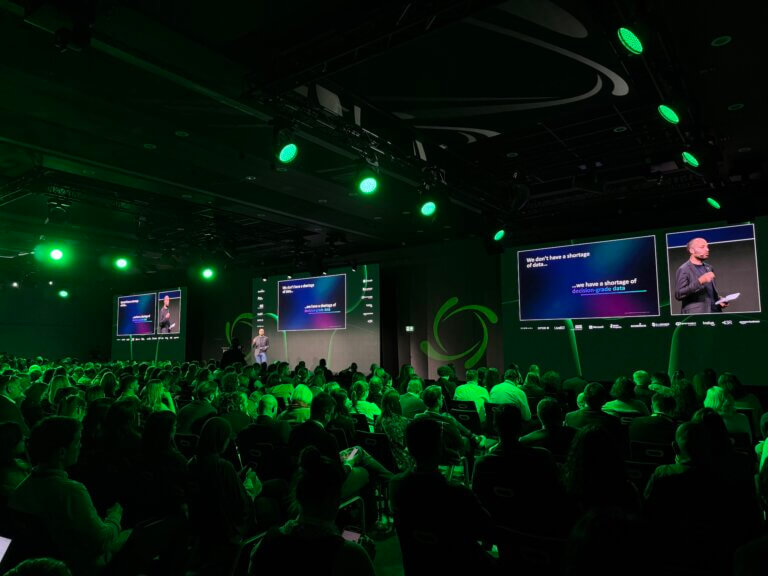
San Francisco marked the final stop of the nine-city EcoVadis World Tour 2025. It brought procurement, tech, and other business leaders together to explore what it takes to build more sustainable and resilient supply chains at scale. While the event took place in late November, the insights are timely as teams set sustainability priorities for 2026 amid global volatility and shifting stakeholder expectations.
Throughout the day, speakers returned to a shared challenge: sustainability ambition isn’t in short supply, but many companies still need stronger supplier visibility and the systems required to deliver on it. Progress is continuing, even as many organizations communicate more cautiously. As Accenture’s Matias Pollmann-Larsen put it, “we don’t talk about it as much because we are busy working on it.” Increasingly, that work is operational: gaining stronger supplier-level ESG insights, embedding those insights into procurement decisions, and using new platforms and tools like agentic AI to expand reach.
Here are key takeaways from the sessions.
Building momentum starts with high-quality supplier data
EcoVadis’ Deanna Rigonan and Laurel Hansen set the tone in their opening remarks by acknowledging the complex reality procurement and sustainability teams must navigate: evolving risks, competing priorities, and pressure to act with incomplete information. But they also emphasized that action is increasing among US companies, even in the face of a uniquely challenging environment.
They then made the “noise to clarity” theme tangible with a look at what we’re seeing across US supplier data. EcoVadis assessed more than 15,000 US companies between 2020 and 2025, including over 6,000 in 2025 alone. Importantly, 61% of those have completed an assessment more than once, showing that commitment is rising. When suppliers stay on the journey, improvement accelerates and data gets better.
The opening also framed a persistent constraint: without reliable supplier data, it’s hard to know where risk sits, what to prioritize, or how to prove business value. The promise of sustainable procurement only becomes real when organizations can trust what they’re seeing and act on it consistently across large supplier networks.
“Procurement can turn resilience from aspiration into something measurable, actionable, and real.”
Deanna Rigonan, EcoVadis
Welcome to the Americas World Tour – watch the session.
Agentic AI is making speed and scale the key differentiators
Naturally, the San Francisco keynote focused on tech’s impact on procurement. Accenture’s Matias Pollmann-Larsen explored how agentic AI is reshaping the function – and why sustainability will increasingly hinge on how quickly companies can operationalize data and decisions at scale.
He traced how the sustainability agenda has evolved over the past two decades: first driven by reputation risk, then formalized into governance and strategy, and more recently embedded into core business models. While companies have become more cautious in how they communicate commitments and targets, he argued this reflects greater scrutiny and a shift from rhetoric to execution rather than weakened ambition. As he put it, when he asks supply chain leaders whether sustainability is losing momentum, the answer is usually the opposite: they’re spending less time talking and more time doing the hard work.
Pollmann-Larsen also linked sustainability to the pressures at the top of the CEO agenda: tariffs, inflation and price volatility, climate impacts, political polarization, and technology disruption. Against that backdrop, procurement has evolved into a leadership lever for resilience, competitiveness, and scalable delivery. Agentic systems can transform day-to-day work by converting unstructured inputs – emails, PDFs, supplier documentation – into usable workflows, delivering less manual effort, better visibility, and faster decision-making. AI can help map supplier ESG risks beyond Tier 1, pinpoint hotspots, and reduce the time teams spend chasing the wrong suppliers.
“The roadblock isn’t innovation – the technology is ready today. The challenge is speed and scale.”
Matias Pollmann-Larsen, Accenture
Keynote: Redefining Work with Agentic AI – watch the session.
Resilient and integrated procurement in practice
Moderated by EcoVadis’ Silvia Schmid, the customer panel focused on execution and how sustainability insights and data can be integrated into everyday supplier management. Leaders from Herbalife Nutrition, Salesforce, and Google Cloud shared approaches that are moving beyond one-off programs and into repeatable operating models.
A few consistent tactics surfaced:
- Make expectations explicit early: Louisa McGuirk (Salesforce) described onboarding suppliers with a program guide and strengthening sustainability requirements through contracts (including formal exhibits).
- Use sustainability inputs as decision factors, not only reports: Several speakers discussed integrating ESG scores into supplier scorecards, supplier business reviews, and even supplier selection.
- Treat human rights as a practical risk process: Both audits and code-of-conduct enforcement were framed as core controls, not optional add-ons.
- Start with data hygiene: Bryan Wiseman (Google Cloud) emphasized that unreliable data slows everything. Validating inputs up front saves time and resources.
The panel also looked at the path forward. AI was repeatedly referenced as a way to widen coverage – moving beyond a top-supplier focus to spot both hidden risks and high-performing smaller suppliers deeper in the ecosystem.
“A best practice is to ensure your data is organized and validated before you start.”
Bryan Wiseman, Google Cloud
Building a Resilient Supply Chain – watch the session.
EcoVadis Solution Outlook: Turning supplier insights into action
In the product session, EcoVadis’ Elise Caves and Pete Rau emphasized a simple shift: scoring and measurement matter, but what teams need most is clear direction on what to do next – across thousands of suppliers and with limited bandwidth.
They outlined three areas we’re prioritizing:
1) Scaling sustainable procurement
A new Program Overview feature gives teams a holistic view of their supply base, from early-stage profiling through IQ risk mapping and full sustainability ratings, making it easier to spot high-risk suppliers, compare inherent risk against engagement levels, and prioritize action.
2) Integrating AI support for buyers and suppliers
EcoVadis highlighted the platform’s AI Assistant, designed to help buying teams analyze supplier performance, prioritize issues, and act more efficiently. On the supplier side, the AI Document Assistant (in beta) aims to reduce effort by scanning uploaded documents and assigning evidence to relevant questions and answer options.
3) More credible Scope 3 data to drive decarbonization
EcoVadis shared more about Carbon Data Reliability Levels, which combine AI and expert review to assess the quality of reported emissions data. The session also previewed a new Product Carbon Footprint Calculator and reinforced the scale of the Carbon Data Network, which already has data from 48,000 suppliers.
The session also covered broader platform enhancements, including stronger regulatory support through Regulatory Lenses, expanded IQ monitoring across more languages, improvements to Vitals for lower-touch supplier assessments, and growing capabilities to get real-time supply chain risks through Worker Voice tools.
“We are about more than just measuring data or performance. That is table stakes.”
Pete Rau, EcoVadis
EcoVadis Solution Outlook – watch the session.
Customer stories: the mechanics of progress
The afternoon customer stories made the mechanics of progress clear: executive sponsorship, supplier enablement, and trusted data built into daily procurement workflows.
- Calix’s Lisa Boucher shared how executive sponsorship is the unlock for cross-functional momentum and supplier accountability. Their results were measurable: moving from 1.8 to 3.1 maturity in two years, reaching 99% direct supplier coverage, and pushing sustainability into RFQs by requesting “sustainable quotes.”
- Liberty Mutual’s Jade Santiago focused on supplier capability-building, including integrating EcoVadis data into Aravo for third-party risk management and using incentives (like EcoVadis subscriptions for small business winners) to grow participation and performance.
- Digital Realty’s Sormeh McCullough shared how primary supplier emissions data has changed the company’s view of progress. EcoVadis carbon data showed that their spend-based estimates were off, requiring a full re-baseline of their science-based target and reinforcing the case for embedding sustainability into business reviews and supplier scorecards.
The stories reinforced a practical model that others can replicate. Leadership creates momentum, better data sharpens priorities, and supplier engagement turns sustainability into repeatable performance.
“One of the most important things you need is executive sponsorship.”
Lisa Boucher, Calix
The Business Case for Sustainability – watch the session.
Build capability, not just campaigns
Deanna Rigonan closed the day by reinforcing what she heard repeatedly from customers. Progress, she said, depends on turning supplier insights into decisions, building expectations into procurement workflows, and keeping suppliers engaged through consistent communication and enablement.
She pointed to the practical building blocks behind successful programs – education and dialogue with suppliers, ESG integrated into contracts and RFPs, and incentives that help sustain participation over time. Her message was clear: scale and acceleration are now non-negotiable, but teams don’t need to be large to make progress when the right systems and tools are in place.
“Know that whether you are a team of one or many, you are not at this alone.”
Deanna Rigonan, EcoVadis
Closing Remarks – watch the session.
Missed the event? Watch the on-demand sessions