Read summarized version with:
 ChatGPT
  Gemini
  Perplexity
  Claude
  Grok
Grok You wouldn’t start a journey without a map and a clear idea of your current location. In the world of corporate strategy, the ESG Gap Analysis is that “You Are Here” marker. It is one of the main steps in developing an ESG strategy.
In fact, gap analysis is the diagnostic, while the strategy is the treatment. You can’t have an effective strategy without the diagnosis first! It is the essential bridge that connects a company’s current state to its future sustainability goals.
What is ESG Gap Analysis?
ESG gap analysis is a process that helps organizations evaluate their current environmental, social, and governance (ESG) performance and compare it with established standards, goals, or industry benchmarks. It highlights strengths, weaknesses, risks, and opportunities for improvement, and helps the company develop a more concise ESG strategy.
The main purpose is to identify gaps between what a company is currently doing and what it should be doing to meet ESG expectations.
Why ESG Gap Analysis Is Important
In the current regulatory and economic landscape, performing a gap analysis isn’t just a “best practice”; it’s a survival tactic. The process has many benefits to your business, including:
Ensuring Regulatory Compliance
In recent years, global standards such as CSRD and IFRS (S1 & S2) have transitioned from voluntary to mandatory compliance.
A gap analysis pinpoints exactly where disclosures are lacking, helping to prevent legal penalties or “qualified” audit opinions.
Reducing ESG-Related Risk
It proactively uncovers vulnerabilities in environmental (e.g., climate risks), social (e.g., supply chain risks), and governance areas, enabling better risk management, resilience, and protection against reputational or financial damage.
By identifying where your data is thin or your claims lack evidence, you can correct your narrative before it reaches the public. This protects the brand from significant damage to its reputation and finances that can result from greenwashing lawsuits and other issues.
Optimizing Resource Allocation
No company has an infinite budget for ESG. A gap analysis highlights your most significant weaknesses, allowing you to direct capital and human effort toward the “material” gaps that offer the highest ROI or risk reduction.
Improving Investor Ratings
Institutional investors use ESG scores to determine the cost of capital. Closing gaps in your governance or environmental data directly improves your standing with rating agencies like MSCI or Sustainalytics, potentially leading to better financing terms.
Providing a Strategic Roadmap
It transforms a general goal of “becoming more sustainable” into a list of projects with clear priorities. An ESG gap analysis tells you exactly what policies need to be written, what sensors need to be installed, and which departments need more training.
A gap analysis provides a baseline of hard data (e.g., actual carbon intensity versus industry averages), allowing the board to move from “gut feelings” to evidence-based strategy.
Future-Proofing the Supply Chain
Many “gaps” exist within Scope 3 emissions (the supply chain). Identifying these gaps early lets you work with suppliers or find new ones before their weak ESG performance hurts your business.
Key Components of ESG Gap Analysis
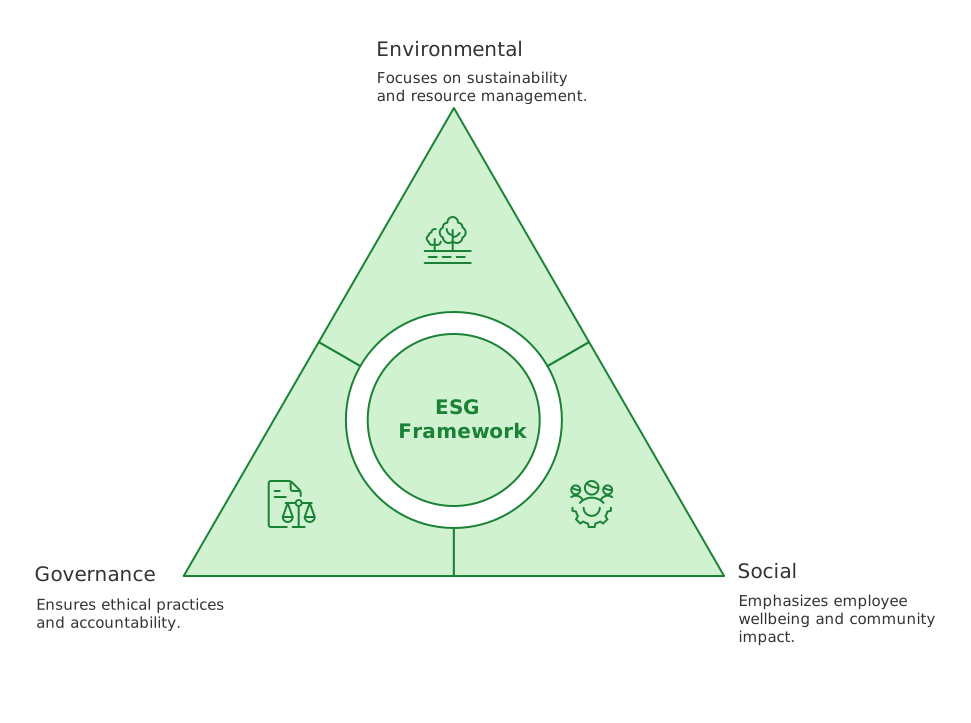
To find the “gaps” in your business, you need to look at three main areas. A good analysis checks your current actions against the following factors:
Environmental Factors
This section looks at how your company affects the planet.
- Carbon Emissions: Do you track your full carbon footprint? This includes your offices, vehicles, and even your suppliers.
- Energy Use: Are you using renewable energy, or are you still relying on old, inefficient power sources?
- Waste Management: How much trash does your business create? A gap analysis checks if you have a plan to recycle or reduce landfill waste.
- Resource Efficiency: Are you wasting water or raw materials? This looks at how to do more with less.
- Biodiversity & Nature: Does your business harm local wildlife or water sources? Protecting nature is just as important as cutting carbon.
Social Factors
This section looks at how you treat people—both inside and outside the company.
- Employee Wellbeing: Do your workers feel safe and supported? This includes mental health, fair pay, and a healthy work-life balance.
- Diversity and Inclusion: Does your team represent different backgrounds? A gap exists if your leadership team all looks or thinks the same.
- Labor Practices: Are your products made under fair conditions? You must check that no one in your supply chain is being mistreated.
- Community Impact: Does your business help the local area, or does it cause problems for the neighbors?
Governance Factors
This section looks at how your company is managed and policed.
- Board Structure: Who is in charge? A gap analysis checks if your leaders are independent and held accountable.
- Ethics and Compliance: Do you have clear rules against bribery and corruption? It’s important to prove that your “moral compass” is working.
- Risk Management: Are you prepared for the future? This identifies if you are ready for climate change or sudden market shifts.
- Transparency and Reporting: Are you honest about your progress? This checks if your public reports match your actual internal data.
How to Conduct ESG Gap Analysis
Conducting an ESG gap analysis doesn’t have to be overwhelming. Think of it as a four-step journey from where you are now to where you need to be.
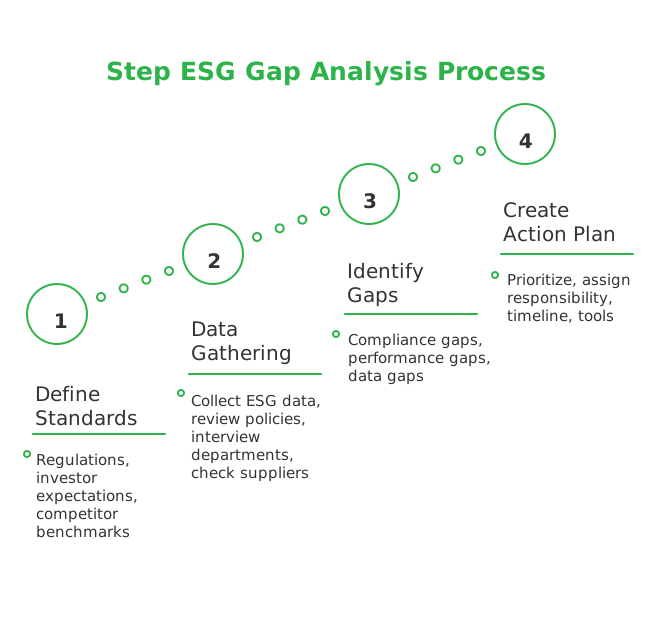
Step 1: Define Your Standards (The Goalpost)
First, you must decide which “rules” you are playing by. You cannot find a gap if you don’t have a target.
- Identify Regulations: List the laws that apply to you (like CSRD or IFRS).
- Check Investor Needs: Look at what your bank or shareholders are asking for.
- Competitor Benchmarking: See what the leaders in your industry are already reporting.
Step 2: Data Gathering (The Reality Check)
Next, look under the hood of your own business. You need to collect evidence of what you are actually doing right now.
- Collect the Numbers: Gather data on electricity, water, and waste.
- Review Policies: Do you have written rules for hiring, safety, and ethics?
- Interview Departments: Talk to HR, Procurement, and Operations to see how they handle ESG daily.
- Check the Supply Chain: Ask your suppliers for their carbon and labor data.
Step 3: Identify the Gaps (The Missing Pieces)
Now, compare your “Goalpost” (Step 1) with your “Reality” (Step 2). This is where you find the holes.
- Compliance Gaps: “The law says we need Scope 3 data, but we only have Scope 1.”
- Performance Gaps: “Our competitors use 50% renewable energy, but we only use 10%.”
- Data Gaps: “We claim to be ethical, but we have no way to prove our suppliers are following the rules.”
Step 4: Create an Action Plan (The Bridge)
Knowing you have a gap isn’t enough; you have to fix it. Rank your gaps by how important they are.
- Prioritize: Fix the legal gaps first to avoid fines.
- Assign Owners: Give each task to a specific person (e.g., the CFO handles data, HR handles diversity).
- Set a Timeline: Decide what can be fixed in 6 months versus 2 years.
- Invest in Tools: If your data is messy, consider ESG software to make it “audit-ready.”
Common Challenges in ESG Gap Analysis
Identifying the gaps in your ESG strategy is essential, but the process often comes with its own set of hurdles. As regulations get stricter, these are the most common challenges businesses face:
- Data Fragmentation: ESG information is often scattered across different departments. Carbon data might be in Facilities, while diversity stats are in HR. Pulling this into one “single source of truth” is often the hardest part.
- Inconsistent Supply Chain Data: You can control your own office, but getting accurate data from hundreds of global suppliers is difficult. Many suppliers lack the tools to report their emissions or labor practices correctly.
- Rapidly Changing Regulations: What was “compliant” last year might not be enough today. Keeping up with the shifting requirements of the CSRD, SEC, or ISSB can feel like hitting a moving target.
- The “Greenwashing” Fear: Many companies find gaps but are afraid to admit them. There is a constant tension between being transparent about weaknesses and worrying about how investors or the public will react.
- Lack of Internal Expertise: Most companies have great accountants and operators, but they may not have “sustainability experts” who understand how to calculate complex metrics like Scope 3 emissions or biodiversity impact.
- Resource Constraints: Conducting a deep-dive analysis takes time and money. Smaller companies often struggle to balance the cost of a gap analysis with the day-to-day costs of running the business.
How to Overcome These Challenges
The best way to beat these hurdles is to start small. Don’t try to fix every gap at once. Instead:
- Use ESG Software: Automation can help gather data from different departments.
- Focus on Materiality: Only worry about the gaps that truly matter to your specific industry.
- Build a Cross-Functional Team: Get your Finance, HR, and Operations heads in the same room once a month.
Get Started Today: Find the Gaps and Unlock Your ESG Potential
Conducting an ESG gap analysis is a powerful first step toward stronger sustainability performance, regulatory readiness, and long-term business resilience. For many organizations, the most difficult part of a gap analysis is turning raw data into an organized plan.
The EcoVadis methodology helps organizations bridge ESG gaps by providing a clear framework for sustainability rating and managing related risks.
Discover how EcoVadis can help your company achieve its ESG goals—schedule a demo today.