Read summarized version with:
 ChatGPT
  Gemini
  Perplexity
  Claude
  Grok
Grok While some headlines may declare ESG investing is in retreat, what’s actually happening is its fundamental recalibration. Investors and regulators are more interested in traceable data and supplier-level evidence of how companies operate across their value chains.
Organizations caught off guard are those that mistook ESG fund outflows and political backlash for a signal to scale back sustainability efforts. In reality, scrutiny has intensified. A recent piece in Harvard Business Review describes this as a move towards a “more pragmatic, risk-first approach” rather than a disappearance of interest.
So what does this recalibration mean for enterprise supplier programs in 2026? And which regulatory changes actually affect your supplier program?
The ESG market: A strategic deep dive
The dominant narrative in boardrooms and business media over the past twelve months has been that ESG investing is in retreat. The data tells a more precise story.
What is declining is the appetite for loosely defined, broadly marketed ESG labels. What is not declining (and in several respects is intensifying) is the underlying demand for decision-useful, auditable sustainability evidence.
ESG investing has not retreated. The bar for what counts as credible has simply risen.
Labelled ESG products are under pressure, but sustainability integration is not
Morningstar Sustainalytics recorded USD 84 billion in net outflows from labelled sustainable funds in 2025, a sharp reversal from USD 38 billion of inflows in 2024. Taken at face value, this appears to confirm the retreat narrative.
Morningstar’s own analysis, however, attributes a significant portion of the movement to technical and structural factors, including large-scale reallocations by UK institutional investors, that shift assets out of the tracked universe without reflecting an equivalent reduction in sustainability requirements applied to those assets.
The asset base itself remains substantial. Global sustainable fund assets stood at approximately USD 3.9 trillion at year-end 2025, supported in part by market appreciation. Robeco similarly characterized 2025 as muted for labelled products while reporting total sustainable assets under management of approximately USD 3.7 trillion by end-September 2025.
Across a broader measurement lens, the Global Sustainable Investment Alliance’s 2024 review identifies USD 16.7 trillion of fund assets reporting the use of responsible or sustainable investment approaches (an increase of approximately USD 5.5 trillion, or 49 percent, over two years).
Claims discipline is tightening, and penalties are real
The regulatory response to ESG label inflation has been systematic and cross-jurisdictional. In the EU, ESMA guidelines on fund names using ESG or sustainability-related terms began applying to new funds from November 2024, with existing funds required to comply by May 2025. The objective, as stated by ESMA, is to provide measurable, verifiable criteria for sustainability claims, replacing aspiration with substantiation.
In the UK, the Financial Conduct Authority’s anti-greenwashing rule, introduced as part of its Sustainability Disclosure Requirements package, extended the same logic to consumer-facing products, with disclosure obligations continuing to expand through 2025.
Enforcement has demonstrated that the financial consequences are real. In April 2025, DWS was fined €25 million by German prosecutors after findings that its ESG-related public statements did not correspond to documented reality.
ESG ratings are diverging
A structural problem is emerging at the heart of how ESG performance is measured. The academic paper Aggregate Confusion finds that ESG rating divergence across major providers is driven primarily by measurement disagreement, accounting for 56 percent of divergence, followed by scope (38 percent) and weighting differences (6 percent).
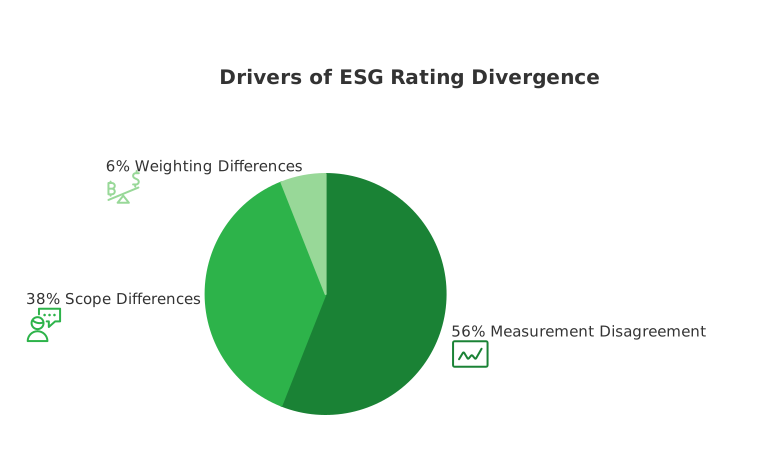
Correlations between ratings from different providers can be remarkably low, leading to situations in which two companies with materially similar supplier programs can receive substantially different external assessments depending on which rating model is applied.
More than half of ESG rating divergence stems from measurement methodology. Primary supplier data removes that variable entirely.
US regulatory uncertainty is a global procurement story
The SEC adopted climate-related disclosure rules in March 2024, then paused implementation amid legal and political challenges. This is frequently read as a signal that climate disclosure pressure is easing. It is more accurately read as a jurisdictional complication in a disclosure environment that remains structurally intact.
Multinational companies operating across the EU, the UK, and California jurisdictions continue to collect and report climate data regardless of SEC timing. The data collection obligation does not pause because one regulator has paused it.
Long-term implications for procurement and supply chain leaders
Over the next several years, several structural shifts will reshape how ESG expectations are transmitted through supply chains:
Greenwashing enforcement is raising the substantiation bar across the entire ecosystem
When ESMA requires fund managers to substantiate sustainability claims, those managers scrutinize corporates in their portfolios. Those corporates scrutinize supplier data. Enforcement at the top of the investment chain produces audit-like expectations several tiers deep in the supply chain.
Regulatory scope is narrowing
The EU Omnibus simplification, confirmed by EU member states on 24 February 2026, materially adjusted thresholds. Sustainability reporting now applies to over 1,000 employees and a turnover of €450 million. Due diligence applies only to companies with above 5,000 employees and €1.5 billion turnover, with implementation deferred to July 2029.
Two dynamics counteract any assumption that scrutiny is easing. First, ISSB standards are being adopted across 37 jurisdictions that represent material shares of global GDP and market capitalization, raising the quality bar for investor-facing sustainability disclosures globally and, by extension, for the supplier data that feeds them.
Second, the largest multinationals remain in scope regardless of Omnibus adjustments and transmit their obligations through supply chains via questionnaires, contract terms, and onboarding standards.
The net effect is that fewer companies face formal obligations, but those that do face higher expectations for structured, auditable evidence, and every supplier serving them faces those expectations by extension.
Scope 3 and human rights exposure sit precisely where procurement has operational leverage
On average, supply chain emissions are 26 times greater than a company’s direct operational emissions, yet only 15 percent of CDP-disclosing corporates have set a Scope 3 target. Due diligence expectations are simultaneously moving beyond tier-one suppliers and becoming demonstrably impact-oriented, requiring repeatable management systems rather than one-off assessments.
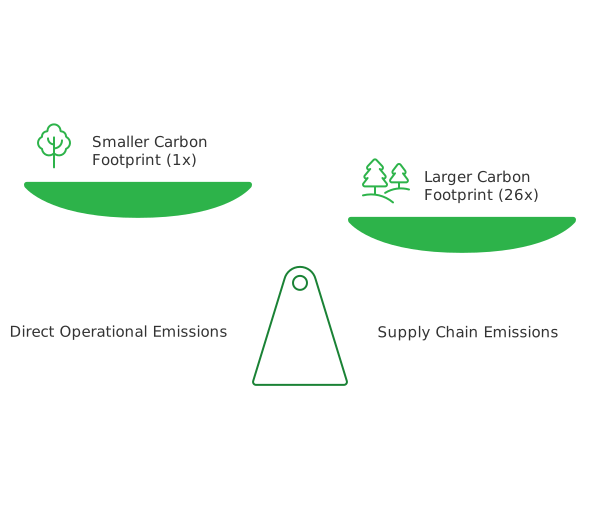
Supply chain emissions dwarf direct operational emissions by a factor of 26. That is where the material exposure lives.
CDP and BCG data show that supply chain Scope 3 emissions are, on average, 26 times greater than a company’s direct operational emissions. The GHG Protocol estimates that Scope 3 accounts for more than 70 percent of the total carbon footprint for many businesses, and links measurement directly to supplier choices. Yet only 15 percent of CDP-disclosing corporates have set a Scope 3 target.
Investor and regulatory attention is moving toward this gap. Sedex’s 2026 analysis notes that due diligence is actively extending beyond tier-one suppliers and becoming impact-oriented, driven by litigation and enforcement pressure.
The metrics investors and auditors are actually asking for
Investors, auditors, and regulators are converging on a set of metrics that distinguish a supplier program with genuine accountability infrastructure from one with only documentation.
Supplier coverage by spend, risk, and geography
The most common proxy for ESG program maturity (number of suppliers assessed) is also the least meaningful to an auditor. What investors and regulators are asking for is proportional coverage:
- What percentage of the spend is covered
- Which high-risk geographies and categories have been mapped
- How far beyond tier one that visibility extends
A program that has assessed 80 percent of suppliers by count but only 30 percent by spend, concentrated in low-risk categories, will not satisfy the risk-based logic now embedded in CSDDD and ISSB-aligned reporting frameworks.
Scope 3 Category 1 coverage by primary data
The specific metric gaining traction is the percentage of Scope 3 Category 1 emissions covered by actual supplier-reported data rather than spend-based estimates. Estimated figures are acceptable as a starting point. They are increasingly unacceptable as disclosed figures in investor-facing reports or assurance processes.
NEXTCHEM’s 2025 sustainability-linked financing framework demonstrates that supplier adoption of science-based targets is already a KPI embedded in financing terms. The direction of travel is toward primary data as a baseline expectation, not a best practice.
Corrective action closure
What auditors are now specifically requesting is evidence of what happened after the risk was identified. Closure rate, the percentage of corrective action plans resolved within defined timeframes, cycle time, and recurrence rate are the metrics that demonstrate an active management system.
A supplier program that identifies issues consistently but cannot show closure data is, from an assurance perspective, a liability register without a remediation function. Regulators are explicitly looking for evidence of action.
Assurance readiness indicators
Workiva’s research highlights a growing expectation for assured sustainability disclosures and integrated ESG data across functions. As CSRD and ISSB requirements expand, organizations must demonstrate not only ESG outcomes but the reliability of the data behind them.
This is exposing a readiness gap in procurement. Auditors are now examining process-level indicators such as consistent supplier data capture across reporting cycles, retained evidence for due diligence claims, documented assessment controls, and stable methodologies from period to period.
How EcoVadis turns supplier data into investor-grade evidence
The metrics ESG investors care about require a measurement infrastructure that most procurement functions do not yet have in place. Building it from scratch, across thousands of suppliers, in multiple geographies and risk categories, is precisely where point-in-time audits and internal questionnaires fall short.
EcoVadis gives procurement, ESG, and compliance leaders a single, governed system for screening, rating, and improving supplier sustainability performance across 185 countries and 250-plus industries. With 49,000 ratings conducted in 2024 and 159,000 since 2020, the platform maps supply chain risk at a depth and consistency that point-in-time audits cannot replicate.
The starting point is your supply chain map. Request a Demo to see how we map your supply chain.