Sustain 2026: The New Operating System for Resilience and Responsible Growth
Read summarized version with:
 ChatGPT
  Gemini
  Perplexity
  Claude
  Grok
Grok Over two days, Sustain 2026 brought together 827 in-person participants in Paris and 1,375 virtual attendees from around the world. It explored a shared reality for procurement, sustainability, and business leaders: the risk environment has changed, and supply chains are now where resilience and competitiveness are built.
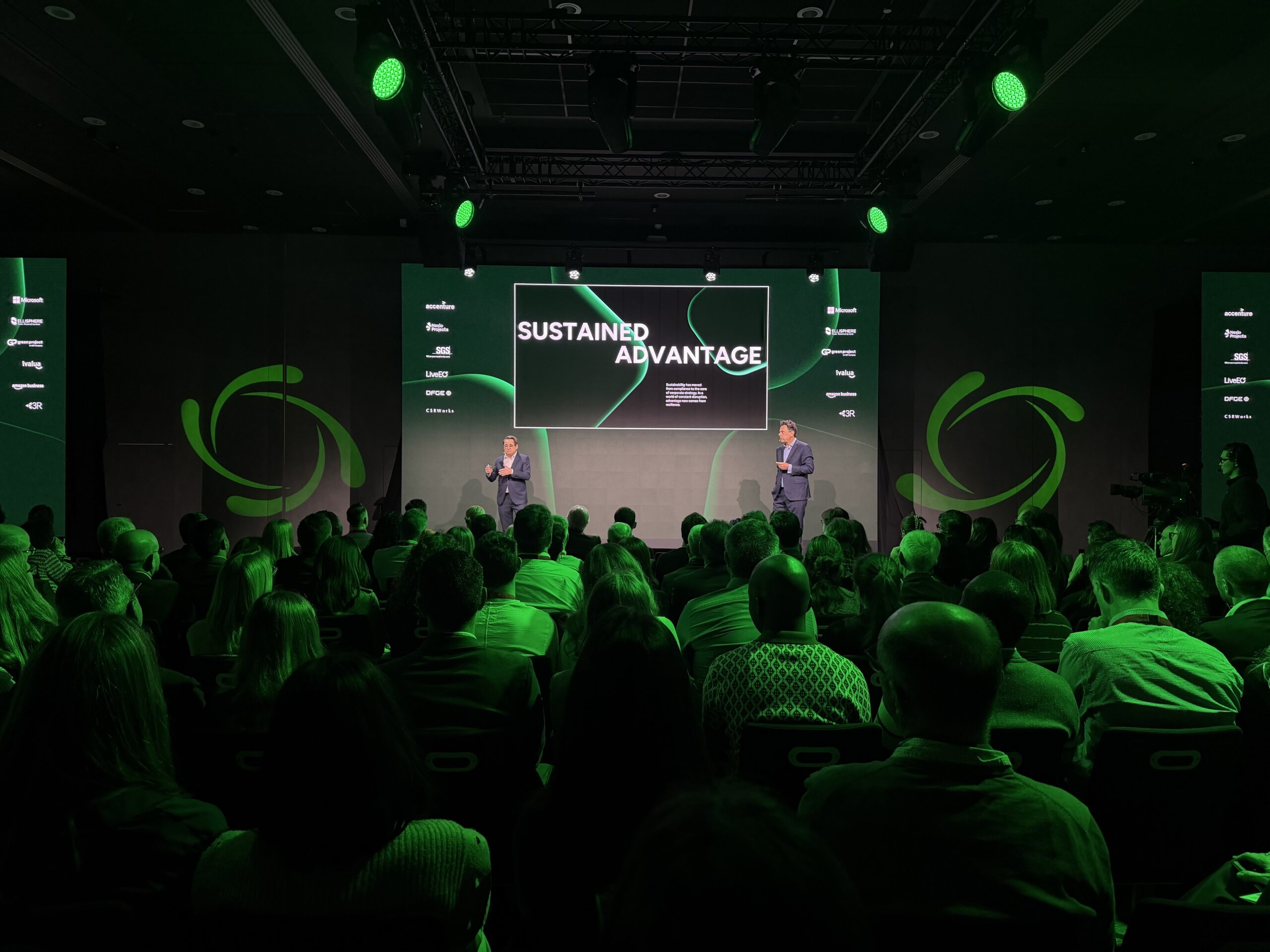
Across keynotes, panels, and breakout sessions, the focus was execution – how to embed sustainability into the operating model, how to turn data into decision-grade intelligence, and how to scale action from strategic suppliers to the long tail. The conclusion was consistent across the agenda: sustainable procurement is no longer a side program. It is becoming an organization-wide operating system for responsible growth, powered by trusted data, supplier collaboration, and AI-enabled workflows that make better, faster decisions possible at scale.
A second theme was equally consistent: value is now the key that unlocks action. As sustainability becomes intertwined with cost competitiveness, supply continuity, financing access, and customer expectations, procurement leaders are being asked to demonstrate measurable outcomes – not only improved performance metrics, but better decisions in the moments that matter. Throughout Sustain 2026, the most compelling examples showed how trusted data, supplier collaboration, and AI-enabled tools can shift sustainability intelligence from dashboards into procurement and purchasing flows, turning ambition into lasting business advantage.
From ambition to operating model: impact must be designed
A core shift emerged early: sustainability is leaving the era of broad pledges and entering the era of operating-model design. In the session From Vision to Action – Creating Business Value that Lasts, the call was to stop treating sustainability as something adjacent to the business and instead engineer it into the system – into incentives, procurement workflows, product design, financing terms, and supplier management.
That logic carried into governance and leadership debates. In Fireside Chat: The Shift from Regulatory Pressure to Strategic Necessity, the panel reframed the moment as structural: Sustainability is becoming a strategic necessity not because of idealism, but because the risk environment has changed.
Richard Gardiner, ShareAction’s Interim Head of EU Policy, captured the pivot with memorable clarity: “Resilience is the new sustainability.” He described how the framing has shifted as impacts increasingly feel local – flooding, insurance shocks, supply disruptions – rather than abstract. Annet Aris, Senior Affiliate Professor and Board Member at INSEAD, extended the point from a corporate lens: resilience is multi-dimensional, and while sustainability is one essential component of it, today’s risks are intertwined. “Risks are not individual anymore. They all hang together,” she said, arguing that environmental, geopolitical, and technological risks now compound and require different decision-making muscles.
Value is the new proof: sustainability has to pay its way
The conference wasn’t just about establishing the “why,” it also put the spotlight on the “so what” with refreshing pragmatism. The most compelling sessions showcased sustainability as a performance lever that reduces risk, protects margins, secures financing and builds resilience in the real economy.
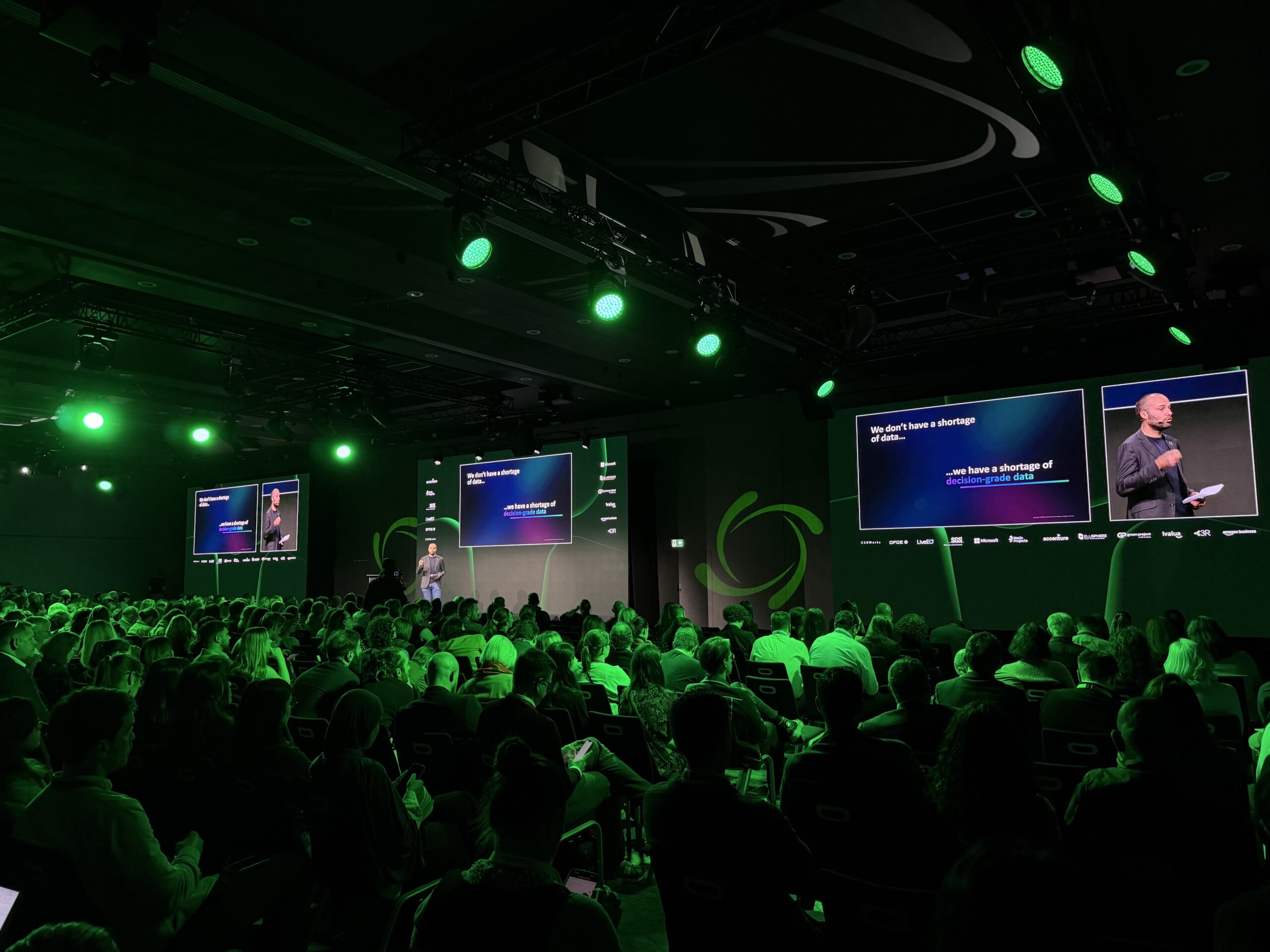
That shift was made particularly clear by Matias Pollmann-Larsen, Global Sustainable Value Chain Lead at Accenture, in his session From Gatekeeper to Value Architect: Responsible Procurement in the Age of AI. The provocation wasn’t that companies are missing data – it’s that they’re missing decision-grade data where it matters most. The line landed because it captured what many teams feel day to day: “It’s not a data crisis. It’s a decision crisis.” Sustainability cannot “live in dashboards.” It has to surface in sourcing events, negotiations, and product choices – right alongside margin, speed, risk, and resilience – if it’s going to change outcomes at scale.
The breakout Best Practices to Drive Tangible Business Value brought that reality down to ground level. Accenture’s Tara Mikhael highlighted “sneak peek” findings from the upcoming Sustainable Procurement Barometer report that showed both genuine progress and stubborn gaps. Tier 1 visibility is improving, but visibility into Tier 2 drops sharply, and Tier 3 remains largely opaque. Product-level carbon data is increasingly being collected, yet too often remains confined to hotspotting and benchmarking uses rather than influencing design decisions or material sourcing. Most tellingly, the integration challenge persists: sustainability is still frequently separated from the procurement systems and workflows where buying actually happens.
Perhaps the most candid moment came through the supplier lens. Engagement is still too often dominated by assessment and rating cycles rather than collaboration and co-innovation. One statistic best summed up this gap between intent and impact: Only 17% of suppliers feel strongly motivated by their customers to take action on sustainability, while many say that commercial incentives like volume commitments and preferred rates would help them move faster.
What emerged across the conference is a new standard for credibility. Sustainability has to be able to answer CFO questions with confidence – not through a slide, but through operating results: better decisions, better performance, and a clearer line from responsible procurement to lasting business value.
From compliance to collaboration: suppliers as partners, not checkboxes
The most compelling stories weren’t about perfect scorecards. They were about supplier partnership and what it takes to move from assurance to impact. That came through powerfully in Peeling Back the Curtain: Building a Sustained Advantage in Procurement, featuring award winners Schneider Electric and Siegwerk.
Christophe Quiquempoix, Sustainable Procurement Director at Schneider Electric, made a crucial point about scale: as supplier emissions typically dwarf operational emissions, the path to meaningful impact runs through the supply chain. His most revealing point wasn’t about audits or ratings, but what comes after: “The work is not doing the audit. The work is really solving the issues we identify.”
Schneider Electric’s story underscored that “designing for execution” looks like public commitments, quarterly progress reporting, and incentives tied to performance. Siegwerk’s Global Supply Chain Sustainability Manager, Cathleen Hansohm, described a pragmatic model shaped by reality: risk assessments are necessary, but questionnaires don’t change conditions on the ground. Change happens when suppliers are supported through workshops, capability-building programs, and targeted deep dives where risk is highest.
This partnership mindset was also echoed in The Double-Edged Sword: AI, Energy & The Future of Sustainable Trade with UK Climate Envoy, Rachel Kyte, and best-selling sustainability author, Andrew Winston, where the global supply chain reality was front and center. They highlighted how developing economies are pursuing rapid energy access so they can participate in the AI and clean economy transition – and how procurement sits directly on that fault line.
The next frontier: make sustainability the easy choice
Among the most practical sessions were those that tackled the hardest challenge in modern procurement: decentralized buying and the long tail. In Making Sustainable Purchasing the Easy Choice at Scale, Monica Visconti-Patel, EcoVadis’ Chief Marketing Officer, and Blake Westerdahl, Sr. Manager from Amazon Business, focused on the “Wild West” of sustainability – the thousands of purchases made outside the strategic supplier core.
Westerdahl summarized the gap simply: “The core problem is friction.” He cited survey results showing intent is high – 81% of procurement leaders say ESG factors matter in purchasing decisions – but execution breaks down because 85% say finding sustainable suppliers is difficult.
The behavioral insight was the real unlock: employees buying small-ticket items prioritize speed. “If you put a heavy compliance process for a $50 item, employees are gonna find a way around that.” The implication is that sustainability will not scale purely through policy documents and portals. It scales when it is nudged, embedded, and surfaced at the point of purchase – in the tools people already use, in the moment they are already buying.
This long-tail lens is also tied back to a broader conference theme: the next era of sustainable procurement is less about more effort and more about better design.
AI is the force multiplier
Artificial intelligence ran through Sustain 2026 as a real force, changing how quickly decisions are made, how complex supply chains feel to manage, and how risk shows up. It came through in two ways: as a climate-action accelerator and as a social and environmental challenge, alongside a trust and governance one.
It was discussed as a shift from reactive monitoring to proactive action – forecasting deforestation risk, improving flood prediction, accelerating rooftop solar design, and enabling smarter energy use. The conference also addressed the environmental footprint of AI, highlighting the significance of transparency, efficiency, and clean energy sourcing as digital infrastructure rapidly scales.
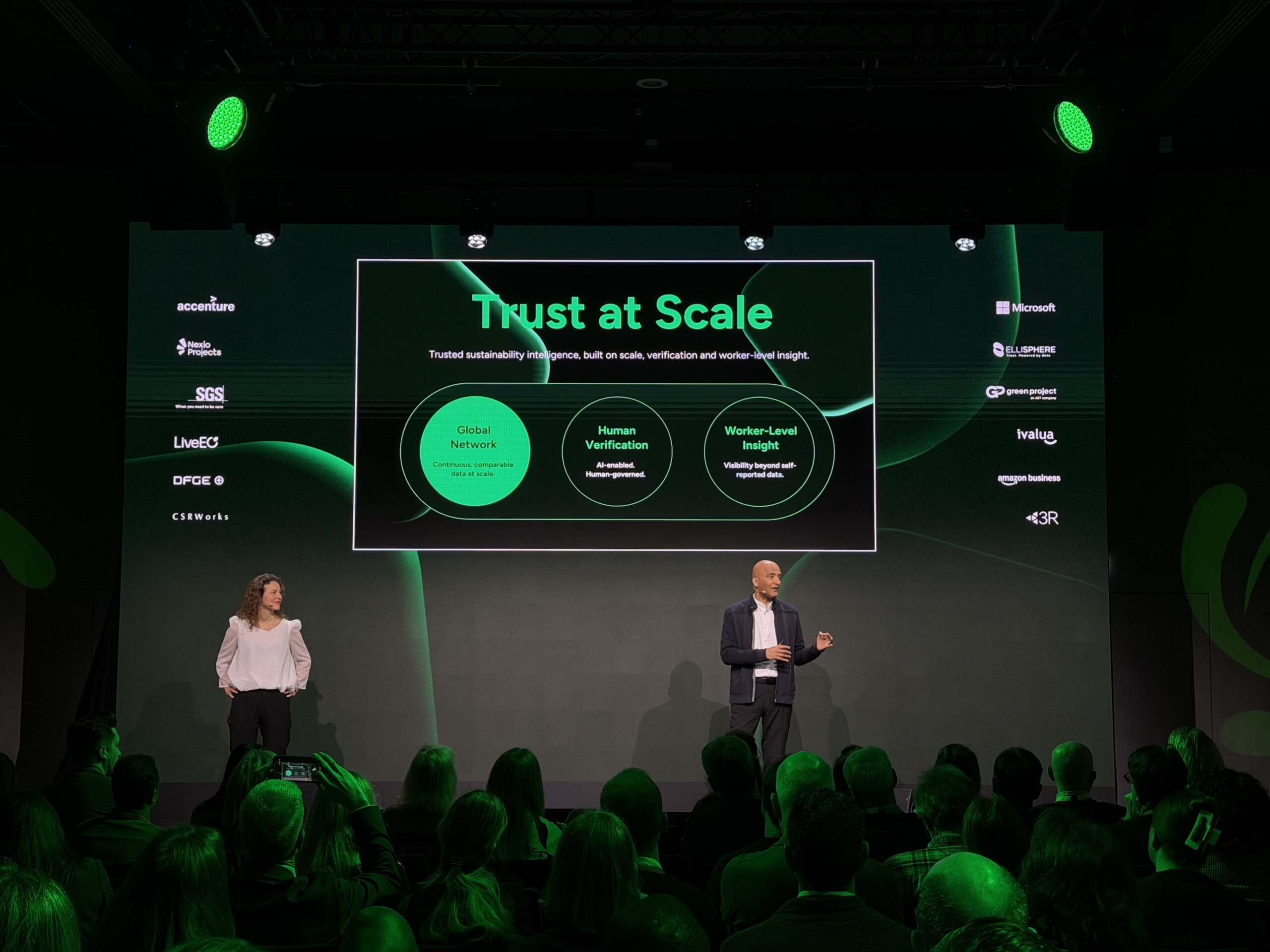
Meanwhile, EcoVadis’ product vision, More Than A Score: The Future of Responsible Growth, focused on the trust side. Krishna Panicker, EcoVadis’ Chief Product Officer, described AI as a force multiplier and warned that credible-looking synthetic sustainability data will become easier to generate. The implication across sessions was consistent: trusted, verified data is becoming essential infrastructure for AI-assisted workflows and scalable supplier engagement.
Put simply, AI won’t fix data integrity – it will amplify whatever is already there. That makes building trust into the system, through verification, triangulation, and worker-level validation, even more important.
Procurement’s new mandate: from gatekeeper to value architect
From Gatekeeper to Value Architect session explored procurement’s evolution over the past decade and how it increasingly owns the decisions where sustainability becomes real: supplier selection, contract design, category strategy, product specifications, financing terms, and the day-to-day trade-offs between cost, continuity, carbon, and risk.
Accenture’s Matias Pollmann-Larsen argued that procurement can no longer sit at the end of the process as a checkpoint. It has to shape the process from the start by embedding sustainability intelligence into the workflow, automating what can be automated, and protecting human judgment for what matters.
This sentiment was also echoed in the session Best Practices to Drive Tangible Business Value. Whether the challenge is integrating carbon data into sourcing events, motivating suppliers with commercial signals, or nudging decentralized buyers toward better choices, the emerging role of procurement is not to police behavior but to design the system so the right decisions are easier, repeatable, and scalable.
The signal from Sustain 2026
Sustain 2026 focused on capability: how can organizations execute at scale, consistently, in the moments that matter? Across thousands of suppliers, millions of purchases, and a compounding risk landscape, the differentiator is no longer intent but design.
If there’s one line that captures where the conference landed, it’s this: the winners won’t be the companies with the most data or the best claims. They’ll be the ones who make better, faster decisions at every point in the system. And increasingly, the procurement leaders in the room are the ones building that system, turning sustainability from a set of commitments into an operating system for resilience and responsible growth.
Thank you to everyone who made Sustain 2026 possible – to our speakers for sharing their insight and candor, to our sponsors and partners for their support, and to every participant in Paris and online for bringing the energy, questions, and collaboration that define this community.