
Supplier Engagement & Science-Based Targets: 2026 Guide
Read summarized version with:
 ChatGPT
 Gemini
 Perplexity
 Claude
 Grok
EcoVadis & Kearney’s 2026 Carbon Action Report identifies supplier engagement as the single most underused Scope 3 lever, tied to a roughly 6x higher science-based target delivery rate.
Companies engaging their suppliers on carbon are roughly 6x more likely to deliver on their science-based targets than those that don’t. Yet only 7% of companies in the EcoVadis network currently do it. That gap, documented in the 2026 Carbon Action Report, is the clearest evidence yet that supplier engagement is the most underused lever in Scope 3 decarbonization, and the fastest path to closing the distance between climate ambition and actual delivery on science-based targets.
Key takeaways
- Companies engaging suppliers on carbon are ~6x more likely to deliver on science-based targets (31% delivery rate versus 5% for those that do not engage).
- Only 7% of companies currently engage suppliers on carbon, leaving the highest-impact Scope 3 lever untouched for the vast majority.
- Adding high-reliability or verified data on top of engagement lifts target delivery a further ~1.7x, taking the total uplift to roughly 7x versus doing neither.
- Companies with verified Scope 1&2 data are ~8x more likely to engage suppliers than those relying on low-reliability data (37% versus 4.5%).
- More than half of the top 10 most impactful actions for cutting operational (Scope 1&2) emissions are directly connected to supply chain action.
Why supplier engagement is the missing lever for hitting science-based targets
The Science Based Targets initiative (SBTi) now counts more than 12,000 companies with validated targets, with thousands more committed. But as the SBTi notes in its foreword to the 2026 Carbon Action Report, execution, not ambition, is now the constraint. Supply chain emissions typically represent 70-90% of a company’s total footprint, which means that achieving a Scope 3 science-based target requires extensive collaboration with suppliers.
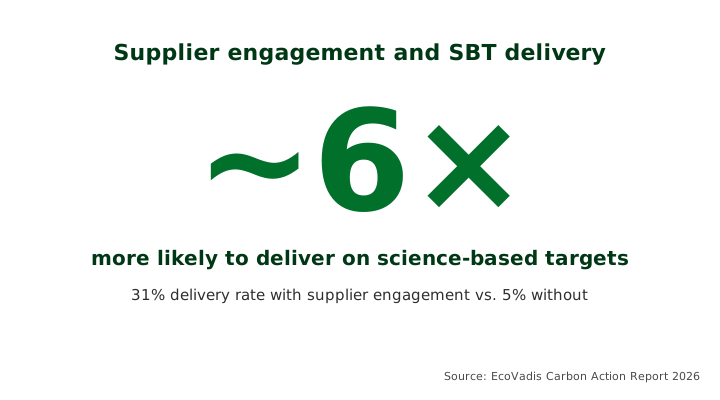
EcoVadis network data makes the point in concrete terms. Among companies that have set carbon reduction targets across any scope, those that don’t engage their suppliers post a delivery rate of just 1 in 20. That is the ~6x multiplier, drawn from a dataset of roughly 56,000 companies assessed on carbon performance over the past year.
“No company can deliver its climate target alone. Business leaders have an opportunity, and responsibility, to use their influence across their value chains, working with suppliers to set science-based targets and accelerate the transition to a net-zero economy.”
David Kennedy – CEO, SBTi
Source: 2026 Carbon Action Report
For procurement and sustainability leaders, the implication is direct. If your organization has an SBTi-validated target but no structured supplier engagement program, you are statistically far more likely to miss it. For context on how EcoVadis has approached its own targets, see our article Science-Based Targets: A Key Tool of Our Decarbonization Strategy.
The supplier engagement gap and what it costs
One of the most striking findings in the report is how few companies are taking decisive action on their supply chain emissions: only 7% of companies in the network currently engage their suppliers on carbon in a structured way. That leaves the highest-impact Scope 3 lever untouched for more than nine in ten organizations, even as regulators, investors, and customers turn Scope 3 into a source of financial and commercial risk.
The report notes that 62% of S&P 500 companies with Scope 3 targets have seen flat or rising emissions since 2021. This is what the execution gap looks like in aggregate: targets set, plans written, and yet emissions aren’t dropping because suppliers haven’t been brought along on the journey.
The good news is that most supply chain emissions are concentrated in a small number of highly connected suppliers. The top 10% of emitters in the network account for 95% of reported Scope 1&2 emissions and are connected to 72 buyers on average (more than double the average of the remaining 90%). Targeted engagement of this group can enhance Scope 3 visibility for dozens of buyers at once and build the foundation for measurable reductions. Companies don’t need to solve engagement across their entire tail spend to scale their impact.
Reliable data amplifies the supplier engagement effect
Among companies that engage suppliers, those with a solid internal carbon maturity – indicated by high-reliability or verified Scope 1&2 data – are even more likely to keep pace with their science-based targets. The 2026 Carbon Action Report shows that among companies actively engaging suppliers, 35% of those with high-reliability or verified Scope 1&2 data hit their targets, versus 21% of those working from low or medium-reliability data. That is another 1.7x uplift on top of the ~6x engagement effect.
There is a reinforcing loop at work here. Companies with verified Scope 1&2 data are ~8x more likely to engage suppliers on carbon than those with low-reliability data (37% versus 4.5%). They are also roughly 13x more likely to select suppliers based on carbon performance and 14x more likely to partner on reduction initiatives. Better data builds the internal maturity that makes credible supplier engagement possible. Credible engagement, in turn, generates better data flowing back from suppliers. The EcoVadis Carbon Action Manager is the platform that operationalizes this loop for buyers.
“Data only creates value when it changes what we do. High-quality data is what allows companies to make better decisions, manage risk more effectively, engage the right suppliers, and understand where investments will have the greatest return.”
Angela Hultberg – Global Head of Sustainability, Kearney
Source: 2026 Carbon Action Report
What actually moves suppliers: the Scope 3 leader playbook
The report profiles a group of buyers who have built structured supplier engagement programs around their science-based targets. Their approaches share three consistent features:
They combine formal requirements with high-touch support. Colt Technology Services embeds a formal sustainability schedule into supplier contracts, requiring high-emitting suppliers to commit to science-based targets and share data. BD makes science-based targets a condition of preferred supplier status but pairs that with internal manufacturing experts sent directly to supplier sites to identify low-cost emissions reductions. This mirrors the pattern described in our article A More Sustainable Approach to a Buyer-Supplier Relationship: mandates alone do not build capability.
They tailor engagement to supplier maturity. Accor’s decarbonization program moves suppliers through three pillars: Measure, Reduce, Promote. BD uses a five-level maturity ladder, securing upfront target commitments even from Stage 1 partners and co-creating “glide paths” to build capability over time. Hitachi Rail shapes every supplier conversation around maturity, so mature suppliers discuss product-level carbon data while lower-maturity suppliers start with the basics.
They use commercial incentives to make progress visible. Accor’s supplier recognition program awards carbon medals based on maturity, disclosure, and target delivery. The report tells the story of a supplier that displayed its gold medal at an industry convention, prompting another supplier to call Accor the next day asking how to qualify. Commercial aspiration can travel faster than compliance pressure.
“If you give suppliers the support they need to set the targets, then they’re much more willing to go on that journey with you than if you approach them with a mandate and no support.”
Amelia Nunn – Associate Director of Responsible Sourcing, BD
Source: 2026 Carbon Action Report
Formalizing expectations in supplier documentation is a natural first step. Read our article How to Design a Supplier Code of Conduct for Supplier Qualification for a practical framing of what to include.
Sector collaboration multiplies supplier engagement
Because high-emitting suppliers are connected to many buyers, coordinated action multiplies impact. When buyers align on a common framework and request, a single supplier conversation can benefit dozens of companies at once. The report describes the Hospitality Alliance for Responsible Procurement, an EcoVadis-powered Sector Initiative uniting Accor and seven partners around a shared carbon maturity framework, so one supplier’s response can fulfill eight separate buyer requests.
Companies participating in Sector Initiatives are more likely to have high-reliability or verified data (45% versus 37% for those outside one), which in turn correlates with higher supplier engagement rates. The SBTi’s guidance on value chain engagement reinforces the same point: no single company can decarbonize its supply chain alone.
“I am convinced that we absolutely need to collaborate and have a unified approach. If we are alone at Accor, it will be complicated to make some suppliers move.”
Laurent Guiouiller – Sustainable Procurement Director, Accor
Source: 2026 Carbon Action Report
For a broader view of how supplier collaboration compounds value, see our article Why Suppliers are Key to Unlocking Sustainable Procurement Value.
How to start building a supplier engagement program tied to science-based targets
If your organization has an SBTi target and wants to capture the ~6x delivery multiplier, the 2026 Carbon Action Report provides a clear roadmap.
First, get your own Scope 1&2 data to a reliability level that gives you credibility with suppliers. Companies with high-reliability data reduce operational emissions 50% faster than lower-reliability peers, and they are far more likely to engage suppliers effectively.
Second, focus on the small group of high-emitting, highly connected suppliers where engagement generates the most Scope 3 visibility and impact.
Third, pair formal contract requirements with high-touch support, maturity-tailored engagement, and commercial incentives that reward supplier progress. This is the pattern that Atos, BD, Accor, Colt, Hitachi Rail, and Volvo Cars have all converged on independently.
Download the 2026 Carbon Action Report for the complete dataset, sector benchmarks, and case studies from leading buyers building supplier engagement programs that actually deliver on their science-based targets.
FAQs
What is supplier engagement in the context of science-based targets?
Supplier engagement means actively working with suppliers to measure, reduce, and report their carbon emissions in ways that support the buyer’s Scope 3 reduction goals. Under SBTi guidance, it typically includes setting supplier targets, collecting primary emissions data, and providing capability-building support. The 2026 Carbon Action Report shows this is the single most underused Scope 3 lever, with only 7% of companies currently doing it in a structured way.
Why does supplier engagement increase science-based target delivery by ~6x?
Because Scope 3 typically accounts for 70-90% of a company’s total emissions, a target that depends on suppliers cannot be delivered without engaging suppliers and helping them improve. The 2026 Carbon Action Report finds that companies engaging suppliers on carbon hit their science-based targets 31% of the time, versus just 5% for those that do not engage. Engagement is what turns a paper target into a delivery pathway.
How does data reliability affect supplier engagement outcomes?
Data reliability compounds the engagement effect. Among companies engaging suppliers, 35% of those with high-reliability or verified data deliver on targets, versus 21% with low or medium-reliability data, a further ~1.7x lift. Companies with verified Scope 1&2 data are also ~8x more likely to engage suppliers in the first place, because reliable internal data builds the credibility needed to ask suppliers for the same.
Which suppliers should we engage first?
Start with high-emitting, highly connected suppliers. The 2026 Carbon Action Report finds the top 10% of emitters account for 95% of reported network emissions and are connected to 72 buyers on average. Engaging a single supplier in this group can improve Scope 3 visibility for dozens of buyers simultaneously, making targeted engagement the fastest route to meaningful reductions and target delivery.
What role do Sector Initiatives play in supplier engagement?
Sector Initiatives bring buyers together around a shared carbon framework so that one supplier response can satisfy multiple buyer requests. The Hospitality Alliance for Responsible Procurement, for example, unites Accor and seven partners so a single supplier submission serves eight buyers at once. Companies participating in Sector Initiatives are also more likely to have high-reliability data (45% versus 37%), which in turn drives higher engagement rates.