
 ChatGPT
  Gemini
  Perplexity
  Claude
  Grok
Grok 

Gain insights from 30+ sustainability leaders, including superstars like Paul Polman, former CEO of Unilever, and Helena Helmersson, former CEO of H&M Group. Learn how to build a sustained advantage through responsible business practices.
10th April 2026
How to Conduct a Supplier Risk Assessment: Process, Categories and Best Practices
Read summarized version with:
A supplier risk assessment is a structured process for identifying, evaluating and prioritizing the risks that third-party suppliers introduce to your business. It covers financial stability, operational reliability, regulatory compliance, environmental performance and business ethics, giving procurement teams a consistent, evidence-based view of where exposure lives across their supply base.
For most organizations, the challenge isn’t recognizing that supplier risk exists. It’s about building a comprehensive, scalable process to identify potential problems before they turn into major disruptions. This article examines the biggest supplier risk categories and presents a repeatable five-step assessment process to turn data into measurable supplier improvement.
Key Takeaways
|
What is a Supplier Risk Assessment?
A supplier risk assessment is a due diligence process for evaluating third-party suppliers across multiple risk dimensions (financial, operational, ethical and sustainability-related) to determine the potential exposure they represent to your organization. These assessments are a critical aspect of supply chain risk management and establishing resilience in a volatile market.
The goal isn’t to build a list of potentially problematic suppliers. It’s to give procurement, compliance and sustainability teams the information they need to make better sourcing decisions, engage suppliers on improvement and respond to risk before it escalates.
A supplier risk assessment is distinct from a vendor risk assessment, though the terms are often used interchangeably. Vendor risk assessment programs typically focus on IT and data security, evaluating suppliers that handle sensitive systems or customer data against frameworks like SOC 2 or ISO 27001. Supplier risk assessments cast a wider net, covering commercial, operational and ESG dimensions that a cybersecurity checklist can’t capture. Both programs share similarities and often run in parallel, especially for large enterprises.
The Primary Categories in a Supplier Risk Assessment
Supplier risk assessment programs typically evaluate exposure across several interconnected categories. The specific weight given to each will depend on your industry, regulatory environment and sourcing strategy, but there are several categories that appear consistently across mature programs.
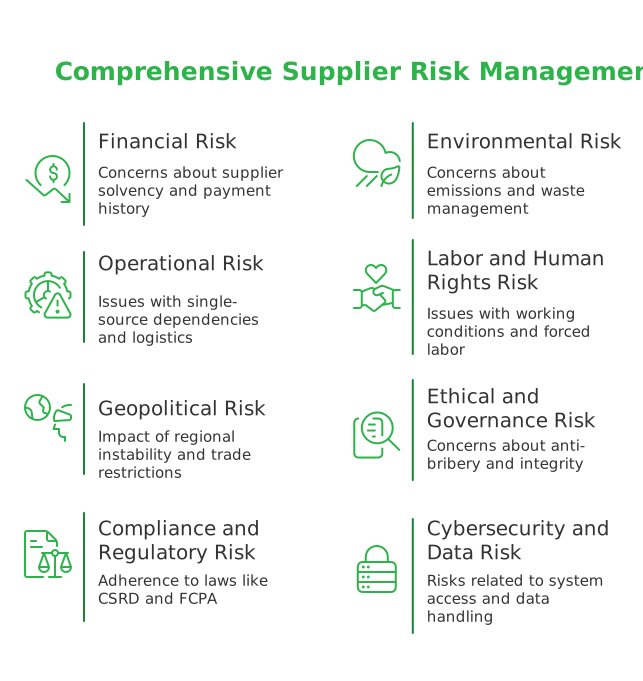
- Financial risk: Supplier solvency, credit exposure, payment history and signs of financial distress that could affect delivery or continuity.
- Operational risk: Single-source dependencies, capacity constraints, geographic concentration and logistics vulnerabilities
- Geopolitical risk: Regional instability, trade restrictions and country-level exposure
- Compliance and regulatory risk: Adherence to applicable laws and regulations, including CSRD, CSDDD, the EU Forced Labour Regulation and anti-corruption statutes like the FCPA and UK Bribery Act
- Environmental risk: Carbon emissions, resource consumption, waste management practices and history of environmental violations
- Labor and human rights risk: Working conditions, wage compliance, freedom of association and exposure to forced or child labor, including through sub-tier suppliers
- Ethical and governance risk: Anti-bribery controls, conflict of interest policies and the integrity of supplier business practices
- Cybersecurity and data risk: Relevant for suppliers that access your systems, handle customer data or sit inside critical digital infrastructure
Mapping risk categories to a consistent, scalable assessment helps organizations move from a reactive compliance exercise to a proactive risk management program.
Supplier Risk Categories
| What It Covers | Key Risk Indicators | |
| Financial | Supplier solvency, credit exposure and payment reliability |
|
| Operational | Supply continuity, capacity and logistics dependability |
|
| Geopolitical | Regional instability, trade restrictions and country-level exposure |
|
| Compliance & Regulatory | Adherence to applicable laws, trade regulations and industry standards |
|
| Environmental | Emissions, resource use and waste management practices |
|
| Labor & Human Rights | Working conditions, wage compliance and sub-tier labor practices |
|
| Ethical & Governance | Anti-bribery controls, conflicts of interest and business integrity |
|
| Cybersecurity & Data | Data handling, system access controls and digital infrastructure security |
|
How to Conduct a Supplier Risk Assessment
A thorough supplier risk assessment process is essential for identifying and prioritizing risks. Organizations with mature supply chains should follow a consistent framework that scales across suppliers, adapts to new risk signals and connects assessment data to real improvement.
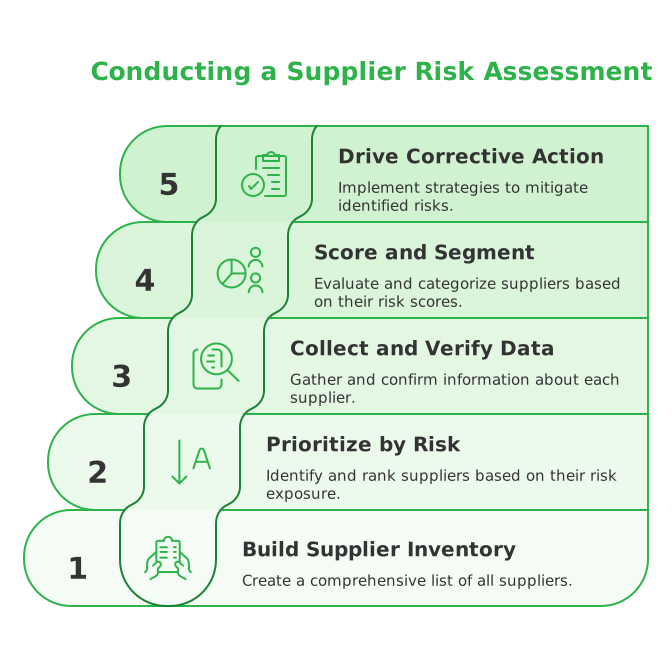
Step 1: Build Your Supplier Inventory
Before assessing risk, know who you’re assessing. Start by compiling a complete supplier inventory that captures spend, category, geography and business criticality. Many organizations discover during this step that their supplier base is larger, more geographically dispersed or more concentrated in high-risk regions than previously thought.
Segment suppliers into priority groups based on spend volume and operational criticality. Suppliers with the highest spend or strategic importance will require the deepest assessments. Lower-spend suppliers may warrant lighter-touch monitoring. This segmentation determines how resources are allocated across the rest of the process.
Step 2: Prioritize by Risk Exposure
With your supplier inventory segmented, the next step is to determine where the greatest risk concentration actually lies. Spend and criticality are inputs, but they don’t tell the whole story. A low-spend supplier operating in a region with high forced labor prevalence or political instability may carry more risk than a high-spend supplier in a more regulated market.Prioritizing suppliers is one stage of the wider supply chain risk management process.
Geographic exposure deserves particular attention right now. Tariff volatility has made single-region sourcing concentration a material risk in its own right. According to a 2026 Thomson Reuters survey, 76% of trade professionals believe the tariffs imposed by the U.S. represent a permanent approach to trade that will persist for at least the next four years. Organizations that haven’t pressure-tested their geographic concentration are more likely to face higher duties and import taxes in the long run.
Build a risk-tiering model that combines spend and criticality with country risk scores, industry risk profiles and the specific categories most relevant to your sourcing strategy. The output is a prioritized list that tells your team where to focus resources first and how frequently each segment needs to be assessed.
Step 3: Collect and Verify Supplier Data
Questionnaires and supplier self-assessments are a common starting point, but they are not an endpoint. Self-reported data is useful for quickly gathering baseline information, but it is not verified without independent corroboration.
Third-party verified data, including sustainability ratings, audit reports, certification records and watchlist screening, provides evidence that makes an assessment credible and defensible. Look for providers that evaluate suppliers across environment, labor practices, ethics and sustainable procurement using a methodology that combines document review, multi-stakeholder feedback and expert analysis. Broad supplier coverage and a standardized scoring framework are what make third-party ratings benchmarkable in a way self-assessments can never be.
Step 4: Score, Rank and Segment Results
Raw data needs to be converted into a consistent scoring framework that your team can act on. A good scoring model accounts for both inherent risk, the baseline exposure driven by industry and geography, and performance risk, the supplier’s recorded behavior and controls.
Once scores are assigned, segment suppliers into clear action tiers: those to monitor on a standard cycle, those to engage proactively on improvement and those requiring immediate remediation or sourcing review. Avoid an overly complex scoring model that is difficult to explain to suppliers or internal stakeholders. For procurement teams managing large or complex supply bases, risk intelligence tools can surface which suppliers or categories have the highest risk concentration across the network, rather than requiring analysts to review assessments one by one.
Step 5: Drive Corrective Action and Track Improvement
An assessment without a corrective action plan is an audit, not a risk management program. The point of identifying risk is to reduce it, and that requires clear improvement timelines, defined KPIs and accountability on both sides of the supplier relationship.
For high-risk suppliers, corrective action plans should specify which gaps need to be addressed, by when and how progress will be verified. For suppliers at lower risk levels, standard reassessment cycles and ongoing performance monitoring are typically sufficient. Between formal assessment cycles, real-time monitoring for early-warning signals, including news alerts, sanctions updates and financial distress indicators, allows teams to respond proactively to developing issues.
From Risk Data to Supplier Performance With EcoVadis
EcoVadis provides the data infrastructure and portfolio intelligence modern businesses need to move from static risk identification to continuous supplier improvement. The platform covers each critical stage of the assessment process:
- EcoVadis Vitals: Supplier questionnaires that deliver verified risk profiles and due diligence coverage across your entire supply base.
- EcoVadis IQ Plus: Risk mapping and real-time ESG intelligence that identifies hotspots, prioritizes supplier engagement and supports compliance with CSRD, LkSG, Modern Slavery Acts and more.
- EcoVadis Ratings: Independently verified assessments of supplier performance across Environment, Labor & Human Rights, Ethics and Sustainable Procurement, giving procurement teams a standardized, evidence-based view supply chain risk.
- Corrective Action Plans (CAPs): Structured improvement plans tied directly to scorecard gaps, giving suppliers a clear roadmap and procurement teams a mechanism to track progress over time.
In Conclusion
A supplier risk assessment is only as strong as the process behind it. Organizations that build structured, repeatable programs, grounded in verified data and connected to clear corrective action, are better positioned to absorb supply chain disruptions, meet growing regulatory demands and build supplier relationships based on transparency and accountability.
FAQs
Q: What are the biggest challenges in conducting supplier risk assessments?
A: Supplier risk assessments are resource-intensive by nature, and several common obstacles can limit their effectiveness:
- Data quality and availability: Suppliers, particularly smaller ones, often lack the systems or capacity to provide complete, accurate information. Self-reported data is inconsistent and difficult to verify at scale.
- Supply base size and complexity: Large enterprises may manage thousands of suppliers across multiple geographies, making comprehensive coverage difficult without automation or tiering strategies.
- Keeping assessments current: Risk profiles change. A supplier that passed an assessment 18 months ago may look very different today, and annual cycles alone are rarely sufficient for high-risk categories.
- Translating scores into action: Many programs generate risk data without a clear process for acting on it. Without defined corrective action workflows, assessment outputs stall at the reporting stage.
Q: How often should a supplier risk assessment be conducted?
A: Most organizations conduct formal supplier risk assessments annually for high-risk and strategic suppliers. Lower-risk suppliers may be assessed every two to three years. Between formal cycles, continuous monitoring for early-warning signals, financial distress, regulatory changes and news events, is recommended for critical suppliers regardless of their risk tier.
Q: What is the difference between a supplier risk assessment and a vendor risk assessment?
A: Vendor risk assessments typically focus on IT, cybersecurity and data privacy, evaluating providers that handle sensitive systems or customer information. Supplier risk assessments cover a broader scope that includes commercial, operational, ESG and ethics dimensions. In practice, many large enterprises run both programs in parallel, with overlapping suppliers evaluated under each framework depending on the nature of the relationship.

Ashley Raleigh is a supply chain professional with 10 years of experience across freight operations, logistics technology, and sustainability. Her work focuses on the evolving role of technology, strategy, and responsible practices in modern supply chains.