
 ChatGPT
  Gemini
  Perplexity
  Claude
  Grok
Grok 

Gain insights from 30+ sustainability leaders, including superstars like Paul Polman, former CEO of Unilever, and Helena Helmersson, former CEO of H&M Group. Learn how to build a sustained advantage through responsible business practices.
14th April 2026
ESG Standards: The Foundation of Strategic Corporate Governance
Read summarized version with:
ESG standards transform vague sustainability commitments into verifiable data. By integrating recognized standards like GRI and SASB into ESG governance models, organizations can move from annual compliance reporting to true sustainability progress.
Global sustainability regulations remain in flux, but the business case for transparent ESG data continues to grow. Leading enterprises recognize that tracking and reporting on corporate initiatives isn’t just about compliance, but necessary for maintaining market relevance. In fact, the 2025 US Business Sustainability Landscape Outlook found that 65% of executives report supply chain sustainability as a competitive advantage, and 62% say it helps attract and retain customers.
Capturing these benefits requires organizations to move beyond vague environmental commitment statements and focus on verifiable metrics. Merging established ESG standards with internal ESG governance helps ensure sustainability claims are backed by data and oversight to secure long-term value.
Key Takeaways
|
What are ESG Standards?
ESG standards are specific requirements for measuring and reporting an organization’s performance. Many companies struggle to defend high-level sustainability goals because they lack a clear definition of what data to collect. A recent Deloitte survey highlights this challenge, noting that a quarter of U.S. executives identify measuring environmental impacts as a primary obstacle to deploying sustainability initiatives. ESG standards bridge this gap by providing a roadmap for data collection and effectively defining the metrics needed to demonstrate progress.
Most of these metrics are categorized into three essential pillars: Environmental, Social, and Governance. However, a critical fourth pillar is Disclosure, making sustainability claims visible and accessible. While the first three pillars organize ESG data, disclosure allows stakeholders to verify it. Without a standardized disclosure process, internal data remains siloed and offers little value to external partners. The demand for validated transparency is driving organizations to supplement their annual reporting processes with a comprehensive ESG governance system.
The Role of Standards in ESG Governance
ESG governance is the structural framework an organization uses to manage its environmental and social impact. Rather than a broad set of values, it is a deliberate process that enhances corporate accountability. A governance model typically consists of several components:
- Executive accountability: Clearly defined roles for leadership to oversee sustainability initiatives and integrate them into the overall business strategy.
- Risk management: Audits and internal controls that help identify potential ESG-related threats to the organization’s reputation or operations.
- Strategic alignment: The process of ensuring that sustainability commitments match long-term organizational goals.
- Continuous oversight: Systems for monitoring performance and adjusting sustainability efforts as regulations and market expectations change.
To work well, a governance structure needs a robust roadmap. ESG standards provide that map by defining specific data points that should be tracked and regularly examined. Without standardized metrics, internal decisions are largely based on anecdotal evidence rather than measurable performance. Standards provide a technical baseline that allows an organization to prove its governance process is working.
Using recognized ESG standards transforms abstract goals into operational KPIs and ensures that every level of the organization works from a unified set of facts. By grounding governance in data, you replace reactive reporting with a permanent sustainability approach and provide the objective proof stakeholders and the public need to trust your progress.
Key ESG Standards Shaping the Global Market
Standardized ESG reporting demands data that is comparable across industries and stands up to scrutiny under audit. Organizations should choose standards based on the stakeholders they need to reach and the jurisdictions in which they operate.
Global Reporting Initiative (GRI)
As the most established standard for impact reporting, GRI is used by organizations to communicate how their operations affect the economy, environment, and society. It adopts a multi-stakeholder approach, making it the primary choice for companies focused on transparency beyond the investment community. As of January 2026, the new GRI 101 Biodiversity standard requires more granular reporting on land use and location-specific impacts throughout the value chain.
Sustainability Accounting Standards Board (SASB)
SASB identifies specific ESG issues most likely to affect a company’s financial performance. These standards are tailored to 77 unique industries, enabling better benchmarking within each sector. Since being absorbed into the IFRS Foundation, SASB metrics have become the backbone for industry-specific disclosures, helping investors identify material risks that impact enterprise value.
European Sustainability Reporting Standards (ESRS)
The ESRS is a mandatory set of standards for organizations falling under the EU Corporate Sustainability Reporting Directive (CSRD). It is built on the principle of double materiality, which means you must report on both your company’s financial risks and the external impact it has on the world. To support compliance for smaller organizations, the EU recently introduced a simplified voluntary standard for SMEs to maintain data integrity with less administrative burden.
International Sustainability Standards Board (ISSB)
The ISSB represents the effort to create a single global baseline for sustainability disclosures. Its primary standards, IFRS S1 and S2, focus on the climate-related risks and opportunities that matter to capital markets. By incorporating the TCFD’s previous recommendations, the ISSB provides a unified language for global investors to evaluate corporate resilience.
Steps for Integrating ESG Standards
Adopting global standards requires a transition from superficial policy to comprehensive data management. This means organizations should establish a repeatable process for identifying, collecting and monitoring ESG metrics.
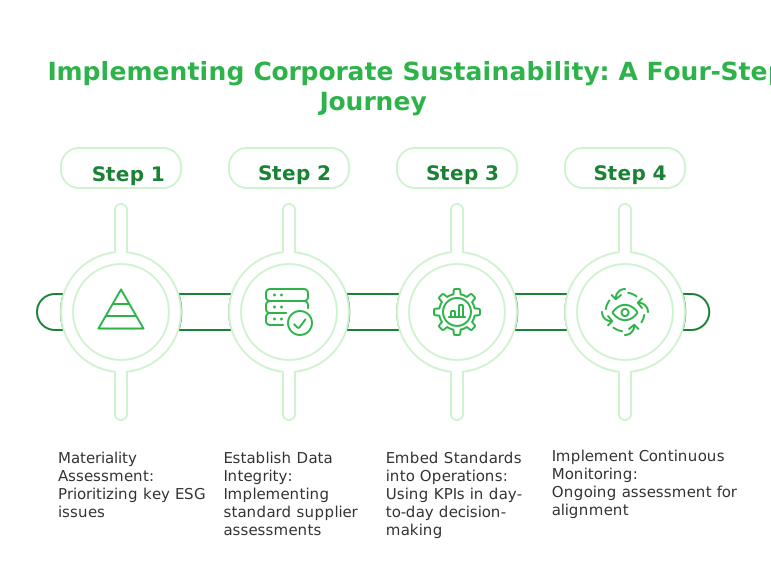
Step 1: Conduct a Materiality Assessment
Attempting to capture every available metric is an inefficient use of corporate resources. You should first isolate the specific ESG issues that could significantly impact your financial performance or your external stakeholders. This prioritization ensures your reporting remains focused on the information that drive value and mitigate sustainability risk, rather than a broad list of irrelevant data points.
Step 2: Establish Data Integrity
Reliable reporting is only as strong as the data provided by your partners and suppliers. To move toward true transparency, you should implement standardized supplier evaluations that account for N-tier suppliers to verify threats deep within the supply chain. Establishing diligent collection protocols ensures that the information you report reflects the actual impact of your value chain and provides a defensible foundation for any public-facing claims.
Step 3: Embed Standards into Operations
Standardized data isn’t useful if it’s siloed in an annual sustainability report. To drive lasting change, these metrics need to inform day-to-day decisions in procurement, risk management and capital allocation. Integrating the right KPIs into your operational strategy turns sustainability into a critical element of your business model and provides the evidence needed for transparent ESG communications.
Step 4: Implement Continuous Monitoring
Annual snapshots simply aren’t sufficient for managing the speed of modern ESG risks. Effective governance relies on ongoing assessment to catch potential performance issues before they become significant liabilities. By monitoring metrics in real time, you can adjust strategies as global standards and stakeholder expectations evolve, keeping your organization ahead of the compliance curve.
Turning ESG Standards into Corporate Governance
Applying global ESG standards across complex supply chains requires a centralized and objective methodology. EcoVadis maps sustainability ratings directly to the international standards like GRI and SASB, making it easy for organizations to ensure sustainability data remains comparable, verifiable and ready for public disclosure.
The EcoVadis sustainability intelligence platform provides comprehensive infrastructure to manage ESG requirements through evidence-based scorecards and predictive risk mapping. Our data-driven approach supports global enterprises that are ready to embrace governance models that account for partner performance across all levels the value chain.
See how standardized ratings can strengthen your corporate governance. Request a consultation with an EcoVadis sustainability expert.
In Conclusion
Adopting recognized ESG standards provides the technical roadmap for a resilient governance framework. Continuous oversight ensures that sustainability remains a visible corporate priority instead of a simple compliance task. Grounding internal decisions in verified, comparable metrics establishes the transparency needed to satisfy global regulatory requirements and public expectations. A data-driven approach transforms abstract commitments into a defensible record of measurable progress.
FAQs
Q: What is the difference between an ESG framework and an ESG standard?
A: An ESG framework provides the high-level principles and “why” behind reporting, while an ESG standard provides the specific, technical “how-to” requirements. Think of a framework (like TCFD) as the set of guidelines for what topics to cover, and a standard (like GRI or SASB) as the detailed instruction manual that dictates which metrics to measure and how to format the data for comparison.
Q: How do you map internal sustainability KPIs to GRI and SASB standards?
A: Mapping sustainability metrics involves matching raw operational data with specific protocols defined by each standard. For GRI, you must match your data to their “Topic-Specific Disclosures,” ensuring internal collection parameters (like which subsidiaries are included) meet their requirements. For SASB, you should cross-reference internal KPIs with the 77 industry-specific “Accounting Metrics” to ensure you are measuring in the exact units (e.g., gigajoules, metric tons) the standard requires for sector-level benchmarking.
Q: How does third-party verification improve ESG data integrity?
A: Third-party verification is essentially an independent audit of a company’s sustainability claims. By reviewing the data collection process and the accuracy of the underlying metrics, auditors provide reassurance that reported figures are verifiable and backed by evidence. This process is essential for defending disclosures against greenwashing accusations and regulatory scrutiny.

Ashley Raleigh is a supply chain professional with 10 years of experience across freight operations, logistics technology, and sustainability. Her work focuses on the evolving role of technology, strategy, and responsible practices in modern supply chains.