
Real-Time Worker Voice in Supply Chains: From Audit to Advantage
Read summarized version with:
 ChatGPT
  Gemini
  Perplexity
  Claude
  Grok
Grok How a multinational retailer’s responsible-sourcing program and a multi-brand pilot in Taiwan are using continuous, anonymous worker voice data to find risks audits miss and rewrite supplier conversations.
Key Takeaways
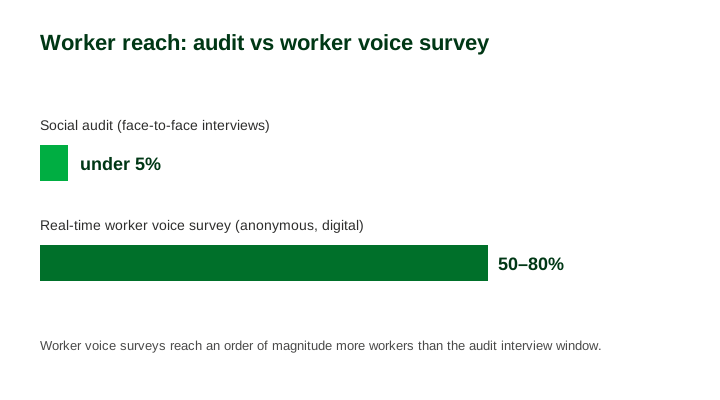
- Social audits typically interview a small share of a factory’s workforce in face-to-face conversations (under 5% in many cases), while real-time worker voice surveys reach 50% to 80% of workers anonymously through digital channels.
- A supplier factory in Bangladesh that passed a clean BSCI audit revealed serious working-condition issues when the retailer ran a worker survey, leading to a structured action plan and measurable improvement.
- A single ethical-line complaint about unpaid resignation fees in South India surfaced a multi-month pattern of similar cases the supplier had not flagged internally.
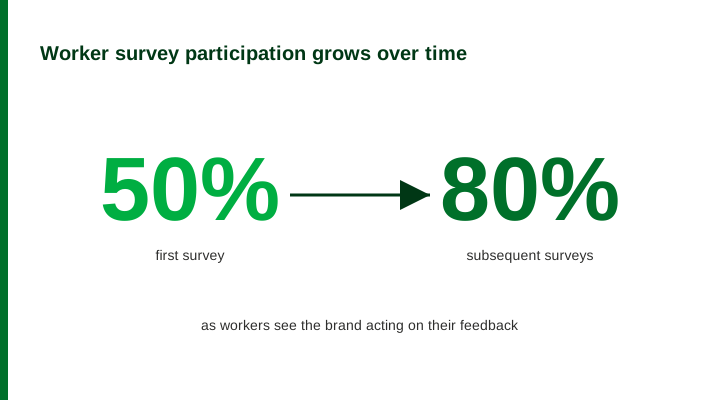
- Worker voice surveys are roughly annual at well-performing factories and every six months where issues are detected. Participation typically grows from 50% on the first survey to 80% as workers see results.
- EcoVadis combines AI-generated insights, human-verified data, and worker-verified data so that risk discovery in worker voice is treated as an improvement signal rather than a contract risk.
Why real-time worker voice matters now
For most companies, social audits remain the foundation of supply-chain human-rights due diligence. They check policies, procedures, fire safety, electrical installations, and the documentary record of a factory at a single moment in time. They are valuable, and as the corporation’s CSR Director put it in a recent EcoVadis fireside conversation, the audit is the first foundation.
But foundations alone are not the building. Audits interview a small percentage of workers in face-to-face conversations that are difficult to keep fully anonymous, and they happen on a one or two year cycle. The reality of factory life between those audits is mostly invisible.
Real-time worker voice fills that gap. For procurement and sustainability teams trying to meet rising regulatory expectations under CS3D, the EU Forced Labor Regulation, and various national modern-slavery acts, the difference between a snapshot and a pulse is the difference between compliance reporting and resilience.
This article distills the core lessons from “From Audits to Advantage: Real-Time Worker Voice for Smarter Supply Chains” an EcoVadis breakout featuring the major retailer’s CSR Director and Dr. Bonnie Ling, Director of Work Better Innovations.
The audit blind spot
Three structural limits of the social audit model came up repeatedly in the conversation.
Limited reach. A typical audit interviews under 5% of a factory’s workers, producing a very limited picture of actual working conditions.
Limited anonymity. Even when audits include worker interviews, they happen face-to-face with an auditor on site. Confidentiality is respected in principle, but full anonymity is not what workers experience.
Limited frequency. Audits run on annual or biennial cycles. The months in between are an information gap, and that gap is precisely where most working-condition risk lives.
These limits are not a critique of audits as such. Audits are a strong foundation, but they need to be paired with a continuous data layer. (See leveraging worker voice for the broader case.)
How real-time worker voice changes the data signal
Digital worker voice changes three properties of the data at once.
Reach. A digital survey can cover 50% to 80% of a factory’s workforce in a single round. That is an order-of-magnitude increase over what an auditor sitting in a meeting room can capture.
Anonymity. Surveys are designed to be one hundred percent anonymous, with strict rules to protect respondent identity. Without that, workers tell you what they think you want to hear.
Frequency. Surveys are continuous rather than one-off, supported by always-on grievance channels. EcoVadis’ Worker Voice solution (built on Ulula technology) is designed to let buyers run worker surveys on a cadence that matches actual risk, annual at well-performing factories and every six months where issues are flagged, and to pair those surveys with a continuous grievance mechanism for incidents that surface between cycles.
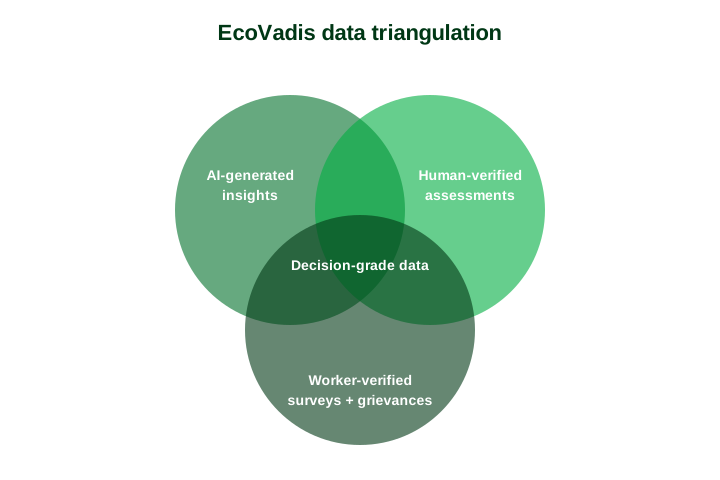
EcoVadis frames the resulting data architecture as a triangulation: AI-generated insights, human-verified insights from assessments and audits, and worker-verified insights from surveys and grievance channels. No single data point is the whole truth. The wisdom comes from the overlap.
Inside the worker voice playbook
Two case studies from the retail corporation illustrate how real-time worker voice changes risk discovery in practice.
Bangladesh: when a clean audit hides the real picture. The retailer worked with a Bangladesh factory that had a strong BSCI social audit on the record. Bangladesh is a higher-risk geography for human rights, so the team launched a worker survey alongside the audit. Questions covered working hours, freedom of movement, harassment, and management practices. Participation was high, and the survey results were materially different from what the audit had captured. The team ran an action plan with the supplier, brought in an NGO partner to train middle management, and saw measurable improvement in working conditions. The corporation kept the supplier in its base. The audit alone would have signaled “all clear,” while the actual conditions remained problematic.
South India: when one complaint is many. A worker who had resigned from a South India factory used the retailer’s ethical line to report that her statutory severance installments had not been paid. The supplier’s first response was to deny that any procedural violation had occurred, so the corporation’s local team investigated. What looked initially like a single grievance turned out to be a pattern: over the previous seven to eight months, several workers had resigned without receiving the legally mandated severance. The supplier’s top management was unaware of the pattern. After a constructive conversation, the supplier reimbursed the affected workers and tightened its internal procedures.
“When there is a problem, it comes from the worker. It’s super credible, and we have to treat it. It’s a reality.”
CSR Director, Multinational Retailer
These examples illustrate the core shift: supplier conversations move from compliance reaction to continuous improvement. Discussions stop being about audit procedures and start being about working conditions and concrete remediation. That cultural change is arguably more durable than any specific finding.
Lessons from a multi-brand Taiwan pilot
Bonnie Ling’s team at Work Better Innovations is running a multi-brand worker voice pilot in Taiwan that focuses on Tier 2 suppliers and migrant-worker populations. The risk profile is very different from Bangladesh. The salient issues are recruitment fees, debt bondage, and forced-labor risk associated with the way migrant workers enter Taiwan from countries of origin in Southeast Asia.
Two findings stand out.
First, even in the early rounds, workers reported fear of retaliation when raising grievances. Bonnie’s read on this is counterintuitive but important: that workers express fear is itself a useful signal that trust has not yet been established and that the engagement model needs more time and reinforcement before data quality stabilizes.
“Finding problems is not a problem. Asking questions is not a problem.”
Dr. Bonnie Ling, Director, Work Better Innovations
Second, the pilot revealed concrete gaps in how factory owners and workers perceive the same situation. Bonnie shared an example of a Lunar New Year karaoke event that a factory owner believed had been a happy team gathering. Workers, polled anonymously, described it as effectively mandatory and said they would have preferred a cash bonus they could put toward their recruitment-fee debt. Neither side was acting in bad faith. Without a real-time worker voice channel, neither would have known.
The Taiwan pilot also reinforces a multi-tier point that our retailer raised independently. Worker voice does not have to start at Tier 1. Their company applies a risk-based approach that can extend to Tier 4, for example spinning mills in Tamil Nadu where dormitory practices can create freedom-of-movement risk independent of the Tier 1 garment factory. The pilot in Taiwan is structured the same way, with the survey reaching workers at Tier 2 because that is where the relevant risk lives.
For procurement teams managing risk under CS3D and CSRD requirements, the practical implication is clear: a one-tier worker voice program will miss the most consequential issues in many supply chains. (See our CS3D and CSRD coverage for the regulatory expectations.)
From compliance reaction to continuous improvement
The most important behavioral change real-time worker voice produces is in the buyer-supplier conversation itself.
Before, conversations were audit-driven, retrospective, and procedural. There was a non-conformance on the report, the supplier presented a remediation plan, and everyone moved on until the next audit. Now, conversations are solution-oriented and continuous. They focus on actual working conditions, not policy documentation. Suppliers know that the buyer can hear from workers at any time, which raises the standard of internal supervision without adding paperwork. The EcoVadis approach is non-punitive: surfacing risk through worker voice is rewarded as an improvement signal in supplier ratings rather than penalized as a compliance failure.
For more on the compliance angle, see the transparency gap under CS3D and our Modern Slavery Acts coverage.
How to start with real-time worker voice
If your organization is starting from a primarily audit-based program, the practical first move is straightforward. Use a risk-based view of your supply base (informed by a tool like EcoVadis IQ or your own risk management infrastructure) to identify which countries, tiers, and supplier types carry the most worker-rights risk. Onboard a focused starting cohort with both supplier management and workers present, so workers understand that participation is voluntary, anonymous, and aimed at improvement. Run a baseline survey, work with the supplier on the action plan, then run again in six months and watch participation grow as workers see action.
FAQs
What is real-time worker voice?
Real-time worker voice is the practice of collecting anonymous, continuous feedback from workers in your supply chain through digital surveys and grievance mechanisms, rather than relying solely on periodic social audits. It typically reaches a much larger share of the workforce (50% to 80%) than audit interviews and runs on a frequency that matches actual risk, with surveys roughly annual or every six months and grievance channels available continuously.
How does real-time worker voice differ from a social audit?
A social audit is a point-in-time inspection that interviews a small share of workers in face-to-face conversations on the audit day. Real-time worker voice complements the audit with a continuous, anonymous, multilingual digital channel that reaches a much larger portion of the workforce and captures conditions between audit cycles. Audits remain a strong foundation; worker voice fills the blind spots between them.
Can worker voice surveys reach beyond Tier 1 suppliers?
Yes. Companies can apply a risk-based approach that extends worker voice surveys to Tier 2, Tier 3, or Tier 4 depending on where the most material human-rights risk sits. In Tamil Nadu, for example, spinning mills (Tier 4) often carry higher freedom-of-movement risk than the Tier 1 garment factory due to dormitory practices. A multi-brand Taiwan pilot is currently running at Tier 2 to address migrant-worker recruitment-fee and debt-bondage risk.
How often should we run worker voice surveys?
Frequency should match risk. At factories where surveys consistently show good working conditions, an annual cadence is typical. Where surveys surface issues, a six-month cadence gives the supplier time to act on the action plan and lets the buyer verify whether conditions have improved. The continuous grievance channel runs in parallel for incidents that arise between survey cycles.
What if a worker voice survey surfaces problems we did not know about?
That is the desired outcome, not a failure. As Dr. Bonnie Ling put it during the panel: “Finding problems is not a problem. Asking questions is not a problem.” The EcoVadis approach is non-punitive: surfacing risks and acting on them is rewarded in the supplier rating, not penalized. The behavioral shift this enables, from compliance reaction to continuous improvement, is the most durable benefit of a real-time worker voice program.