
Scope 3 Decarbonization Roadmap: 9x Better Results
Read summarized version with:
 ChatGPT
  Gemini
  Perplexity
  Claude
  Grok
Grok A fireside conversation between Dexter Galvin of EcoVadis and Anne-Laure Green, Global Sustainability Lead at Kimberly-Clark Corporation, drawing on EcoVadis’s analysis of 55,000 companies.
Key Takeaways
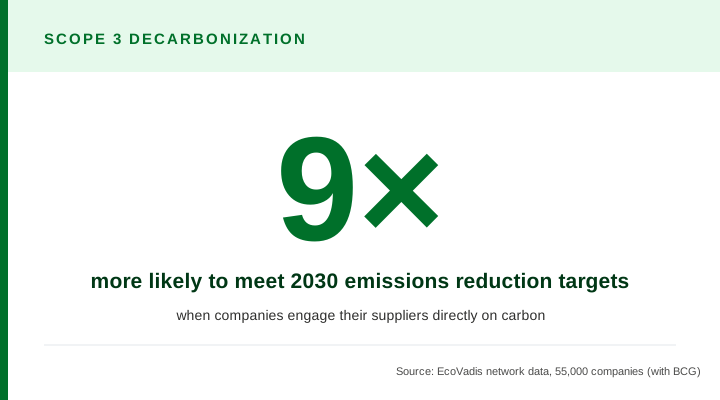
- Supplier engagement makes companies 9x more likely to meet their 2030 emissions reduction goals, according to EcoVadis’s analysis of 55,000 companies conducted with BCG.
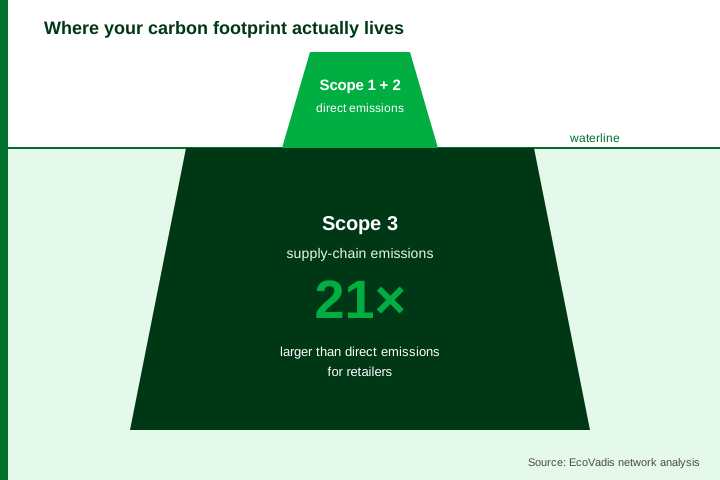
- For retailers, Scope 3 emissions are 21x larger than their direct emissions; for most organizations, the supply chain is the dominant share of their total carbon footprint.
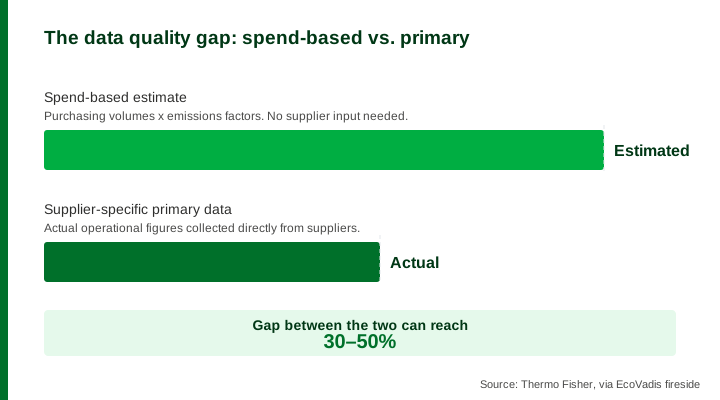
- Spend-based carbon estimates can diverge from real supplier-specific data by 30–50% (Thermo Fisher). The earlier you move to primary data, the more accurate your science-based target baseline becomes.
- Kimberly-Clark focused its entire scope 3 decarbonization roadmap on just 200 suppliers, covering 65% of spend and 50% of emissions, using a beginner-to-advanced progression matrix to meet each supplier where it is.
- Only 8% of suppliers currently have product carbon footprints (PCFs). Getting them started, not perfect, is the practical entry point.
Why Scope 3 emissions sit at the heart of any decarbonization roadmap
Building a scope 3 decarbonization roadmap requires starting with an honest picture of where your emissions actually live. The most durable framing for this is the iceberg: the carbon emissions visible in Scope 1 and 2 reporting, your direct and energy-related emissions, are just the tip above the surface. The overwhelming bulk sits below in your supply chain. For retailers, Scope 3 runs to 21 times their own direct emissions. For Kimberly-Clark, a company with a rigorous Scope 1 and 2 program already in place, Scope 3 still accounts for roughly 70% of its total carbon footprint.
The financial case for acting is equally concrete. Since the year 2000, climate-related disruptions have cost the global economy $3.6 trillion. Insurance premiums have risen 5–7% consistently every year since 2020. This is not a risk on some distant horizon; it is already running through supply chains as higher input costs, tighter insurance terms, and greater sourcing volatility.
The structural gap makes the urgency sharper. EcoVadis’s analysis of 55,000 companies, conducted in partnership with BCG, found that far too few tier-one suppliers are measuring, managing, or reducing their own emissions. Almost none are engaging their own supply chains in turn. The cascade of action needed to drive systemic change has barely begun, leaving most procurement organizations with a significant blind spot at tier two and beyond.
Why spend-based data stalls scope 3 supplier engagement
Many organizations build their Scope 3 baseline using spend-based estimation: purchasing volumes multiplied by published emissions factors. It is fast and requires no supplier cooperation. The problem is how far the resulting number can be from reality.
Thermo Fisher, the medical devices company, published the discrepancy between its spend-based estimates and the supplier-specific data it later collected. In some cases the gap ran to 30–50%. That is not a rounding error; it means a company could be significantly misestimating its actual footprint, calibrating a science-based target on a flawed baseline, and directing reduction effort to the wrong places.
Moving to primary data also produces a less obvious benefit: it activates internal action. Dexter Galvin shared the story of Doug, an energy manager at a US engineering firm whose climate-skeptic C-suite had declined his energy-efficiency proposals for years. When National Grid, a major customer spending roughly $100 million with the firm, sent a sustainability questionnaire, everything changed overnight. Leadership called for Doug, approved his entire backlog of projects, and the work was under way before a single data point had been formally submitted. As Galvin put it, “just the power of asking the question” was enough to set the process in motion. Doug retired having achieved the goal he had spent his career working toward.
The implication is that supplier engagement around carbon data is not primarily an information-gathering exercise. It is the lever that unlocks action, both in your supply chain and within your own organization.
Inside Kimberly-Clark’s scope 3 decarbonization roadmap
Anne-Laure Green joined Kimberly-Clark two years ago as Global Sustainability Lead for Sustainable Procurement, bringing 25 years of supply chain and procurement experience to the role. Kimberly-Clark had already built a strong Scope 1 and 2 program. Its externally committed Scope 3 target started at a 20% reduction by 2030, and SBTi subsequently asked the company to raise it to 40%, pending final approval. Green’s task was to build a supplier engagement program that procurement could actually deliver.
Focus ruthlessly on the right suppliers
The first decision was scope. Kimberly-Clark’s supplier base runs to thousands of companies. Green was direct: trying to engage all of them would produce data, not action.
“Data for the sake of data is pointless. Apart from the fact that you might have some numbers for your reporting, it isn’t driving action.”
Anne-Laure Green, Global Sustainability Lead, Kimberly-Clark Corporation
Kimberly-Clark started with 200 suppliers. Those 200 represent 65% of the company’s total spend and 50% of its emissions, concentrating effort where it matters most while remaining operationally manageable. For each supplier, the team used EcoVadis Ratings to understand existing carbon maturity, and accessed Carbon Action Manager to structure the engagement and track progress without piling new standalone data requests on suppliers who were already stretched.
Building a supplier carbon maturity progression
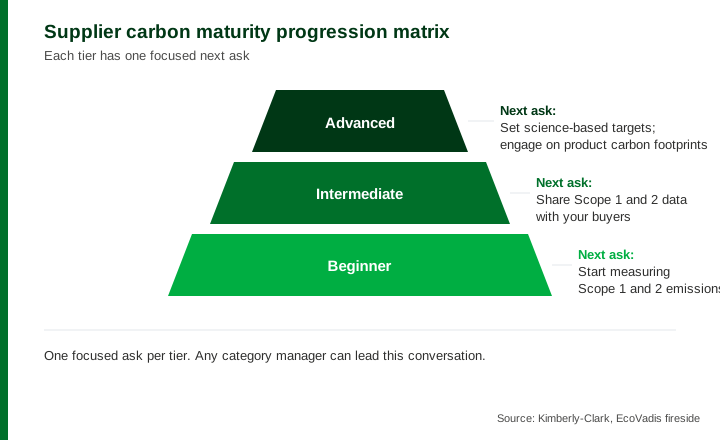
One of the most transferable elements of Kimberly-Clark’s approach is what Green calls the progression matrix. Rather than presenting every supplier with the same corrective action list, the team segmented them by maturity: beginner, intermediate, or advanced. Each tier has a defined next step, so every procurement conversation is concrete.
A beginner supplier, not yet measuring its own emissions, gets one specific ask: start measuring Scope 1 and 2. An intermediate supplier already reporting those figures gets the next ask: share the metrics with us. An advanced supplier with reduction targets in place moves into a conversation about Scope 3 and product-level carbon footprints. The matrix becomes a one-page crib sheet that any category manager can bring into a supplier meeting and use to direct a focused conversation, without needing to become a sustainability specialist.
“We can’t do it without them. And we can’t do it without talking to them. And we can’t do it without understanding what they’re doing.”
Anne-Laure Green, Global Sustainability Lead, Kimberly-Clark Corporation
The matrix also works contractually. Kimberly-Clark piloted a one-page addendum to supplier contracts: a progress chart showing a supplier where they are and what the next step is, alongside sustainability metrics to incorporate into the existing scorecard. The guiding principle was simplicity: keep the addendum to one page and make it something procurement can actually use in a supplier meeting.
Embedding sustainability into procurement decisions
The progression matrix solves the “what do I ask” problem. Embedding sustainability into existing workflows solves the “when and where” problem.
Kimberly-Clark added sustainability to its standard supplier scorecard alongside cost, quality, and service. Green describes this shift as procurement moving from a triangle to a square: those four pillars now sit equally in every strategic supplier relationship. The scorecard tracks monthly activities that move toward the 40% Scope 3 goal, not the emissions number itself, because that number cannot realistically be audited month-to-month.
Sustainability questions were also embedded into the RFP process through Coupa, KC’s procurement platform. A template of questions goes out automatically with every relevant RFP, suppliers complete it as part of their standard response, and the data feeds directly into selection conversations. Sustainability is not yet the primary selection criterion, but it is consistently part of the decision.
A practical anecdote captures how simple the ask can be. Green joined a meeting with a chemical supplier. The supplier already tracked the carbon impact of every process improvement it made; it had simply never been asked to put that data in the same spreadsheet as the cost savings. Once asked, the combined reporting happened immediately, and the business now receives monthly updates showing cost savings and carbon reductions side by side. As Galvin noted, “nobody wakes up in the morning and goes, I wish I had a new reporting platform to put data in.” Reducing friction matters as much as ambition.
Communicating scope 3 progress to the C-suite
Engagement with the C-suite requires a different register. Generic sustainability messaging rarely moves executive attention.
What does move it is connecting Scope 3 progress to metrics the business already tracks: investor questions, customer retention, and supply chain resilience. Anne-Laure Green noted that Kimberly-Clark’s customers are asking KC exactly what KC is asking its suppliers. Demonstrating a documented, data-backed Scope 3 reporting program is what retains enterprise customers and answers investor due diligence credibly. Kimberly-Clark now displays its EcoVadis medals and badges on Amazon Business, signaling to buyers that its sustainability credentials are independently verified.
Green runs a monthly communication letter to procurement sharing specific supplier stories: this category, this supplier, this result. The results are not always cost savings. Some are risk mitigation decisions. Some are supplier development choices. The letter builds a steady record of visible progress that can travel upward without requiring a separate sustainability briefing.
Five takeaways for any scope 3 decarbonization program
- Ask the question first. Supplier engagement is the strongest predictor of Scope 3 progress: companies that engage suppliers on carbon are nine times more likely to meet their 2030 goals. The data exchange follows from the conversation, not the other way around.
- Rebaseline on primary data. Spend-based estimates can diverge from supplier-specific figures by 30–50%. Moving to primary data earlier means your science-based targets reflect actual emissions rather than modeled ones.
- Focus on the highest-leverage suppliers. A focused list covering the majority of spend and emissions is more actionable than a comprehensive one. Kimberly-Clark started with 200 and covered 50% of its Scope 3 footprint.
- Meet suppliers where they are. A progression matrix, segmenting beginner, intermediate, and advanced suppliers into defined next steps, gives procurement a consistent and non-overwhelming engagement framework. One ask at a time compounds over time.
- Integrate, don’t add. Embedding sustainability into existing scorecards, RFP templates, and contract addenda is what makes programs scale. Adding parallel workflows creates friction for procurement teams and suppliers alike.
How to start your scope 3 supplier engagement program
The most common reason scope 3 programs stall is not ambition; it is scope. Starting with a defined supplier cohort, a clear target, and a standard engagement framework produces early wins that build organizational momentum.
“Don’t drown yourselves in data. Really be selective about which suppliers, what data, what’s important to your organization, and connect it.”
Anne-Laure Green, Global Sustainability Lead, Kimberly-Clark Corporation
EcoVadis’s Carbon Action Manager provides access to existing emissions data across the EcoVadis network, meaning many of your strategic suppliers may already have data available without a new reporting request. The EcoVadis Academy supports capability building for suppliers at any maturity level. For companies mapping Scope 3 regulatory obligations under CSRD or CS3D, the PCF Calculator helps close the product-level data gap that only 8% of suppliers have addressed to date.
The full conversation between Dexter Galvin and Anne-Laure Green is available in the session recording titled “The Scope 3 Advantage: Building a Roadmap for Data-Driven Decarbonization“.
FAQs
What is a scope 3 decarbonization roadmap?
A scope 3 decarbonization roadmap is a structured plan for identifying, measuring, and reducing carbon emissions in your supply chain. It typically starts with baseline measurement, either spend-based or supplier-specific, followed by targeted supplier engagement, the setting of science-based reduction targets, and a monitoring framework to track progress against activities rather than just end numbers. EcoVadis’s analysis of 55,000 companies found that companies engaging suppliers directly are nine times more likely to meet their 2030 goals.
Why is supplier engagement the most powerful lever in scope 3 emissions reduction?
Supply chain emissions almost always outweigh a company’s direct footprint, and suppliers only begin to act when they are asked. EcoVadis data shows companies that engage suppliers on carbon are nine times more likely to meet 2030 reduction goals. Engagement also activates internal action: in Kimberly-Clark’s experience, many suppliers already tracked relevant data but had never been asked to share it in a format useful to buyers.
What is the difference between spend-based and primary carbon data in a scope 3 program?
Spend-based data estimates supplier emissions by applying published emissions factors to purchasing volumes. It requires no supplier cooperation and is quick to produce, but can diverge from actual supplier figures by 30–50% (Thermo Fisher). Primary data, collected directly from suppliers, reflects real operational numbers. The gap matters most when setting science-based targets, which should be grounded in the most accurate baseline available.
What is a supplier carbon maturity progression matrix?
A progression matrix segments suppliers into tiers, such as beginner, intermediate, and advanced, and maps each tier to a defined next step. A beginner is asked to start measuring Scope 1 and 2 emissions. An intermediate supplier is asked to share those figures. An advanced supplier moves into target-setting and product carbon footprint conversations. The matrix gives procurement a practical crib sheet for focused supplier discussions without requiring specialist sustainability expertise.
How do I get C-suite buy-in for a scope 3 supplier program?
Connect scope 3 progress to metrics the C-suite already tracks: investor questions, customer retention, and supply chain resilience. Generic sustainability messaging rarely moves executive attention. Concrete outcomes, such as a customer relationship retained because of verified emissions data, or a supply chain risk identified through the engagement program, make the business case tangible. Sharing specific supplier stories through regular internal communications builds a visible evidence base over time.