
 ChatGPT
  Gemini
  Perplexity
  Claude
  Grok
Grok 
![A vertical or circular process graphic illustrating all eight steps as a continuous cycle rather than a linear list. Reinforces the idea that ESG auditing is ongoing.]](https://ecovadis.com/wp-content/uploads/2026/06/eight-step-esg-audit-process-checklist.svg)

Gain insights from 30+ sustainability leaders, including superstars like Paul Polman, former CEO of Unilever, and Helena Helmersson, former CEO of H&M Group. Learn how to build a sustained advantage through responsible business practices.
16th April 2026
Scope 3 Reporting: A step by step guide
Read summarized version with:
57% of companies currently reporting on Scope 3 using supplier-specific data say supplier data collection is their biggest challenge, and even mature reporters continue to struggle with participation, accuracy and consistency.
Scope 3 reporting covers everything outside your own operations, including the suppliers, logistics partners, raw material producers and end-of-life product impacts that make up the vast majority of most companies’ actual climate exposure.
Despite growing regulatory pressure from frameworks like the CSRD and SBTi, the gap between what is disclosed and what is independently verified remains wide.
This article breaks down what credible Scope 3 sustainability reporting requires in 2026, where most programs fall short and what a verified, audit-ready approach looks like in practice.
Key Takeaways
- Scope 3 emissions account for around 75% of an organisation’s total carbon footprint on average.
- Scope 3 emission reporting is becoming a legal obligation across multiple jurisdictions, including CSRD, California SB 253 and Australia’s mandatory climate disclosure framework.
- 79% of companies cite supplier data availability as their top Scope 3 challenge.
- The biggest barrier in Scope 3 reporting is the myth that you need perfect data before you can start. You don’t.
What Is Scope 3 Reporting?
Scope 3 reporting is the practice of measuring and disclosing the indirect greenhouse gas emissions that occur across your company’s value chain, both upstream from your suppliers and downstream from your customers.
To understand why it matters, it helps to see where it sits alongside the other two scopes:
- Scope 1 covers direct emissions from your own operations (fuel combustion, company vehicles and on-site manufacturing).
- Scope 2 covers indirect emissions from the energy you purchase, primarily electricity and heat.
- Scope 3 covers all other indirect emissions across your value chain, both upstream (suppliers) and downstream (customers).
Unlike Scope 1 and 2, Scope 3 emissions occur outside your direct control, making them harder to measure. They also account for the majority of most companies’ total carbon footprint, which is precisely why regulators and investors are paying closer attention to them.
The GHG Protocol Corporate Value Chain Standard is the only internationally accepted methodology for Scope 3 accounting. It breaks value chain emissions into 15 categories covering everything from purchased goods and services (Category 1) to the use of sold products (Category 11) and investments (Category 15). A company does not need to report every category except those that are material to its business model.
For a consumer goods manufacturer, that typically means Category 1 (purchased goods and services) represents the largest share of emissions. Scope 3 reporting is how companies make those upstream and downstream emissions visible, measurable and actionable.
Why Scope 3 Reporting Matters More Than Ever in 2026
There was a time when Scope 3 reporting was voluntary, and largely the domain of large multinationals with dedicated ESG teams. That era is ending.
The Regulatory Floor Is Rising
Scope 3 reporting requirements are moving from voluntary to mandatory, and the assurance requirements are tightening alongside it.
CSRD went into effect in January 2023 with phased reporting requirements. Large public interest entities reported first, followed by other large companies reporting 2025 data in 2026, and SMEs listed on EU-regulated markets reporting 2026 data in 2027.
Beyond Europe, California’s SB 253 mandates Scope 3 disclosures for companies with over $1 billion in revenue, with first disclosures due in 2027 based on 2026 data. Australia’s framework also phases in Scope 3 reporting requirements starting July 2026 for mid-sized companies and July 2027 for smaller ones.
Companies outside the EU often assume these regulations don’t apply to them. That is a dangerous assumption. If you supply to an EU-headquartered company, or if any part of your customer base operates under CSRD, you are already inside the regulatory orbit.
Scope 3 Represents the Majority of Your Actual Climate Impact
Scope 3 emissions often account for over 90% of a company’s carbon footprint, or up to 11.4 times the emissions generated by its own operations.
A company focused exclusively on Scope 1 and 2 is, in most cases, managing less than 10% of its actual climate impact. That is not a credible position for investors, buyers and regulators trying to assess real decarbonisation progress.
Investors and Buyers Are Acting on Scope 3
Global frameworks like the GHG Protocol, ISSB, TCFD and SBTi are becoming the de facto standards for investors and ratings agencies to evaluate climate-related risks and opportunities. Customers are also scrutinising value chain emissions more than ever, especially Scope 3, favouring businesses that show real climate accountability.
As of mid-2024, only 15% of companies reporting to the CDP have set targets for Scope 3, which means the companies that do have verified, credible Scope 3 data are already differentiating themselves in procurement processes, investor conversations and financing discussions.
If your largest customer is CSRD-compliant, you are already in their Scope 3 inventory, whether you know it or not.
Scope 3 Reporting Challenges Most Companies Face
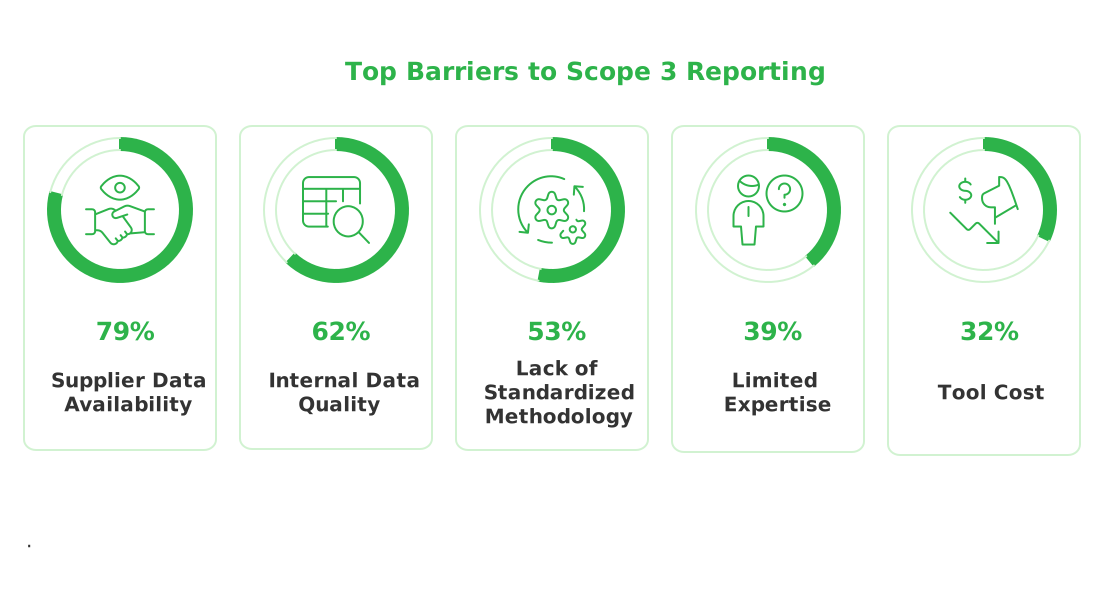
Despite a 27% increase in companies reporting on all three scopes in 2025, 62% of organisations currently reporting Scope 3 cite internal data quality as a major barrier, while 79% say supplier data availability remains a top challenge. The reasons go deeper than just data.
No Clear Starting Point for Scope 3 Reporting
The main barrier to Scope 3 reporting, cited by about 70% of survey respondents, is a lack of supplier data. Without access to activity-level or product-specific data, even the most motivated businesses struggle to calculate accurate emissions. The 15-category GHG Protocol can appear overwhelming in scope, and so teams defer, waiting until they have a clearer plan that never quite materialises.
The honest reality: Most companies that report well on Scope 3 today did not start with complete data or full category coverage. They started with estimates, identified their most material categories and built from there. A focused, improving program consistently outperforms a perfect one that never launches.
Supplier Data Is Hard to Collect
When suppliers do respond to data requests, the resulting data often lacks transparency. Companies frequently receive figures without understanding how they were calculated or their accuracy, making it difficult to validate data or compare results.
Many companies have defaulted to annual supplier surveys as their primary data collection method, and survey fatigue is a growing problem. Suppliers serving multiple large customers receive numerous sustainability questionnaires annually, many requesting similar information in different formats, creating a significant barrier to engagement.
The honest reality: Treating supplier data collection as a purely technical task is the core mistake. Suppliers respond far more completely when they understand why the data is being requested, not just what is being asked.
Context sets the foundation, but compliance requires more than context alone. Suppliers need clear expectations around submission deadlines, data formats and reporting obligations built directly into their contracts and codes of conduct. Without those guardrails in place, sustainability data requests will always compete with every other priority on a supplier’s desk and rarely win.
Fear of Exposing Gaps or Liabilities
Some companies avoid Scope 3 ESG reporting because they view it as potentially detrimental to the firm’s perception, worrying that disclosing a large, unmanaged footprint will create reputational or regulatory exposure.
The honest reality: The fear is understandable but increasingly counterproductive. Regulators and investors are far more concerned about companies that are not measuring than companies that are measuring and disclosing gaps with a credible improvement plan.
Lack of Internal Resources or Expertise
Scope 3 reporting demands a level of internal expertise that most organizations have not yet built. Managing supplier engagement, validating incoming data and maintaining audit-ready documentation across multiple emission categories requires dedicated resources that sit outside most sustainability teams’ current capacity.
In a Berkeley survey, one respondent described the resourcing requirement as equivalent to building a second finance function, one that tracks carbon rather than cost.
According to the 2025 State of Supply Chain Sustainability Report by MIT, a lack of standardised methodologies is cited as a challenge by 53% of companies, followed by the complexity of calculations (52%), limited internal expertise or resources (39%) and the high cost of measurement tools (32%).
The honest reality: The tools most teams are relying on are making the problem worse. The same MIT report found that spreadsheets remain the top data collection tool, with 66% of respondents using them in some form to track Scope 3 emissions. For organizations operating across complex, multi-tier supply chains, spreadsheets cannot provide the auditability or consistency that regulators and investors now expect.
A Step-by-Step Guide to Getting Started
The biggest mistake companies make with Scope 3 reporting is treating it as a sustainability team project. Accurate Scope 3 data sits inside supplier operations, logistics networks and procurement systems, which means the people who manage those relationships need to be part of the process from the start.
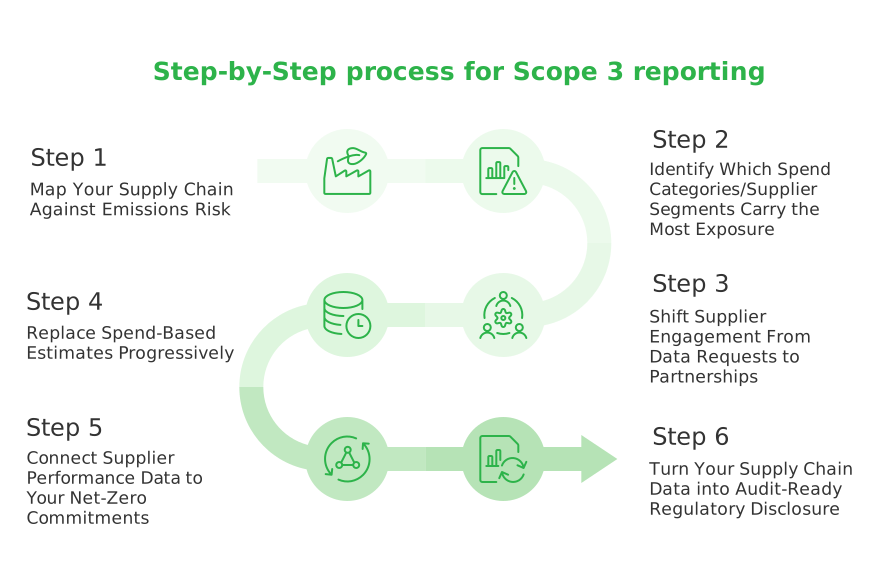
Step 1: Map Your Supply Chain Against Emissions Risk
Before you can measure, you need to know where your emissions are concentrated. That means mapping your existing supplier base (by spend, geography, industry and commodity type) against known emissions risk profiles.
Spend data is often the most accessible starting point, but it needs to be overlaid with emissions intensity data to be useful for Scope 3 prioritisation. Risk mapping tools like EcoVadis IQ let procurement teams identify which parts of the supply chain carry the highest Scope 3 exposure before committing to full measurement across all 15 GHG Protocol categories.
Step 2: Identify High-Exposure Suppliers and Categories
For most companies, 3 to 5 categories represent 80% of total Scope 3 emissions, which means a focused approach to your highest-risk spend categories will deliver far more value than trying to cover everything at once.
For a procurement leader, materiality is a question of which suppliers, which categories and which geographies are driving the most emissions exposure, and which of those you have enough commercial leverage to actually influence.
Start where emissions intensity is highest and your ability to drive supplier action is strongest.
Step 3: Build Supplier Partnerships, Not Just Data Requests
This is where most Scope 3 programs stall. Companies send out questionnaires. Suppliers ignore them or return low-quality, unverifiable data. This makes the whole program lose momentum and revert to spend-based estimates indefinitely.
The fix is not to send better questionnaires. It is to tier your supplier engagement based on emissions exposure and strategic importance. High-priority suppliers warrant direct conversations, shared reduction targets and joint action plans. Lower-tier suppliers can be managed through standardised third-party assessments that reduce the reporting burden on both sides.
A supplier that improves its emissions performance is worth more to your Scope 3 target than ten questionnaires returned on time.
Suppliers engage when they understand what is being asked, why it matters commercially and what support is available to help them respond.
Step 4: Replace Spend-Based Estimates Progressively
Spend-based estimates are a legitimate starting point for scope 3 carbon reporting. Only 15% of companies now rely solely on spend-based methods, down from 30% in 2024. Regulators, investors and enterprise buyers are increasingly scrutinising how Scope 3 numbers are calculated, and spend-based estimates alone are no longer sufficient to meet that bar.
The transition does not need to happen all at once. Start with your top 20–30 suppliers by emissions exposure (the ones identified in Steps 1 and 2) and work to collect verified, supplier-specific activity data for those relationships first. Use spend-based estimates for the rest of your supply base until you have the capacity to improve them.
EcoVadis’ Carbon Action Manager is designed specifically for this transition:
- Helps procurement teams collect verified supplier carbon data at scale
- Moves from portfolio-level estimates toward the supplier-specific, primary data that regulators and investors are increasingly requiring.
Step 5: Connect Supplier Performance Data to Your Net-Zero Commitments
A Scope 3 baseline is only valuable if it drives action and measurable improvement. The goal is a procurement function that uses emissions data the same way it uses cost and quality data: as a live input into sourcing decisions, contract conditions and supplier development priorities.
Once your baseline is established, set science-based reduction targets through the SBTi framework. Then embed progress against those targets into your supplier scorecards, category strategies and supplier review cycles. Emissions reduction should be a procurement KPI that is tracked quarterly and reported to leadership.
Tools and Frameworks That Make Scope 3 Reporting Easier
The right infrastructure removes friction from data collection through to disclosure. Here are the key building blocks:
GHG Protocol Corporate Value Chain Standard
The GHG Protocol Scope 3 Standard is the foundation of credible Scope 3 accounting globally. It is the most widely used and globally accepted framework for consistent, transparent Scope 3 accounting across sectors.
If your reporting is not grounded in GHG Protocol methodology, it will not hold up to assurance, investor scrutiny or regulatory review.
Science-Based Targets Initiative (SBTi)
Once you have a baseline, the SBTi framework provides sector-specific guidance for setting credible, Paris-aligned Scope 3 reduction targets. It is increasingly expected by investors and buyers as proof that your decarbonisation commitments are grounded in science rather than ambition.
Supply Chain Sustainability Rating Platforms
One of the most practical ways to improve Scope 3 data quality is through supplier sustainability ratings.
EcoVadis’ Scope 3 Carbon Management solution connects supplier sustainability performance data directly to your Scope 3 inventory. It gives procurement and sustainability teams a governed, consistent, independently verified source of supplier emissions data rather than self-reported data.
For companies managing large, geographically dispersed supplier networks, this significantly reduces the burden of primary data collection while improving data credibility.
Carbon Accounting Software
The right carbon accounting solution will help you manage Scope 1, 2 and 3 emissions at scale, align with evolving frameworks like CSRD, ISSB and the GHG Protocol and provide the transparency your stakeholders demand.
The framework tells you what to measure. The infrastructure determines whether anyone believes the number.
How EcoVadis Supports Verified Scope 3 Reporting
The most common breakdown in Scope 3 programs is supplier data quality. Companies send requests, receive inconsistent responses and end up publishing disclosures built on estimates they cannot defend to regulators or investors.
EcoVadis Carbon Action Manager gives procurement and sustainability leaders verified, consistent supplier carbon data across 150,000 companies, 205 industries and 180 countries.
Here is what the platform delivers:
- The Carbon Heatmap identifies where the highest emissions risks sit across the full supply base, including suppliers not yet ready for a full EcoVadis rating.
- Suppliers receive their own carbon scorecard with prioritised improvement areas and access to the EcoVadis Academy.
- Collaborative action plan tracking turns data collection into a capability-building exercise rather than a one-way compliance request.
- Product-level carbon footprint data exchange supports the granular reporting that CSRD and SBTi now require.
Request a Demo to find out exactly where your Scope 3 exposure sits, which suppliers are carrying the most risk and what verified data would change about the decisions you are making today.
FAQs
What is the difference between Scope 3 upstream and downstream emissions?
Upstream emissions cover everything that happens before your operations (purchased goods and services, capital goods, supplier transportation and business travel). Downstream covers what happens after (product distribution, customer use and end-of-life treatment).
Do we need to report all 15 Scope 3 categories?
No. The GHG Protocol requires companies to report on categories that are material to their business, meaning those significant in size or influence relative to their total emissions footprint. For most companies, 3 to 5 categories account for the majority of Scope 3 exposure, and those are where measurement and reporting efforts should be focused first.
What is double-counting in Scope 3 reporting?
Double-counting occurs when the same emission is claimed by more than one company in the same value chain. The GHG Protocol is designed to prevent this within a single inventory, but problems arise at the boundaries. To avoid it, document the system boundary for each category you report on and specify whether you need cradle-to-gate or gate-to-gate figures when collecting supplier data.