
Closing the Scope 3 Measurement Gap: 2026 Guide
Read summarized version with:
 ChatGPT
 Gemini
 Perplexity
 Claude
 Grok
EcoVadis & Kearney’s 2026 Carbon Action Report reveals that companies relying on spend-based estimates may be underreporting their upstream Scope 3 footprint by as much as 2.7x, distorting targets, investment decisions, and supplier strategies.
A growing number of companies report on Scope 3, but most rely on estimates rather than primary data. The 2026 Carbon Action Report, based on EcoVadis carbon ratings of more than 56,000 companies over the past year, quantifies this measurement gap at network scale: the difference between what estimate-based accounting shows and what primary supplier data reveals. The gap has real consequences: targets set against an inaccurate baseline, capital flowing to the wrong hotspots, and reduction claims that don’t hold up under scrutiny. For procurement and sustainability leaders, closing this gap is an ongoing priority.
Key takeaways
- Companies with low-reliability supplier data report a median Scope 3 multiplier of 2.5x, versus 6.8x for those with high-reliability or verified data, a 2.7x gap.
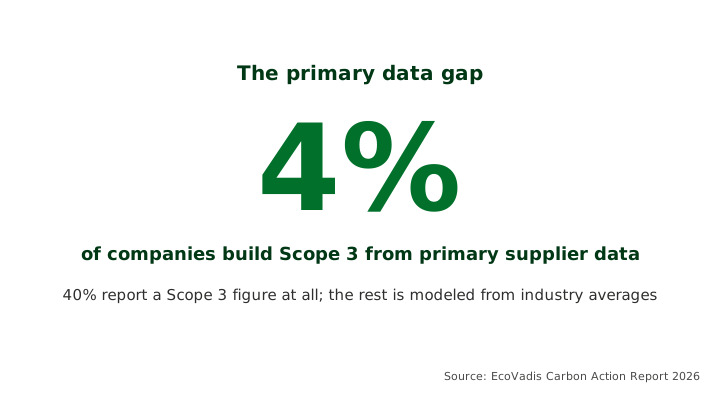
- 40% of companies in the network report a Scope 3 figure, but fewer than 1 in 10 use primary data for these calculations.
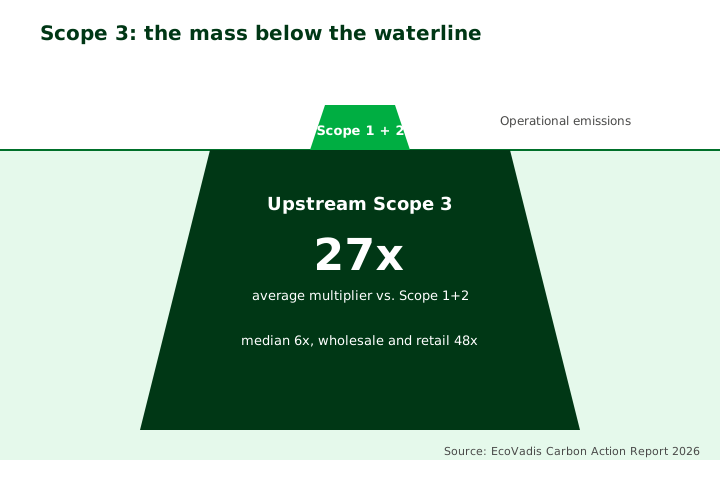
- Among companies with verified data across all three scopes, upstream Scope 3 emissions are 27x operational emissions on average (6x at the median), with wholesale and retail at the high end (48x median).
- Companies actively reporting on Scope 3 cut their own direct emissions by 8.4% over two years, more than twice as fast as those reporting only on Scopes 1&2.
- 62% of S&P 500 companies with Scope 3 targets have seen flat or rising emissions since 2021, evidence that ambition without reliable data does not translate into progress.
Why the Scope 3 measurement gap exists
A company’s Scope 3 footprint is assembled from the operational emissions of the companies it buys from. Where those figures are unavailable, which is most of the time, they are estimated from spend using industry averages. This spend-based approach was a reasonable starting point when supplier-level carbon data barely existed. But an overeliance on it is now a barrier to progress.
Across the EcoVadis network, 40% of companies report a Scope 3 figure, but fewer than one in ten have built it from primary supplier data. The rest estimate their footprint from industry averages that flatten out real differences between suppliers and mask the true scale of upstream emissions. As the report notes, data quantity is not the same as quality. AI tools are helping companies collect more data, but many are processing unverified inputs, which amplifies errors across supplier networks at speed.
For a practical entry point on why supplier-reported figures matter, see our article on why primary emissions data matters.
The 2.7x underestimation gap: what the data shows
The report compares reported Scope 3 multipliers, meaning upstream Scope 3 emissions divided by combined Scope 1&2 emissions, across three data reliability tiers. The pattern is stark:
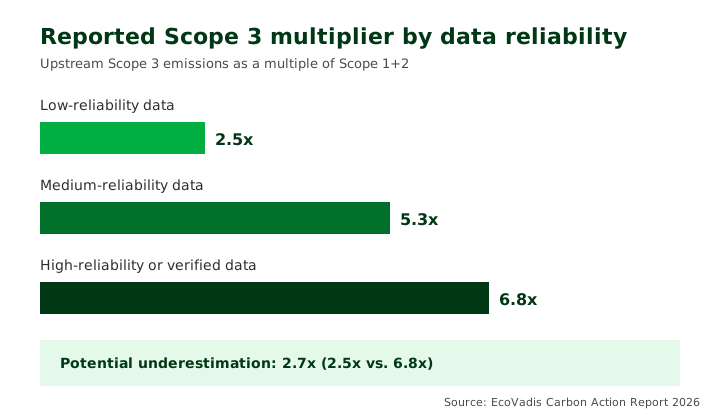
- Companies with low-reliability data report a median multiplier of 2.5x.
- Those with medium-reliability data report 5.3x.
- Those with high-reliability or verified data report 6.8x.
This suggests that companies relying on lower-reliability data may be underestimating their true upstream Scope 3 footprint by as much as 2.7x. In sectors where the multiplier is naturally larger (wholesale and retail has a median of 48x), the absolute size of the gap may be even greater.
“Companies are making capital and sourcing decisions on carbon numbers they can’t actually trust.”
Pierre-François Thaler – Co-Founder and Co-CEO, EcoVadis
Source: 2026 Carbon Action Report
Better data can initially expand a reported footprint as previously uncounted emissions come into view. But as the report makes clear, this isn’t a step backward but rather a step toward complete visibility. From that more accurate baseline, companies can typically shrink their footprint year over year, revealing genuine performance gains that estimates had previously obscured.
The real cost of the Scope 3 measurement gap
The measurement gap directly impacts the decisions that determine the success of a decarbonization program. It presents three key challenges:
- Flawed targets: A science-based target calibrated to a footprint underestimated by up to 2.7x is inherently flawed. A target calibrated to a footprint that may be significantly understated is built on shaky ground, a pattern consistent with the 62% of S&P 500 companies with Scope 3 targets that have seen flat or rising emissions since 2021.
- Misdirected investment: Spend-based estimates cannot distinguish between a high-performing supplier and a laggard in the same industry. Capital and engagement resources flow to averages instead of hotspots. The report shows that emissions are heavily concentrated: the top 10% of emitters in the network account for 95% of reported Scope 1&2 emissions, and the top 1% for well over half. Without primary data, buyers will struggle to identify their hotspots.
- Regulatory and commercial exposure: Starting in 2027, the EU’s CBAM will require companies to purchase certificates for embedded carbon in imports, priced off the EU ETS carbon price (roughly $92 per tCO2e as of July 2026). MSCI and S&P frameworks tie Scope 3 performance to ESG ratings and index inclusion. For the regulatory backdrop, see our article on how CSRD is affecting non-EU companies and this practical guide on building credible Scope 3 reporting.
The GHG Protocol reinforces the same point in the report’s foreword: high-quality, decision-useful data is what turns emissions accounting from a reporting exercise into an operating input.
Why primary supplier data closes the Scope 3 measurement gap
Primary data works because it captures what industry averages cannot: the difference between suppliers. Two companies in the same sector can have wildly different carbon intensities depending on energy mix, process efficiency, and Scope 1&2 maturity. Spend-based methods treat them as identical. Primary data treats them accurately.
The report shows how reliable data accelerates improvement. Companies with high-reliability or verified Scope 1&2 data reduced operational emissions 50% faster than those with low- or medium-reliability data over a two-year period. Those with verified data are also roughly 8x more likely to engage their own suppliers on carbon than low-reliability peers (37% versus 4.5%). Better data doesn’t just improve the number, it also changes what companies actually do.
“Data only creates value when it changes what we do. High-quality data is what allows companies to make better decisions, manage risk more effectively, engage the right suppliers, and understand where investments will have the greatest return.”
Angela Hultberg – Global Head of Sustainability, Kearney
Source: 2026 Carbon Action Report
The EcoVadis Carbon Estimator gives suppliers a way to get from no data to a defensible initial baseline, the first step toward getting out of the low-reliability tier.
How leading buyers are closing the gap
The report profiles buyers who have already moved beyond estimate-based Scope 3 accounting. Their playbooks share three traits:
They embed accountability in procurement. At Hitachi Rail, the Head of Supplier Sustainability sits inside procurement so decarbonization targets flow from the board into buying decisions. BD built its supplier sustainability team into procurement with CPO-level escalation when engagement stalls. Atos runs bi-weekly sessions between procurement and sustainability to align on individual supplier emissions figures.
They set formal, granular targets. Colt Technology Services embeds a sustainability schedule into supplier contracts, requiring high-emitting suppliers to commit to science-based targets and share data. Volvo Cars sets carbon targets at the start of every vehicle program alongside cost, quality, and technical requirements.
They tailor engagement to supplier maturity. Accor uses a Measure, Reduce, Promote pathway, starting with a maturity assessment before collecting emissions data. BD uses a five-level maturity ladder and co-creates “glide paths” with less mature partners rather than demanding polished data upfront.
“Assessing maturity is the basis for the next step. The idea is to push suppliers forward until they are sufficiently advanced to actually decarbonize.”
Laurent Guiouiller – Sustainable Procurement Director, Accor
Source: 2026 Carbon Action Report
This kind of segmented approach is a hallmark of a mature program. For the wider strategic framing, see our 2026 Sustainable Procurement Barometer and our article on Scope 3 reporting readiness among US and Canadian companies.
The network effect: why targeted engagement scales fast
The gap is easier to close than it looks because the underlying emissions are heavily concentrated. The top 10% of emitters in the EcoVadis network are connected to 72 buyers on average, more than double the average for the remaining 90%. This means that improving the data reliability of one high-emitting supplier can simultaneously strengthen the carbon intelligence of dozens of buyers.
EcoVadis Sector Initiatives help amplify this effect. The Hospitality Alliance for Responsible Procurement, which unites Accor and seven partners around a shared carbon maturity framework, means one supplier response can fulfill eight separate buyer requests. Companies with verified Scope 1&2 data already have three times as many buyer connections as those with low-reliability data, which suggests that verified data is becoming a commercial signal.
The takeaway for procurement leaders is that the bottleneck does not need to be solved across the entire supply chain at once. Focused engagement of high-impact suppliers, ideally through a value chain Scope 3 reporting solution, can quickly enhance network-wide visibility.
Close the Scope 3 measurement gap: where to start
Companies with access to reliable carbon data are moving beyond reporting toward real, measurable reductions. The gap is widening, but three moves can help you start closing it:
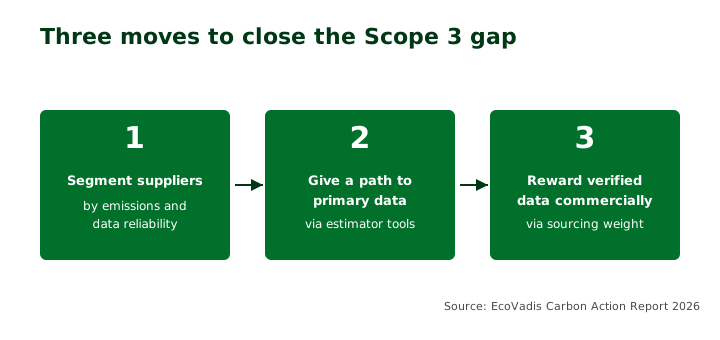
- Segment suppliers by emissions concentration and data reliability: Focus initial engagement on the small, high-impact group of suppliers responsible for most of your Scope 3 footprint.
- Give suppliers a low-friction path to primary data: Estimator tools and standardized reliability frameworks lower the barrier from “no data” to “usable data.”
- Reward verified data commercially: Preferred supplier status, sourcing weight, and public recognition all accelerate uptake far more than compliance pressure alone.
The EcoVadis Carbon Action Manager is built to support each of these moves, giving buyers reliability-graded supplier data and suppliers a structured path up the maturity ladder.
Download the 2026 Carbon Action Report for the complete dataset, sector benchmarks, and case studies from leading buyers building supplier engagement programs that actually deliver on their science-based targets.
FAQs
What is the Scope 3 measurement gap?
The Scope 3 measurement gap is the difference between a company’s reported upstream Scope 3 footprint when built from spend-based estimates versus primary supplier data. The 2026 Carbon Action Report finds that companies with low-reliability data report a median Scope 3 multiplier of 2.5x their operational emissions, while those with high-reliability or verified data report a multiplier of 6.8x. This suggests a potential 2.7x underestimation of supply chain emissions.
Why do spend-based Scope 3 estimates underestimate emissions?
Spend-based methods multiply procurement spend by industry-average emissions factors. They cannot distinguish between a high-performing supplier and a laggard in the same sector, and they often understate emissions in carbon-intensive categories. The result is a footprint calibrated to averages rather than reality. Primary supplier data replaces those averages with actual operational emissions, often revealing a materially larger upstream footprint.
How much of a company’s carbon footprint typically lies upstream in the supply chain?
According to SBTi’s foreword in the 2026 Carbon Action Report, Scope 3 typically accounts for 70 to 90% of a company’s total emissions. In the EcoVadis network, the average upstream Scope 3 multiplier is 27x operational emissions (median 6x), with wholesale and retail sectors reaching a median of 48x. Transportation is at the low end with an average of 2x.
Will my footprint expand if I start collecting primary supplier data?
Yes, many companies will see an initial expansion. The report notes that better supplier data often expands a reported footprint as previously uncounted emissions come into view. But from that more accurate baseline, footprints typically shrink year over year as reductions become genuinely measurable. The initial expansion is a sign of improved visibility, not worse performance.
How do I start closing the Scope 3 measurement gap?
Begin by identifying your highest-impact suppliers, since emissions concentration is extreme (the top 10% of network emitters account for 95% of reported Scope 1&2 emissions). Give those suppliers a structured path to primary data through estimator tools and reliability frameworks, and pair formal contract requirements with high-touch engagement and commercial incentives for verified data.