
 ChatGPT
  Gemini
  Perplexity
  Claude
  Grok
Grok 

Gain insights from 30+ sustainability leaders, including superstars like Paul Polman, former CEO of Unilever, and Helena Helmersson, former CEO of H&M Group. Learn how to build a sustained advantage through responsible business practices.
20th April 2026
Supply Chain Sustainability in 2026: What the Data Is Telling Us
Read summarized version with:
About 90% of a company’s carbon footprint sits outside its own walls, across the suppliers and logistics partners that make up its extended supply chain. Regulations like the EU CSRD and Germany’s Supply Chain Act have made that exposure a legal liability.
Yet only 10% of companies can accurately measure their Scope 3 emissions, not because targets are missing, but because the data infrastructure to back them up isn’t in place.
In this article, we will break down what the numbers are telling us about supply chain sustainability and what it means for your business.
Key Takeaways
- 81% of procurement leaders say ESG matters, yet 85% still can’t act on it.
- LkSG, CSRD, and EUDR are already in force, but the regulatory bar is still rising. Building only for current compliance is not enough.
- Most Scope 3 disclosures today rely on layered estimates, and regulators are questioning their reliability.
- AI adoption in supply chains is increasing, but its impact is limited by the quality of supplier ESG data.
What Is Supply Chain Sustainability?
Supply chain sustainability is the practice of managing the environmental, social, and ethical impacts of your company’s supply chain (from raw materials to the end customer).
For example, a global manufacturer sources components from dozens of suppliers across multiple countries. Without visibility into how those suppliers operate, that manufacturer is unknowingly carrying risk at every tier. Supply chain sustainability principles enable businesses to systematically identify, measure and reduce those risks.
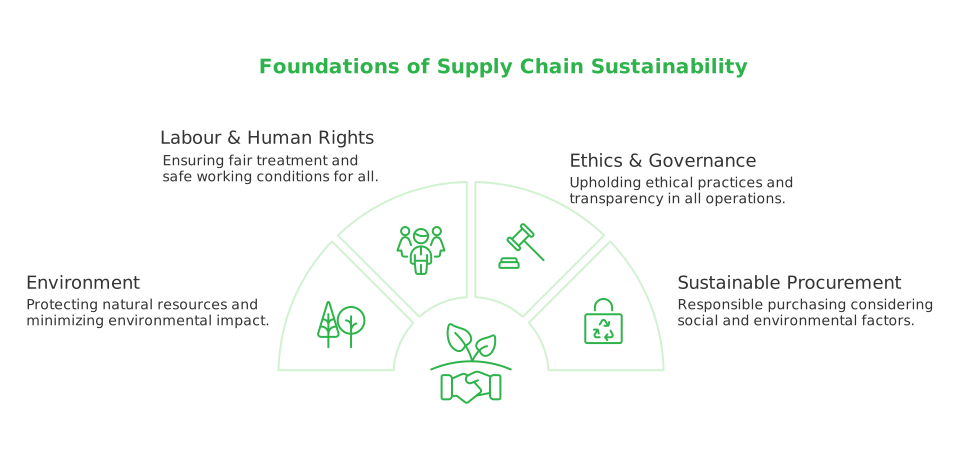
Supply chain sustainability strategy typically covers four core components:
- Environmental impact: Carbon emissions, resource use, waste and biodiversity across supplier operations.
- Labour & human rights: Fair wages, safe working conditions and zero tolerance for forced or child labour.
- Ethics & governance: Anti-corruption, transparent business practices and responsible sourcing policies.
- Sustainable procurement: Actively selecting and developing suppliers based on sustainability performance.
The State of Supply Chain Sustainability in 2026
The pressure on supply chains to perform sustainably has never been higher. But the gap between intent and execution is still significant. Here’s what the data shows:
Leaders Think They’re Ready. The Data Says Otherwise.
At Sustain 2026, survey findings revealed that 81% of procurement leaders say ESG factors matter in purchasing decisions, yet 85% say finding sustainable suppliers is difficult. Only 17% of suppliers feel strongly motivated by their customers to take action on sustainability.
This exposes what could be called the confidence trap. Organisations score themselves highly on readiness, while their actual outcomes tell a different story. Many have policies and targets in place, but still rely on self-reported supplier data, have limited visibility beyond tier 1 and lack systems to track improvements.
Regulation Is No Longer on the Horizon (It’s Here)
Standards such as LkSG and CS3D, along with growing pressure for Scope 3 reporting, now require companies to monitor, audit and verify the origin and impact of their products across the value chain. The EU’s EUDR, ESPR and CBAM are also raising the bar on transparency.
As a result, companies must provide clearer product-level data, improve emissions reporting and strengthen their due diligence processes.
Companies that design their supply chain sustainability programs solely around current legal requirements are already behind. The regulations being implemented today were drafted three to five years ago.
The next wave (covering biodiversity, water use, and nature-related disclosures) is closer than most teams expect.
Over 730 organizations are voluntarily aligning with TNFD recommendations; the ISSB is targeting an exposure draft on nature disclosures by October 2026, with mandatory requirements expected to follow. Among the sustainable supply chain companies now aligned with TNFD recommendations are Sanofi, Burberry and Pirelli.
AI Is a Force Multiplier
After rapid AI adoption in 2025, companies are now entering the optimisation era. Agentic AI is becoming a powerful tool for procurement teams. It can scan supplier data, flag risks, monitor compliance and autonomously recommend new sourcing options.
The shift is happening from experimentation to strategic deployment, using AI where it genuinely adds value in sustainability, such as automating ESG reporting, improving energy efficiency and enhancing supply chain transparency.
The AI narrative in sustainability tends toward optimism, and understandably so. But there is a critical caveat that is rarely foregrounded. As AI becomes embedded in procurement workflows, credible and verified sustainability data becomes essential infrastructure.
Feed an AI system bad supplier data, and it will make faster, more confident bad decisions. The companies that will gain the most from AI-assisted sustainability are the ones that have invested in data quality first.
AI in procurement is only as trustworthy as the supplier data it runs on, and right now, most of that data has never been independently verified.
Scope 3 Is the Biggest Blind Spot
Scope 3 emissions became the primary decarbonisation challenge in 2026, with pressure increasing on companies to engage suppliers, align emissions methodologies and set credible targets. Some industries are particularly under the radar, such as fashion, food and electronics.
Scope 3 supply chain emissions are, on average, 26 times greater than a company’s direct operational emissions, yet only 38% of businesses are currently measuring their Scope 3 footprint, according to an IBM-commissioned survey.
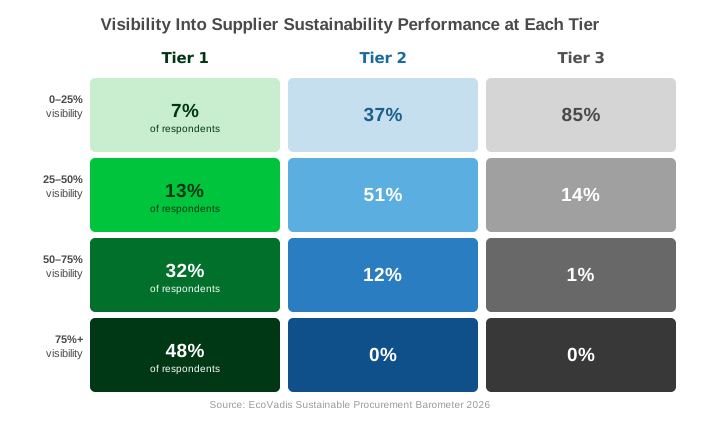
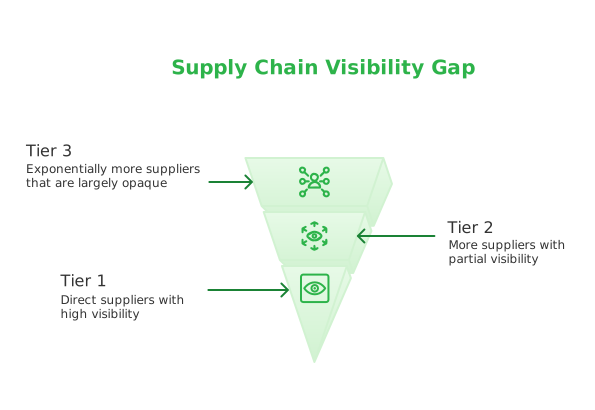
Yet visibility into deeper supply chain tiers remains weak. 95% of companies have visibility into their Tier 1 suppliers, but that visibility extends to Tier 2 or beyond for only 42%. Tier 3 remains largely opaque for most organizations.
Most Scope 3 disclosures today are built on approximations (rather than measured data). Spend-based calculation methods, which many companies rely on due to a lack of primary data, introduce significant variance. Two companies in the same industry with identical supply chains could report materially different Scope 3 numbers simply due to methodology choices.
In 2025, sustainability reports grew longer but less useful. Companies disclosed more metrics than ever, yet few of them connected to business outcomes that executives or investors could act on.
The companies building supply chain sustainability programs today are writing the compliance playbook everyone else will be scrambling to follow in three years.
Why Supply Chain Sustainability Ratings Matter
Sustainability claims without verification are just claims. Third-party sustainability ratings have become credible signals that companies can present to procurement teams, investors and regulators
A verified sustainability rating is now the entry ticket to enterprise procurement conversations and the price of that ticket is rising every year.
Ratings Are Becoming a Prerequisite for Doing Business
According to a 2025 survey by IntegrityNext, 70% of global companies have already embedded sustainability into their procurement process, and more than 80% view it as a strategic priority.
The shift from “nice to have” to “prerequisite” happened faster than most suppliers anticipated. The problem is that many small and mid-market companies are still treating ratings as a compliance exercise rather than a commercial strategy.
Suppliers without a verified sustainability rating are increasingly being filtered out before an RFP is even issued. Procurement teams at large multinationals now run their supplier base through third-party rating platforms like CDP before shortlisting vendors. If a supplier hasn’t been assessed, they simply don’t appear in the results.
A strong rating also helps to actively win business. One company attributed over €37 million in revenue to its gold-level sustainability rating, directly linked to clients who factor supplier sustainability performance into their purchasing decisions.
Ratings Translate ESG Into the Language of Finance
One of the persistent challenges in supply chain sustainability has been making the business case internally, particularly to CFOs and boards who need numbers to make decisions. Impact measurement turns sustainability from a cost centre into a source of strategic advantage.
The companies that can connect sustainability ratings to financial outcomes (lower risk premiums, fewer supply disruptions, better financing terms and higher win rates) are the ones gaining boardroom buy-in. Ratings provide the baseline data needed to make that connection.
Without a verified, consistent score over time, there is no baseline. Without a baseline, there is no ROI story. And without an ROI story, sustainability budgets remain vulnerable whenever financial pressure rises.
Overcoming Sustainable Supply Chain Issues
Sustainable supply chain management is where most companies still struggle, and the reasons are more structural than strategic.
Challenge 1: No Visibility Beyond Tier 1
Most companies have reasonable visibility into their direct (Tier 1) suppliers. Beyond that, it drops off sharply. Companies must achieve full visibility across all supply chain tiers to address risks and fulfill regulatory obligations.
How to overcome it: Start by mapping your most material spend categories and identifying which carry the highest risk (by geography, commodity type, or industry).
Engage high-risk suppliers directly, request primary emissions data instead of relying on industry averages, and use supply chain sustainability software that pulls from multiple data sources to surface issues beyond Tier 1.
Challenge 2: Supplier Data Is Inconsistent, Incomplete, or Unverified
Even when suppliers provide sustainability data, its quality is often unreliable. Self-reported questionnaires vary wildly in methodology and scope. Companies are under pressure to report more and prove more, with verifiable, auditable data, yet the gap between what is disclosed and what is independently verified remains wide.
How to overcome it: Replace or supplement self-reported questionnaires with verified, standardised third-party assessments for your strategic and high-risk suppliers.
EcoVadis provides analyst-verified supplier assessments backed by a methodology aligned to international frameworks, including GRI, UN Global Compact, and ISO standards.
Challenge 3: Proving ROI to the CFO
Sustainability budgets face internal scrutiny like any other spend, and justifying them without a clear line to financial outcomes is increasingly difficult. Chief Sustainability Officers are under pressure to translate ESG performance into business terms, specifically, avoided costs, risk reduction and return on investment.
How to overcome it: Build a measurement framework before you build your program. Define upfront what success looks like, whether that is fewer supply disruptions, lower compliance risk or better financing terms and build your tracking around those outcomes from day one.
How EcoVadis Verifies Supplier Sustainability
The gap between a company’s sustainability commitments and its ability to prove them is, at its core, a data infrastructure problem. Boards are asking harder questions. Regulators are demanding documented due diligence. Buyers are requiring verified supplier performance, rather than self-declarations.
With over 150,000 companies rated across 205 industries and 180 countries, EcoVadis gives procurement, ESG and compliance leaders verified supplier intelligence. Use it to identify risk, prioritize supplier engagement and make sourcing decisions you can defend to regulators and boards.
Request a Demo. See where your supplier network stands against sustainability risk before your regulators or buyers do it for you.
FAQs
Does supply chain sustainability only matter for large corporations?
No. SMEs that are not subject to mandatory reporting requirements may still be indirectly affected through their customer and supplier relationships, as larger in-scope companies will request emissions and sustainability data from them to meet their own disclosure obligations.
How often should we reassess our suppliers on sustainability?
Annual reassessment is the baseline, but static ratings miss dynamic risk. High-risk suppliers (those in geographies or sectors with elevated labour, environmental, or governance risk) warrant more frequent monitoring.
How does supply chain sustainability differ by industry?
Supply chain sustainability risks vary based on the materials a company sources, the geographies it operates in and the nature of its production processes.
- Manufacturing focuses on labour conditions, environmental impacts and conflict minerals
- Fashion and textiles on worker rights, chemical safety and social impacts
- Technology on conflict minerals, electronic waste and labour practices
- Food and agriculture on deforestation, water usage and farmworker rights
- Automotive on supply chain complexity and emissions