
 ChatGPT
 Gemini
 Perplexity
 Claude
 Grok

Gain insights from 30+ sustainability leaders, including superstars like Paul Polman, former CEO of Unilever, and Helena Helmersson, former CEO of H&M Group. Learn how to build a sustained advantage through responsible business practices.
20th October 2026
Navigating the SBTi Corporate Net-Zero Standard V2: Insights from the EcoVadis Community
Read summarized version with:
Decarbonization is no longer a corporate social responsibility initiative tucked away in an annual sustainability report; it’s becoming a core part of business strategy. Driven by evolving regulatory frameworks, growing financial reporting requirements, and mounting value chain expectations, organizations are looking for ways to transition from simply setting high-level climate commitments to proving real-world emissions reductions.
To explore these changes, EcoVadis hosted an expert webinar featuring Diana Farmer, Head of North America at the Science Based Targets initiative (SBTi), alongside Lucía Melendo (ESG Director) and Cecile Marette (Procurement Director) from Colt Technology Services.
Below, we break down some key updates to the SBTi Corporate Net-Zero Standard V2, examine how organizations like Colt are operationalizing Scope 3 decarbonization, and describe data-driven methodologies for value chain assessments.
Overview of Key Framework Updates
- The updated SBTi Corporate Net-Zero Standard V2 shifts focus toward implementation, including enhanced transparency about reporting progress and continuous improvement over time.
- The Standard introduces a differentiated approach based on company classification (Category A and Category B), considering factors such as organizational size and geography.
- The new Standard introduces a focused and flexible framework to support companies’ transitions to net-zero scope 3 emissions, prioritizing significant sources and reflecting companies’ varying levels of influence across value chains. Improving scope 3 data quality will be critical, with solutions like the EcoVadis Carbon Action Module supporting more granular emissions tracking.
Key Updates in the SBTi Corporate Net-Zero Standard V2
The Science Based Targets initiative continues to serve as a global benchmark for corporate climate target setting, with over 13,900 companies validated worldwide. As Diana Farmer (SBTi) explained during the session, the release of the updated SBTi Corporate Net-Zero Standard V2 represents nearly three years of multi-stakeholder research, pilot testing and two public consultations designed to align target-setting criteria with operational structures.
“The Standard sets out actionable pathways to decarbonize, and it was developed to better reflect the operational realities across sectors, geographies and company sizes. The Standard also marks a decisive shift from target setting to implementation.” — Diana Farmer, Head of North America, SBTi
The updated Standard introduces structural and technical adjustments that aim to increase transparency for companies navigating complex value chains:
- Focus on implementation: The Standard recognizes that setting targets is the start – not the end – of the net-zero journey, with a stronger focus on implementation, including enhanced transparency about reporting progress and continuous improvement over time, reinforcing action and encouraging companies to raise ambition as they advance through their net-zero journey.
- Category A and Category B classifications: To accommodate differences in organizational capacity, the Standard introduces a differentiated approach based on company size and geography.
- Category A: Large companies in high-income countries
- Category B: Small companies in lower-income countries.
Certain requirements for Category A companies are optional for Category B – for example, disclosure of transition plans, assurance of target base year data, and scope 3 target setting.
- Updated target methodologies:
- Scope 1: Provides more practical target-setting methods and allows companies to select from three approaches for setting scope 1 targets to: reduce emissions on a linear trajectory to net-zero; reduce operational emissions intensity from applicable sector activities; and set asset transition targets based on a plan to decarbonize assets in line with science-based milestones and/or a carbon budget.
- Scope 2: Gives companies two options for addressing scope 2 emissions to support the transition to a low-carbon electricity system: emissions reduction targets and low-carbon electricity alignment targets, encouraging businesses to increase their percentage of clean energy procurement on a linear trajectory.
- Scope 3: Expands targets beyond absolute reductions to include supplier or customer alignment targets, and category-specific targets tailored to upstream and downstream activities.
- Transition planning requirements: All companies must develop and maintain a transition plan outlining target implementation plans, including key dependencies and assumptions. Category A organizations are required to disclose transition plans.
- Implementation hierarchy: Guides how companies prioritize different actions to implement targets and support the scale-up of net-zero-aligned practices or technologies within their operations, value chains, activity pools, or sectors. It defines three levels of action:
- Activity level: Actions taken as close as possible to the emissions source that directly reduce emissions in companies’ physical GHG inventories.
- Activity pool level: Interventions within shared systems that companies source from or feed into (e.g., logistics sheds or regional energy grids).
- Sector level: Actions that target emissions sources within a relevant market or geography, but fall outside the more narrowly defined activity pool (e.g., environmental attribute certificates).
Enabling actions to address structural constraints to enable future decarbonization are recommended; however, these do not contribute toward target progress.
Scope 3 Data Assessment and Value Chains
While operational targets (Scope 1 and Scope 2) cover direct activities and are a critical place for businesses to start decarbonizing, the majority of corporate emissions reside in upstream and downstream value chains.
Research from EcoVadis and BCG indicates that supply chain emissions are 21 times higher than direct operational emissions on average. For sectors like retail, food and telecommunications, this ratio can be even higher.
This creates what Julia Guerrero Corellano (Scope 3 Specialist at EcoVadis) describes as a state of mutual dependency:
- Enterprise buyers rely on primary supplier data to complete value chain accounting. They require suppliers to engage in order to hit their own targets.
- Suppliers need long-term support from buyers to invest in sustainable transformation. This support includes technical upskilling and clear commercial incentives.
When buyers and suppliers collaborate effectively, compliance becomes a shared competitive advantage. In fact, EcoVadis data reveals that engaged suppliers are 9 times more likely to be on track to achieve their climate goals.
Case Study: Scope 3 Management at Colt Technology Services
Colt Technology Services, a global B2B digital infrastructure provider, also shared its experience with setting SBTs during the webinar. Colt faces a dual responsibility: meeting increasing demand for digital infrastructure while also reducing carbon emissions. They explain how integrating target-setting frameworks into operational tracking has been key to the success of their current sustainability program.
Setting Near-term Net-zero Targets
Colt has laid out the following targets:
- Scope 1 & 2: 47% absolute emissions reduction by 2030 (2019 baseline).
- Scope 3: 28% absolute emissions reduction by 2030.
- Net-Zero Target: 90% absolute emissions reduction across all scopes by 2045.
Through fleet electrification, infrastructure decommissioning and renewable electricity procurement, Colt has reported an 87% reduction in Scope 1 emissions. As direct operational emissions decreased, Scope 3 came to represent nearly 99% of Colt’s total footprint, highlighting the necessity of supply chain engagement. As Lucía Melendo pointed out:
“Addressing Scope 3 emissions requires continuous engagement with suppliers and partners and getting the highest quality data we can from those vendors.” — Lucía Melendo, ESG Director, Colt Technology Services
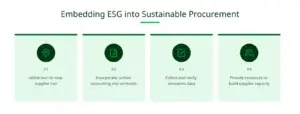
Embedding ESG Into Sustainable Procurement
To address the 99% of emissions residing in purchased goods, capital equipment and leased assets, Colt embedded sustainability directly into its core procurement function.
“We start with a very simple principle: every supplier has an environmental impact, and together we share the responsibility for understanding and reducing that impact… ESG criteria are included in our evaluation process, typically representing between 10% to 20% of supplier scoring.” — Cecile Marette, Procurement Director, Colt Technology Services
Their framework uses four key processes:
- Risk mapping: Utilizing EcoVadis risk-mapping solutions to segment suppliers by procurement spend, category emissions, and risk profiles.
- Contractual frameworks: Incorporating schedules requiring key vendors to establish carbon accounting procedures.
- Verification: Utilizing the EcoVadis Carbon Action Manager and other frameworks such as CDP alongside direct engagement with vendors to collect primary supplier data and monitor ratings.
- Continuous capacity building: Providing resources and check-ins to assist suppliers in progressing from measurement to emissions tracking.
Colt set a goal for 70% of its supply chain emissions to have SBTs set or committed to by 2030. Between 2024 and 2026, Colt expanded its supply chain emissions coverage under science-based targets or sustainability commitments from 57% to nearly 64%.
EcoVadis Solutions for Value Chain Carbon Management
EcoVadis provides software and data solutions to support corporate transparency and carbon reporting:
- Carbon Action Manager: Enables suppliers across varying maturity levels to calculate, report, and disclose carbon footprints and reduction metrics using primary data.
- EcoVadis IQ Plus: Delivers real-time ESG risk intelligence to guide your supply chain strategy and support regulatory compliance
- The EcoVadis Community: Connects organizations to share standardized methodologies and access peer benchmarking data.
Want to Find out More?
Access the recorded sessions from SBTi and Colt Technology Services through the EcoVadis Community platform.
The EcoVadis Community is where sustainability leaders connect to exchange practical insights, gain expert tips, and get their questions on sustainability and regulation topics answered. It’s open and free for all. Sign up today.
FAQs
What is the main difference between SBTi Net-Zero Standard Version 1 and Version 2?
The SBTi Corporate Net-Zero Standard V2 builds upon Version 1, which has become recognized as the ‘gold standard’. Version 2 shifts focus from target setting to implementation. It moves beyond a one-size-fits-all model to reflect the realities of how businesses operate and the levers they have the most influence over, and introduces formal company categorizations (Category A vs. Category B). It encourages companies to prioritize direct emissions reductions across operations and value chains, complementing this with interventions that transform the systems in which they operate where direct decarbonization is not yet feasible. The Standard expands Scope 3 target-setting options, provides an explicit implementation hierarchy for addressing value chain emissions, and introduces a voluntary recognition mechanism to encourage companies to take action to address the impact of their ongoing emissions in the short-term, as well as a longer-term requirement for larger companies to take progressive responsibility for these emissions.
When does the SBTi Corporate Net-Zero Standard V2 take effect?
Validation against the SBTi Corporate Net-Zero Standard V2 opens in early 2027. A transition window allows organizations to select between Version 1.3 and Version 2 throughout 2027. Compliance with Version 2 becomes mandatory for new submissions and target renewals starting February 1, 2028.
What is the difference between Category A and Category B companies in SBTi V2?
The SBTi Corporate Net-Zero Standard V2 introduces a differentiated approach based on company size and geography:
- Category A: Applies to larger enterprise organizations in high-income countries.
- Category B: Designed for mid-sized companies and SMEs in lower-income countries.
Certain requirements for Category A companies are optional for Category B. For example, disclosure of transition plans, assurance of target base year data, and scope 3 target setting. While some requirements are optional for Category B companies, the SBTi strongly encourages these companies to go beyond the minimum requirements.
Why are Scope 3 emissions so critical to achieving corporate net zero?
For most businesses, upstream and downstream supply chain emissions account for over 80–90% of total carbon impact (and up to 99% in sectors like telecommunications). Because direct operations (Scope 1 and 2) represent a small fraction of overall carbon footprints, reaching true net-zero is impossible without actively engaging suppliers to measure and reduce Scope 3 emissions.
How can buyers support suppliers who are new to setting science-based targets?
Enterprise buyers can accelerate supplier climate maturity by streamlining data requests, sharing internal decarbonization best practices, embedding ESG scoring into procurement evaluations, and directing suppliers toward practical tools like the EcoVadis Carbon Action Manager and the SBTi Academy.

Eloise Moench is a Communications Expert at EcoVadis. Backed by a decade of experience driving communications for international energy transition and ecological restoration organizations, she brings deep insight into clean energy policy, human rights, and biodiversity. She holds a Masters Degree in Climate Ethics from the University of Amsterdam, and specializes in breaking complex environmental frameworks down into clear, actionable insights.