
 ChatGPT
  Gemini
  Perplexity
  Claude
  Grok
Grok 

Gain insights from 30+ sustainability leaders, including superstars like Paul Polman, former CEO of Unilever, and Helena Helmersson, former CEO of H&M Group. Learn how to build a sustained advantage through responsible business practices.
21st July 2026
Building a Resilient Biodiversity Strategy: 4 Actions Your Team Can Implement Now
Read summarized version with:
Did you know that 55% of global GDP is moderately or highly reliant on nature? Because global supply chains rely heavily on natural resources, environmental decline poses a material economic risk for many businesses. Yet, despite these financial implications, only 1% of listed companies publicly disclose their biodiversity impacts according to the Intergovernmental Science-Policy Platform on Biodiversity and Ecosystem Services (IPBES).
On Earth Day, April 22, 2026, the EcoVadis Community hosted a dedicated session exploring how businesses can bridge this gap and implement a resilient biodiversity strategy. Guest speakers Guillaume Wahl from the World Wildlife Fund (WWF) and Filip Orlinski from Caldic shared practical advice on how organizations, both large and small, can integrate climate and nature efforts rather than treating them as separate issues.
By turning sustainability goals into a core biodiversity strategy and action plan, companies can secure long-term resilience, motivate internal teams and successfully meet evolving client expectations.
Key Takeaways:
- A successful corporate biodiversity strategy does not require building systems from scratch. Organizations can leverage existing climate governance to manage nature-related risks.
- Practical biodiversity risk assessment tools like the WWF Biodiversity Risk Filter and ENCORE provide the visibility needed to move from awareness to measurable corporate action.
- Small, localized proof-of-concept programs build the internal business case and secure executive buy-in for broader biodiversity conservation strategies.
The Business Case for a Corporate Nature-Positive Strategy
Historically, corporate sustainability efforts have centered on carbon emissions reductions. Today, the conversation has begun to shift as organizations increasingly recognize that climate health and natural ecosystems are deeply interconnected. Because of this, advancing a corporate nature-positive strategy has become a central element of long-term risk management.
Most supply chains rely on commodities and agricultural products like timber, mineral resources or clean water, all of which depend on the health and stability of surrounding ecosystems. When natural assets degrade, organizations can experience supply disruptions, price volatility and regulatory penalties. To navigate this complexity, businesses are utilizing biodiversity risk assessment tools to gather data on environmental dependencies. This visibility helps organizations implement effective biodiversity conservation strategies that support operational resilience.
Implementing a robust biodiversity strategy allows companies to get ahead of shifting regulations and changing market dynamics. Governments worldwide are introducing stricter reporting requirements for corporate environmental impacts. At the same time, institutional investors are evaluating nature-related risks when allocating capital. By developing a comprehensive biodiversity strategy and action plan, organizations can gather reliable data, maintain investor confidence and build truly resilient supply chains.
4 Key Learnings from the EcoVadis Community Session
During the live webinar hosted in the EcoVadis Community, sustainability expert Guillaume Wahl broke down several actions that any team wanting to address biodiversity challenges can begin implementing today.
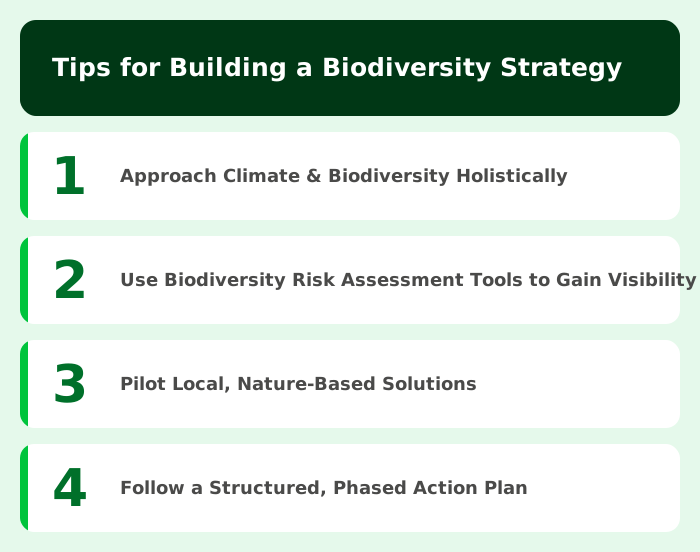
1. Tackle Climate and Biodiversity Holistically
Building an effective biodiversity strategy and action plan does not require your team to reinvent your existing sustainability frameworks. Organizations with established climate governance and ESG goals already possess the operational foundations needed to manage nature-related metrics.
The procurement processes, data collection pipelines, and executive reporting structures used for carbon accounting can be adapted to track biodiversity impacts. Translating existing internal expertise into integrated action saves time and resources while helping to build a more cohesive environmental strategy.
2. Gain Visibility with Biodiversity Risk Assessment Tools
Advancing environmental efforts can seem complex if organizations lack clear data about their reliance on natural ecosystems. Yet established digital frameworks can already provide the structure needed to accurately map supply chain dependencies and environmental impact.
Tools like the WWF Biodiversity Risk Filter, ENCORE Risks and Exposure Tool or the Materiality Screening Tool provide the clarity needed to begin taking measurable action. These resources help sustainability managers pinpoint exactly where their supply chains are most vulnerable to ecological decline, allowing for data-driven prioritization.
3. Pilot Nature-Based Solutions
Large-scale environmental overhauls can feel overwhelming and often face internal resistance due to perceived costs. To overcome this hurdle, many companies opt for focusing first on piloting localized, nature-based solutions.
Launching localized proof-of-concept programs in high-priority or high-risk locations provides practical evidence and positive data points of what works. These smaller pilots can demonstrate the concrete value of biodiversity conservation strategies to internal stakeholders, helping sustainability teams build the internal support and executive buy-in needed to secure a budget for larger initiatives.
4. Follow a Clear, Phased Action Plan
Once an organization identifies its environmental dependencies and risks, advancing progress requires a structured approach. In the session, Guillaume highlighted an established five-step mitigation hierarchy designed to guide corporate action:
- Avoid: Prevent environmental impacts by relocating project locations or sourcing materials away from ecologically sensitive areas.
- Reduce: Minimize the scale of unavoidable impacts through smarter operational choices and cleaner technologies.
- Restore: Direct efforts toward repairing degraded ecosystems within your operational footprint.
- Regenerate: Support ecosystems in recovering their natural functionality and improving local biodiversity over time.
- Transform: Drive systemic change by contributing to industry-wide shifts, policy improvements and collaborative conservation models.
Join the EcoVadis Community
The EcoVadis Community is the premier space where sustainability leaders connect to exchange the practical insights needed to navigate corporate compliance and build resilient sustainability strategies.
As a member, you will gain direct access to a full program of collaborative forums, expert-led content series and peer-to-peer networking events. These are intentionally designed to help you benefit from the shared knowledge of leading organizations like WWF, EFRAG and the Living Wage Foundation.
Don’t navigate the evolving sustainability landscape alone. Turn shared corporate knowledge into measurable improvement for your organization.
Join the EcoVadis Community Today and Connect with Your Peers
FAQs
Q. What is a biodiversity strategy for business?
- A corporate biodiversity strategy is a structured framework that an organization uses to identify, measure, manage and mitigate its impacts and dependencies on natural ecosystems. This strategy helps businesses minimize ecological harm across their supply chains while identifying opportunities to invest in nature-positive practices that secure long-term operational resilience.
Q. How does biodiversity risk affect global supply chains?
- More than half of global economic output relies moderately or highly on healthy ecosystems. When natural resources degrade, businesses can experience direct supply shortages, increased raw material costs, regulatory fines and operational disruptions. Mapping these dependencies using biodiversity risk assessment tools helps companies protect their supply chains from unpredictable environmental shocks.
Q. What is the difference between a climate strategy and a corporate nature-positive strategy?
- While a climate strategy focuses primarily on reducing greenhouse gas emissions and managing carbon footprints, a corporate nature-positive strategy expands this focus to include the broader health of ecosystems. This includes managing water risk, preventing deforestation, minimizing soil degradation and actively conserving plant and animal species variety.

Eloise Moench is a Communications Expert at EcoVadis. Backed by a decade of experience driving communications for international energy transition and ecological restoration organizations, she brings deep insight into clean energy policy, human rights, and biodiversity. She holds a Masters Degree in Climate Ethics from the University of Amsterdam, and specializes in breaking complex environmental frameworks down into clear, actionable insights.