
Supplier Carbon Data Reliability: The EcoVadis DRL Guide
Read summarized version with:
 ChatGPT
 Gemini
 Perplexity
 Claude
 Grok
The 2026 Carbon Action Report shows why not all supplier emissions data is equal, and how EcoVadis’ four-level Data Reliability framework gives buyers a defensible basis for Scope 3 accounting.
Supplier emissions data reliability is now what separates a Scope 3 program that drives measurable reductions from one built on shaky assumptions. The 2026 Carbon Action Report, based on data from more than 56,000 companies assessed through the EcoVadis platform, makes the point clearly: companies relying on low-reliability data may be underestimating their upstream Scope 3 footprint by as much as 2.7x. That gap has direct consequences for target setting, capital allocation, and regulatory exposure.
To close it, EcoVadis built a carbon data reliability framework that grades every emissions metric reported through the platform using a three-gate check for evidence, rigor, and plausibility. The output is one of four Data Reliability Levels: low, medium, high, or verified. This article walks through how the framework works and why it matters for both buyers looking to report a more accurate Scope 3 footprint and suppliers looking to make their data commercially useful.
Key takeaways
- Companies with low-reliability data may be underestimating upstream Scope 3 by 2.7x. The median Scope 3 multiplier climbs from 2.5x for low-reliability reporters to 6.8x for those with high-reliability or verified data.
- The EcoVadis Data Reliability Level (DRL) framework grades every reported emissions metric across four levels: low, medium, high, and verified.
- Better data drives faster action. Companies with high-reliability or verified Scope 1&2 data reduce operational emissions 50% faster than lower-reliability peers.
- Verified data is becoming a commercial signal. Companies with verified Scope 1&2 data have roughly three times as many buyer connections as those with low-reliability data.
- Only 12% of companies reporting operational data to the EcoVadis platform currently have third-party verified Scope 1&2 figures, leaving substantial room for supplier data quality to improve.
Why supplier emissions data quality is the Scope 3 bottleneck
A company’s Scope 3 footprint is assembled from the operational emissions of the companies it buys from. Where those figures are unavailable, which is most of the time, they are estimated from spend using industry averages. The 2026 Carbon Action Report finds that across the EcoVadis network, 40% of companies report on Scope 3 but fewer than one in ten build their figures from primary supplier data.
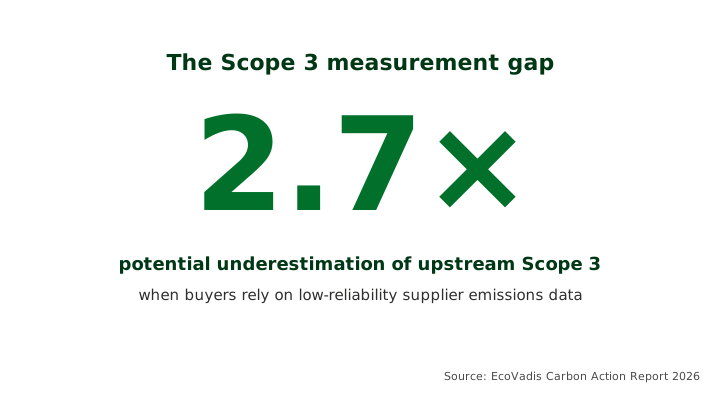
The result is a Scope 3 measurement gap that shapes what companies target, where they invest, and which suppliers they engage. When the input is unreliable, the strategy built on it is unreliable too.
“Ambition and commitments are not the issue: execution is. Companies are investing in Scope 3 programs, yet many still base target setting, procurement, and capital allocation on data that is simply not reliable enough to guide action or measure impact.”
Angela Hultberg – Global Head of Sustainability, Kearney
Source: 2026 Carbon Action Report
AI is amplifying the problem. According to our 2026 Sustainable Procurement Barometer, nearly two-thirds of large multinationals report using AI tools for carbon data validation, but most are processing data that is unverified or inherently flawed. Without a shared basis for grading reliability, errors propagate across supplier networks at scale.
Inside the EcoVadis carbon data reliability framework
The EcoVadis Carbon Data Reliability Levels framework was developed in response to a core challenge in supply chain carbon accounting: not all emissions data is equally reliable, and treating low-reliability data as if it were primary can produce materially inaccurate Scope 3 figures. By assigning a reliability level to every metric reported through the platform, the framework gives buyers a consistent basis for assessing which supplier data can be used for primary accounting and which requires supplementation with estimates. It also gives suppliers a clear path to improve the reliability of their data over time.
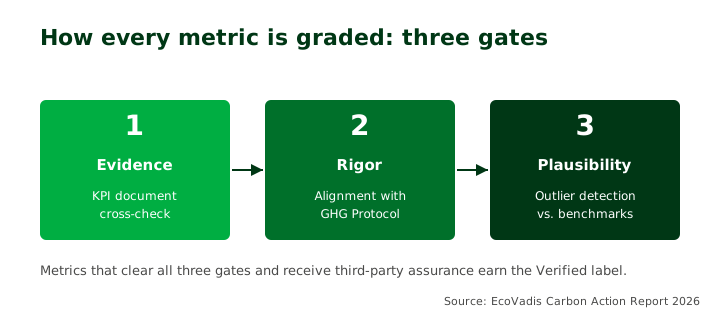
The framework applies a sequential three-gate process to every emissions metric submitted through the Carbon Data Network.
Gate 1: Evidence (KPI document cross-check)
Submitted evidence is verified against supporting documentation such as a CDP submission or sustainability report. If evidence is absent, invalid, or outdated, the metric cannot progress past this gate.
Gate 2: Rigor (best practice check)
Accounting practices are assessed for alignment with recognized standards, including the GHG Protocol. Metrics with only partial methodology alignment can qualify as medium reliability; only those validated against international standards clear this gate for higher levels.
Gate 3: Plausibility (outlier detection)
Figures are compared against industry benchmarks to flag statistical anomalies. A number that fails plausibility, even if the evidence and rigor gates were cleared, drops back down the reliability scale.
Only metrics that clear all three gates and are independently verified by a third-party auditor receive the highest label: verified.
The four supplier emissions data reliability levels
Based on the three-gate process, every reported metric is assigned one of four data reliability levels.
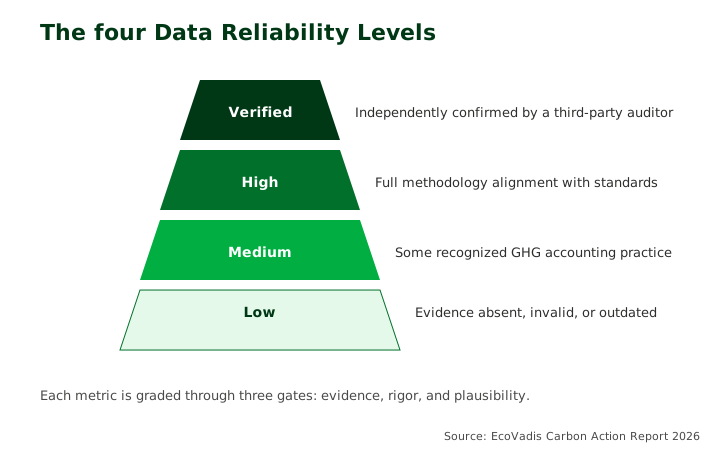
- Low: Evidence is absent, invalid, or outdated; or the figure failed plausibility. Not usable for primary GHG accounting.
- Medium: Some recognized GHG accounting practice is present, but not full methodology alignment.
- High: Methodology is validated against international standards; evidence and plausibility gates are passed.
- Verified: Independently verified by a third-party auditor. The highest data confidence level available for primary carbon accounting.
Across the EcoVadis network, Scope 1&2 data reliability is split as follows: 33% low, 21% medium, 33% high, and 12% verified. Buyers calculating their Scope 3 footprint should expect a significant share of supplier figures to need supplementation with estimates.
What reliable data actually delivers
The report’s central finding is that higher reliability correlates with better outcomes on the metrics that matter most to procurement and sustainability teams.
Companies with high-reliability or verified Scope 1&2 data reduced operational emissions 50% faster than those with low or medium reliability over a two-year period. Among companies with science-based targets, those with verified data stay on track 77% of the time versus 54% for those with less reliable data. And companies with verified Scope 1&2 data are roughly eight times more likely to broadly engage suppliers on carbon than low-reliability peers (37% versus 4.5%).
The commercial signal is just as clear. Companies in the network with verified data have three times as many buyer connections as those at the low-reliability level. Reliable data increasingly helps suppliers attract and build better relationships with buyers.
“Data only creates value when it changes what we do. High-quality data is what allows companies to make better decisions, manage risk more effectively, engage the right suppliers, and understand where investments will have the greatest return.”
Angela Hultberg – Global Head of Sustainability, Kearney
Source: 2026 Carbon Action Report
How the reliability framework changes Scope 3 accounting
The clearest illustration of why supplier emissions data quality matters is the Scope 3 multiplier: how much larger a company’s upstream footprint is than its operational one. The 2026 Carbon Action Report finds that, among companies with third-party verified data across all three scopes, the median multiplier is 6x, with sectors like wholesale and retail sitting at 48x and transportation as low as 2x.
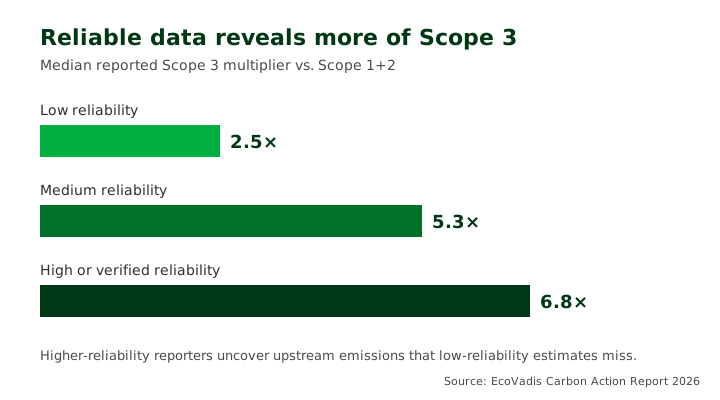
But the multiplier a given company reports depends heavily on the reliability of its data. Companies relying on lower-reliability data report a median Scope 3 multiplier of 2.5x. That jumps to 5.3x at medium reliability and 6.8x for those with high-reliability or verified data. The difference represents emissions that were always there but were invisible in the estimates.
“When carbon data can be generated once and used across business, reporting, and regulatory purposes, it stops simply being a reporting exercise and becomes an operating input.”
Tim Mohin – CEO, GHG Protocol
Source: 2026 Carbon Action Report
This is why buyers investing in primary supplier emissions data often see their reported footprint grow before it starts to shrink. The initial expansion is not a step backward – it represents a more accurate baseline that companies can start to measure real reductions from. Suppliers, in turn, can use the framework to see exactly what would move their reliability score up a level, whether that is stronger evidence, closer GHG Protocol alignment, or third-party verification.
Where the framework fits in a Scope 3 program
The carbon data reliability framework is the backbone of the EcoVadis Carbon Action Manager, the integrated platform through which buyers assess supplier carbon risk and maturity, collect primary emissions data, and engage suppliers at scale. Since the Carbon Action Manager’s launch, more than 200,000 carbon scorecards have been produced, and more than 60,000 companies now report emissions metrics through the Carbon Data Network.
For buyers building a defensible Scope 3 reporting approach, the DRL classification provides immediate visibility into which supplier figures can be used for primary accounting and which need supplementation with estimates. That distinction matters under emerging regulations, from CSRD to the Carbon Border Adjustment Mechanism, where the assumption that “reported” equals “reliable” no longer holds.
For suppliers, the same framework acts as an improvement roadmap. Moving from low to medium reliability requires establishing recognized GHG accounting practices. Moving from medium to high reliability requires full methodology alignment. And moving from high reliability to verified requires third-party assurance. Each step also correlates with commercial advantage: verified suppliers are three times more connected to buyers than low-reliability ones.
How to strengthen supplier emissions data quality
The 2026 Carbon Action Report identifies three behaviors separating Scope 3 leaders from the rest: they treat carbon data as a strategic asset, they focus engagement on the small number of high-impact suppliers that drive most of the footprint, and they recognize that no single company can solve Scope 3 alone. The DRL framework is the connective tissue across all three, giving buyers a common language for what reliable supplier data looks like and suppliers a clear path to get there.
Download the 2026 Carbon Action Report for the complete dataset, sector benchmarks, and case studies from leading buyers building supplier engagement programs that actually deliver on their science-based targets.
FAQs
What is the EcoVadis carbon data reliability framework?
The EcoVadis DRL framework is an independently validated methodology that grades every supplier emissions metric reported through the EcoVadis Carbon Data Network across four levels: low, medium, high, and verified. Each metric is assessed through a three-gate process covering evidence (documentation cross-check), rigor (alignment with GHG Protocol and other standards), and plausibility (outlier detection against industry benchmarks). The framework gives buyers a defensible basis for Scope 3 accounting.
What are the four data reliability levels?
Low means evidence is absent, invalid, outdated, or the figure failed plausibility; it is not usable for primary GHG accounting. Medium indicates some recognized GHG accounting practice but not full methodology alignment. High means methodology is validated against international standards with evidence and plausibility passed. Verified is the highest level: data independently confirmed by a third-party auditor and suitable for primary carbon accounting.
Why does supplier emissions data quality matter for Scope 3?
Because Scope 3 is assembled from supplier operational emissions, low-reliability data systematically understates the true footprint. The 2026 Carbon Action Report finds companies relying on low-reliability data may be underestimating their upstream Scope 3 footprint by 2.7x. Unreliable inputs lead to unrealistic targets, misdirected investment, and strategies that fail to deliver. Higher reliability is also linked to 50% faster reductions and better partnerships.
How is high-reliability data different from verified data?
Both clear the same three gates for evidence, rigor, and plausibility, and both are suitable for primary Scope 3 accounting. The difference is external assurance: verified data has been independently confirmed by a third-party auditor, giving it the highest confidence level in the framework. Only 12% of companies reporting Scope 1&2 data in the EcoVadis network currently hold this designation, though verified reporters have three times as many buyer connections as low-reliability peers.
How can suppliers improve their data reliability level?
Progression tracks the three gates. Moving off low reliability requires providing valid, current evidence such as a CDP submission or sustainability report. Reaching medium means adopting recognized GHG accounting practices; reaching high requires full alignment with international standards like the GHG Protocol; reaching verified requires third-party assurance. The Carbon Data Network shows suppliers where they sit today and what specifically would raise their score, turning the reliability assessment into a concrete improvement roadmap.