
 ChatGPT
  Gemini
  Perplexity
  Claude
  Grok
Grok 

Gain insights from 30+ sustainability leaders, including superstars like Paul Polman, former CEO of Unilever, and Helena Helmersson, former CEO of H&M Group. Learn how to build a sustained advantage through responsible business practices.
1st June 2026
What Our Barometer Report Reveals About Sustainable Procurement ROI
Read summarized version with:
Are you tracking the ROI of your sustainable procurement efforts? The 1,000 multinationals surveyed for our recently published 2026 Sustainable Procurement Barometer say they are. Produced with Accenture, the report provides a unique look into what’s driving procurement teams, how leaders are building a sustainable procurement “operating system”, and the type of value these efforts are delivering. This article explores three key findings on ROI and value from the report.
1) The value case is expanding – measurement remains a challenge
The value case for sustainable procurement is still anchored in risk and compliance. Two-thirds of Barometer respondents cited managing ESG risks in the supply chain as a top driver of program return on investment (ROI), while 69% cited readiness for emerging sustainability regulations.
But a clear shift is underway. Leaders – the top 10% of this year’s survey respondents based on supplier visibility, data integration, and other key indicators – are realizing significant value beyond the risk and compliance foundation. 80% of leaders cited supply chain innovation as an ROI driver, compared with 54% of all other companies. Leaders are also more likely to see cost savings and revenue growth from their sustainable procurement efforts.
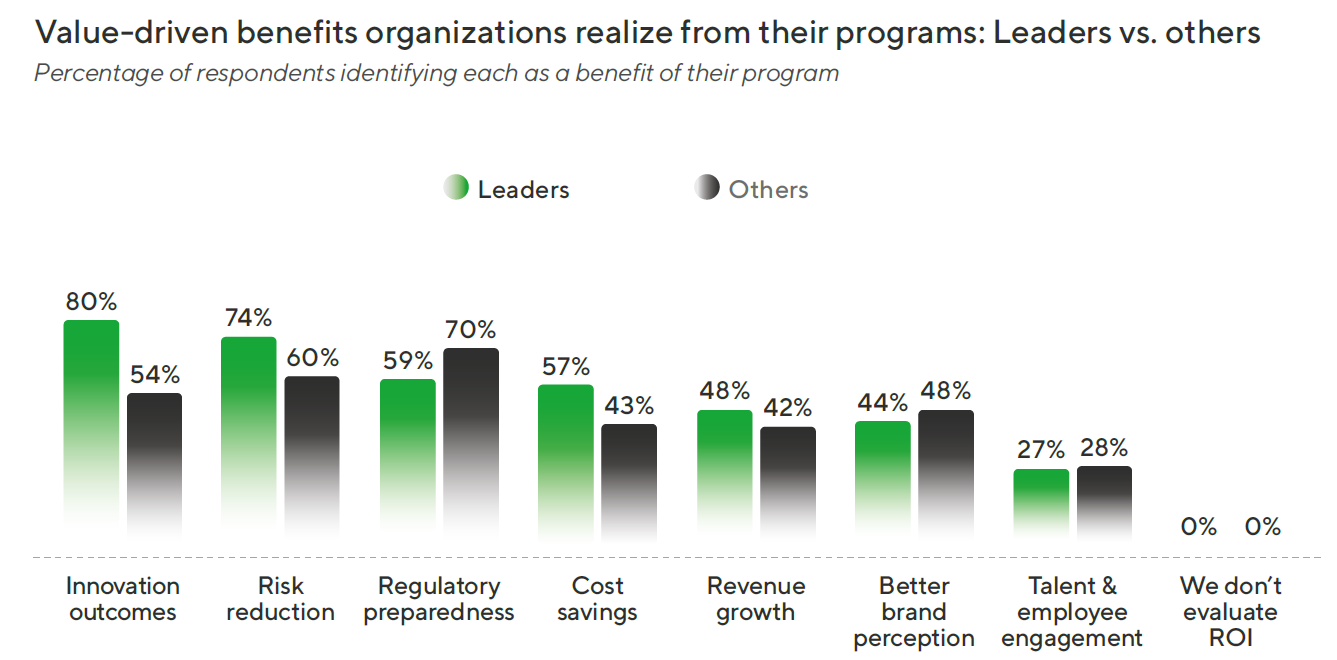
EcoVadis & Accenture, 2026 Sustainable Procurement Barometer
Though the value case is expanding, companies are still struggling to measure it. Just over half of Barometer respondents say “unclear ROI” is their biggest hurdle to securing more investment for sustainable procurement. Leaders are even more likely to flag it as a barrier (67% vs. 54%), which speaks to the complexity of measuring value across so many dimensions at once.
Despite this complexity, the Barometer shows that progress is being made. Nearly 70% of companies are quantifying the financial ROI of their efforts and 30% are using specific metrics to track sustainability-enhanced revenue growth and profitability. Companies are also measuring the value of their program through:
- Total cost of ownership calculators (56% of companies)
- Supplier performance KPIs with ESG weighting (52%)
- Supplier relationship duration (48%)
- ESG-linked financing indicators (42%)
- Revenue disruption tracking (39%)
2) Supply chain innovation is the next ROI frontier
Unlocking value from the type of innovation highlighted above requires companies to build new operating models, deploy cutting-edge technologies, and deepen partnerships across the supply chain. In particular, Barometer respondents cited supplier co-innovation as a key lever of supply chain transformation and the next value frontier for sustainable procurement.
The survey results point to the areas where collaboration is expected to be impactful. 43% of respondents ranked circularity and resource efficiency among the top three innovation areas shaping their 2026 procurement strategy – more than any other area. This is followed by biodiversity and nature-positive solutions (34%), supplier equity (26%), and digital traceability and responsible AI use (24%). As the chart below shows, companies anticipate that digital traceability and AI will become their top innovation focus area within 2–3 years.
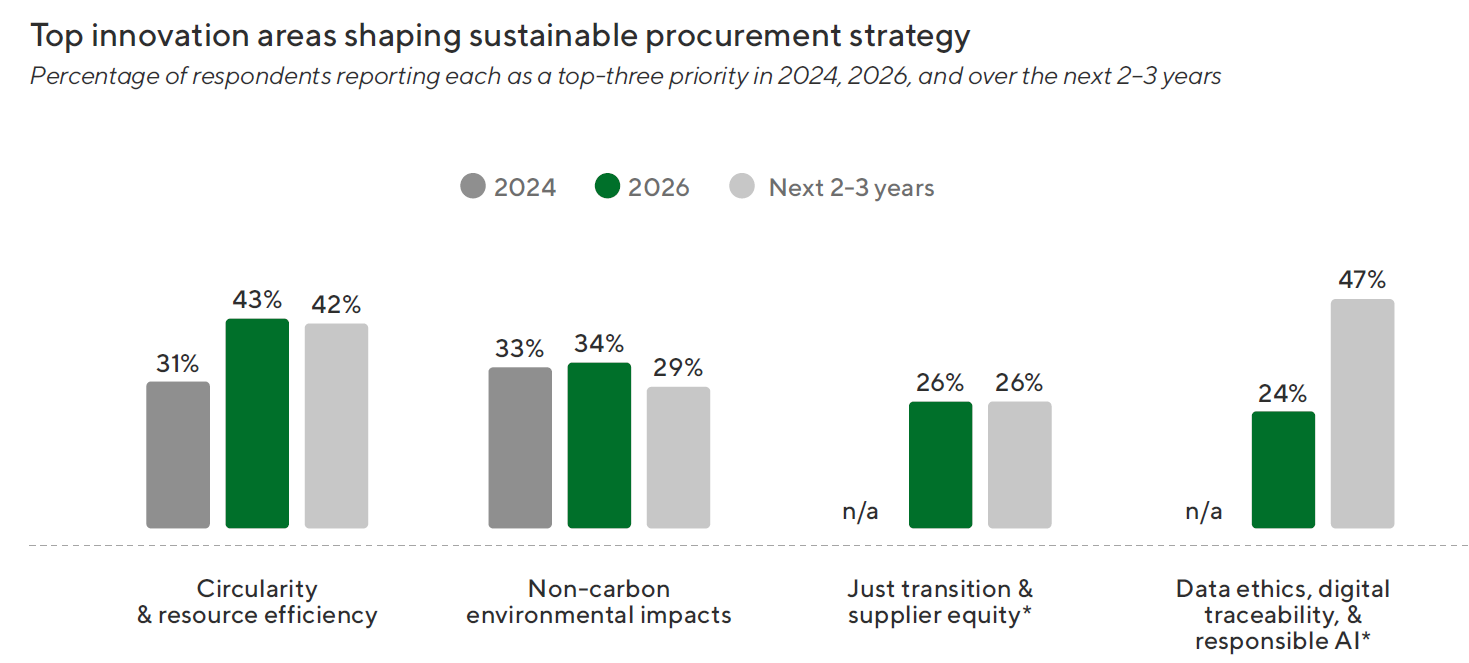
EcoVadis & Accenture, 2026 Sustainable Procurement Barometer
The Barometer reveals that companies are increasingly viewing circularity as a strategic pillar of long-term competitiveness and resilience. Research by Bain backs this up, with 65% of businesses expecting circular solutions to improve supply chain resilience, and more than 70% of manufacturing executives anticipating these strategies will boost their revenue by 2027. Unlocking this value will require moving beyond isolated internal initiatives toward coordinated action across the value chain, from material sourcing and product design to reverse logistics and secondary raw material markets.
AI can help accelerate this shift. According to Accenture, nearly 40% of companies already expect AI-enabled supply chain operations to improve circularity and efficiency – this will likely increase as AI evolves and deployment scales. These circularity gains are part of the reason companies with mature AI-led processes are reporting roughly 2.5x higher revenue growth and productivity than peers.
3) Supplier engagement gaps are limiting value creation
For this year’s report, we also surveyed nearly 2,000 suppliers across global supply chains. Their responses provide valuable insight into the benefits suppliers are seeing from their own sustainability initiatives, how they perceive buyer commitment, and the support they need to advance their programs.
The survey revealed three critical gaps weakening buyer-supplier collaboration and limiting the value companies can realize from their sustainable procurement efforts:
1) The value gap: Nearly two-thirds of suppliers report “improved relationships and collaboration with customers” as a top-three benefit of their sustainability efforts, compared with only 28% who say the same about “improved revenue and market opportunities.” This highlights that many suppliers are not yet seeing stronger collaboration translate into more commercial value. The good news is that many companies already have a strong foundation for building co-innovation initiatives that deliver mutual value.
2) The perceived commitment gap: Only 41% of suppliers say their customers are highly committed and actively engaged in driving supply chain sustainability. Nearly half say their customers are just committed in principle, and 12% see minimal or no commitment. This shows there’s a lot more buyers can do to engage suppliers and help them build the capabilities needed to provide better data and make measurable sustainability improvements.
3) The carbon data gap: Two-thirds of buyers report that they are collecting product carbon footprint data from at least some suppliers. However, the supplier survey reveals a critical gap: 30% provide no carbon data at all to buyers and just 21% provide detailed primary data across the three scopes. Even fewer provide product-level data. To deliver on growing ambitions around circularity, buyers will need to take a significant leap forward on building carbon transparency across supply chains.
Next steps
The Barometer makes it clear that sustainable procurement is moving from a risk-management function to a broader engine of value creation. Companies are already measuring ROI across cost, revenue, resilience, and innovation – the next wave of returns will come from more mature operating models and supplier engagement that yields better data and real improvement. Leaders are showing what’s possible when sustainability is embedded into procurement strategy and supplier relationships. For everyone else, the opportunity is to move beyond compliance-driven programs and build the capabilities needed to turn sustainable procurement into a measurable source of competitive advantage.