
 ChatGPT
 Gemini
 Perplexity
 Claude
 Grok

Gain insights from 30+ sustainability leaders, including superstars like Paul Polman, former CEO of Unilever, and Helena Helmersson, former CEO of H&M Group. Learn how to build a sustained advantage through responsible business practices.
20th October 2026
What Is Carbon Accounting and Where Do Companies Start?
Read summarized version with:
Carbon accounting has moved from sustainability best practice to board-level priority. Governments worldwide are tightening climate disclosure requirements, with jurisdictions representing more than 55% of global GDP now taking steps toward mandatory ISSB-aligned reporting. For businesses still treating emissions measurement as optional, the window is closing. Understanding what carbon accounting is and how to do it well is essential in an ever-evolving global trade market.
Key Takeaways:
- Carbon accounting quantifies an organization’s greenhouse gas emissions across Scope 1, 2 and 3, providing a baseline for decarbonization strategies.
- Scope 3 emissions, which originate deep in the supply chain, are the largest and most difficult to measure, making supplier data quality a critical factor.
- Regulatory requirements are expanding globally, with meaningful differences by region that organizations need to monitor closely.
- Accurate emissions data is the prerequisite for credible reporting, meaningful reduction targets and informed procurement decisions.
What Is Carbon Accounting?
Carbon accounting is the process of quantifying greenhouse gas (GHG) emissions produced by an organization’s activities, and is an essential component of building a corporate decarbonization strategy. The recognized global standard for doing this is the Greenhouse Gas Protocol, which provides the methodology most companies, regulators and reporting frameworks rely on.
Because carbon dioxide is the most prevalent GHG, emissions from other gases such as methane and nitrous oxide are converted into carbon dioxide equivalents, or CO2e. This conversion uses each gas’s global warming potential (GWP), a measure of how much heat it traps relative to CO2 over a set period. CO2e allows organizations to report a single, comparable emissions figure across all GHG sources.
The Three Scopes of Carbon Accounting
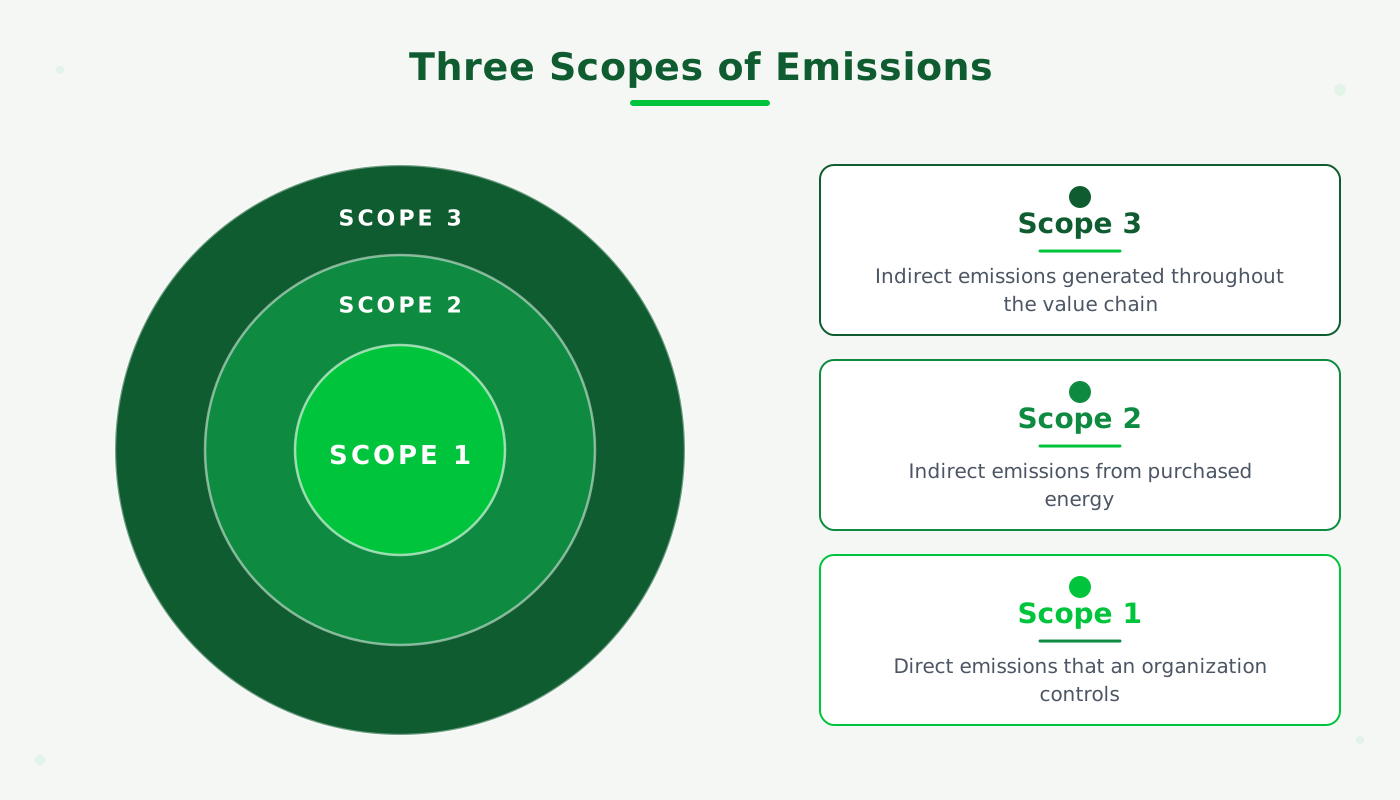
The GHG Protocol, along with most major reporting frameworks, organizes emissions into three scopes based on their source and the degree of organizational control over them.
- Scope 1: Direct emissions from sources owned or controlled by the organization, including onsite fuel combustion, manufacturing processes and company-owned vehicles.
- Scope 2: Indirect emissions specifically from purchased energy, including electricity, steam, heating and cooling that the organization consumes but does not generate itself.
- Scope 3: All other indirect emissions tied to the organization’s activities but outside its direct control, including those produced by suppliers, business travel, employee commuting, purchased goods and product end-of-life disposal.
Scope 3 carries the largest emissions footprint by a wide margin. According to the EcoVadis Carbon Action Report, upstream Scope 3 emissions can exceed Scope 1 and 2 combined by more than 21 times. For procurement and sustainability teams, that scale makes supplier emissions data central to any serious carbon accounting effort.
Carbon Accounting Methods: How It’s Done
Calculating value chain emissions requires two inputs: business data describing what an organization does, and emissions factors that translate that activity into a CO2e figure. The source of those inputs determines the method used.
- Spend-based carbon accounting: Takes the financial value of a purchased good or service and multiplies it by an emissions factor for that category. It is faster to implement and is a starting point, but the emissions factors used are based on industry averages, which limits how accurately results reflect a company’s actual footprint.
- Activity-based carbon accounting: Uses physical data, such as liters of fuel consumed or kilograms of material purchased, multiplied by corresponding emissions factors. It produces more accurate estimates but requires detailed operational data that can be difficult and time-consuming to collect.
- Hybrid method: Combines both approaches and is recommended by the GHG Protocol. Organizations use activity-based data where it is available and fill remaining gaps with spend-based estimates.
Most organizations choose to start with a spend-based baseline and work toward greater activity-based precision over time. That progression is straightforward for Scope 1 and 2, where data sources are largely internal and controllable. Scope 3 is harder. Measuring emissions from suppliers, logistics partners and upstream production requires data that many organizations simply do not yet collect or share consistently. This challenge becomes more pronounced the further upstream you go.
Why Carbon Accounting Is a Modern Business Priority
Carbon accounting was once a voluntary signal of environmental ambition. For most large organizations today, it is a baseline business requirement.
Regulatory Compliance
Climate disclosure requirements are tightening in some markets and shifting in others. Key developments businesses need to monitor:
- EPA Greenhouse Gas Reporting Program (GHGRP): Federal climate disclosure obligations in the U.S. are shrinking. The EPA extended the 2025 reporting deadline for approximately 8,000 facilities to October 2026 while evaluating a proposal that would eliminate requirements for 46 of 47 source categories. Combined with the rescission of the 2009 Endangerment Finding, which removed the legal foundation for federal GHG standards across most sectors, mandatory federal reporting may soon apply only to the petroleum industry.
- California SB 253: Large companies doing business in California must disclose Scope 1 and 2 emissions beginning in fiscal year 2026, with Scope 3 reporting added in 2027. The requirement applies regardless of where a company is headquartered, making it the most significant active climate disclosure rule in the U.S.
- EU Carbon Border Adjustment Mechanism (CBAM): As of 2026, CBAM covers six sectors: steel, cement, aluminum, fertilizers, electricity and hydrogen. Importers must report the embedded carbon content of their goods and purchase certificates priced at EU carbon rates. Organizations that cannot provide verified supplier-level emissions data are assessed at default rates based on worst-case emissions intensity for their product category, often resulting in significant overpayment.
ESG Reporting and Investor Expectations
Investors are no longer treating sustainability performance as a secondary consideration. According to recent surveys, 88% of investors have increased their use of ESG information in making investment decisions, and emissions data is central to how that performance is evaluated. Organizations without credible, verified carbon figures are increasingly at a disadvantage when competing for capital.
Supply Chain Efficiency
The emissions an organization controls directly are rarely its biggest climate exposure. The GHG Protocol estimates that supply chain activities account for 80% of a company’s carbon emissions and generate more than 90% of the air pollution tied to production and distribution. High-carbon activities in that chain frequently indicate inefficiencies that drive costs as well as emissions.
Identifying and addressing those hotspots through carbon accounting can generate operational savings alongside environmental progress. Supplier assessments that incorporate emissions data give procurement teams a measurable basis for prioritizing reduction efforts where they will have the most impact.
Carbon Accounting Challenges and How to Address Them
Carbon accounting is a data-intensive process, and the quality of the output depends entirely on the quality of the input. For most organizations, the biggest challenges are practical ones: where data comes from, how it is managed and whether it will hold up to scrutiny.
- Supplier data gaps: Scope 3 accuracy depends on emissions data from suppliers, and that data is often incomplete or unavailable. In fact, research from EcoVadis found that 30% of suppliers provide no primary emissions data to buyers. Closing that gap requires clear reporting expectations and structured supplier engagement.
- Siloed data: Emissions data is rarely held in one place. Energy records, procurement data, logistics information and supplier inputs often live across disconnected systems, making consolidation time-consuming and error-prone.
- Emissions factor selection: Applying the wrong emissions factor, whether due to outdated figures, incorrect source categorization or a mismatch between the factor’s geographic scope and the operation it is meant to reflect, can materially skew results. Factor selection requires deliberate methodology and regular review.
- Manual processes and audit risk: Organizations that rely on spreadsheets to manage emissions data introduce consistency and traceability risks that grow as reporting obligations expand. Automating data collection and maintaining a clear audit trail from source to final figure reduces that exposure considerably.
None of these challenges are insurmountable. Organizations that address them systematically can establish a carbon accounting foundation that supports both credible reporting and meaningful reduction.
How to Build a Carbon Accounting Program
There is no single path to a complete carbon accounting program, but the organizations that make the most progress start with what is measurable, build rigor over time and treat data quality as a prerequisite for everything else.
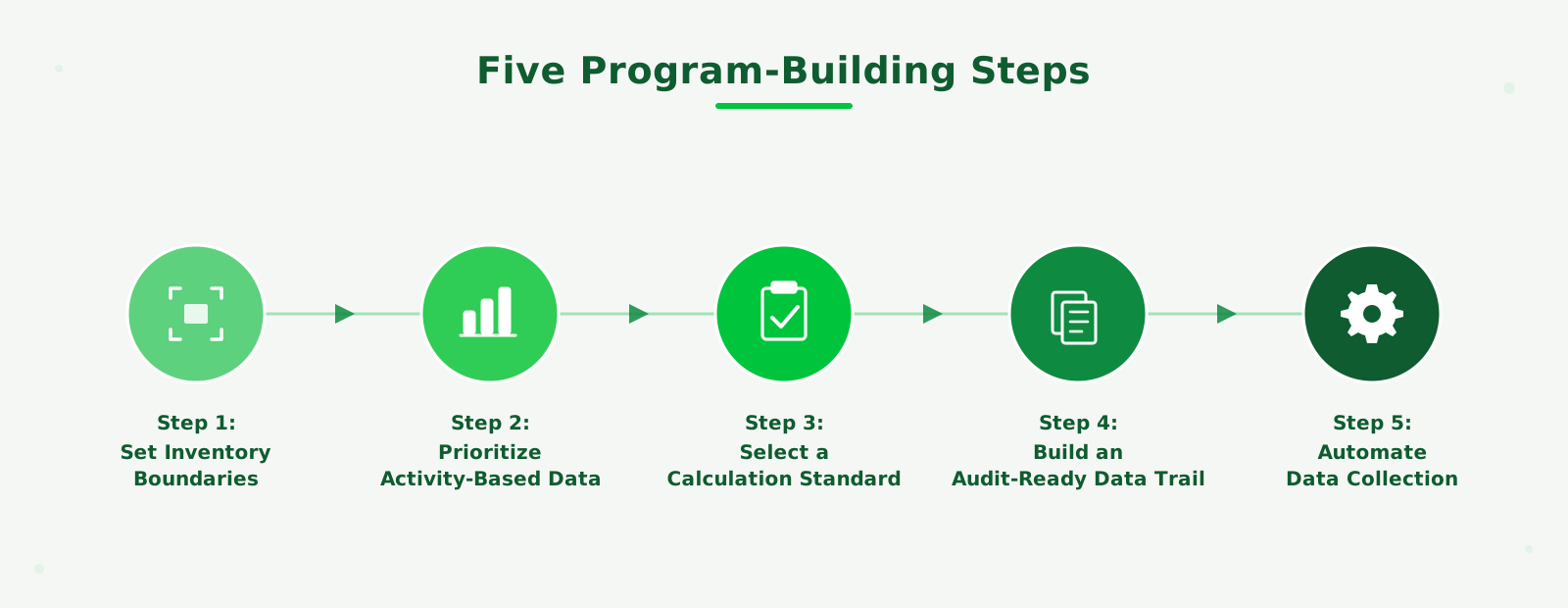
- Set inventory boundaries and establish a baseline: Define which operations, entities and emission sources fall within scope before calculating anything. A clearly documented baseline is the reference point against which all future progress is measured.
- Prioritize activity-based data sources: Utility meters, fuel records and procurement data produce more accurate emissions estimates than spend-based proxies. Use spend-based methods to fill gaps, not as a default.
- Select a calculation standard and apply it consistently: The GHG Protocol is the recognized standard for most organizations. Consistency in methodology across reporting periods matters as much as the methodology itself.
- Build an audit-ready data trail: Every emissions figure should be traceable back to its source. Assign clear ownership for data collection and document methodology decisions as they are made.
- Automate where possible: Manual data collection creates errors and slows reporting cycles. Specialized tools like the EcoVadis Carbon Action Manager help organizations manage supplier emissions data at scale, particularly for Scope 3 where data sources are most fragmented.
From Measurement to Action
Accurate carbon accounting is the logical starting point for any credible decarbonization strategy. Afterall, without a reliable baseline, reduction targets are arbitrary and progress is impossible to prove. But getting the numbers right is only half the work. Organizations also need the tools and supplier relationships to act on what the data reveals.
The EcoVadis Carbon Action Manager helps procurement and sustainability teams manage supplier emissions data at scale, turning fragmented value chain metrics into concrete progress. If you’re ready to take control of your corporate emissions, get started with EcoVadis today.