Carbon Tax: Understanding Supply Chain Cost Exposure
Read summarized version with:
 ChatGPT
  Gemini
  Perplexity
  Claude
  Grok
Grok As of 2026, carbon pricing initiatives cover approximately 28% of global greenhouse gas emissions, and that coverage is growing. For companies managing international supply chains, carbon taxes represent a direct and rising cost that extends well beyond their own operations and deep into their supply chains.
This article explores how carbon taxes work, where they apply in 2026 and what companies can do to manage exposure across their supply chains.
Key Takeaways
- Carbon taxes are now active in more than 27 countries, with coverage expanding across the EU, North America and Asia.
- For most businesses, the largest carbon tax exposure sits in the supply chain, not in direct operations.
- Under CBAM, importers without verified supplier emissions data are assessed at default rates that assume worst-case emissions intensity.
- Primary supplier emissions data is the highest-leverage input for reducing carbon tax liability across regulated markets.
What Is a Carbon Tax?
A carbon tax sets a fixed price per metric ton of CO2 equivalent (CO2e) emitted. Unlike regulations that cap what companies can emit, a carbon tax lets companies decide how much to emit while attaching a direct cost to that decision. The higher the business carbon footprint, the higher the tax bill.
Carbon taxes apply either upstream, at the point where fossil fuels enter the economy, or downstream, directly to large industrial emitters based on measured output. Where the tax is applied determines who writes the check, but the cost is usually passed on to buyers either way.
Carbon Taxes vs Emissions Trading Systems
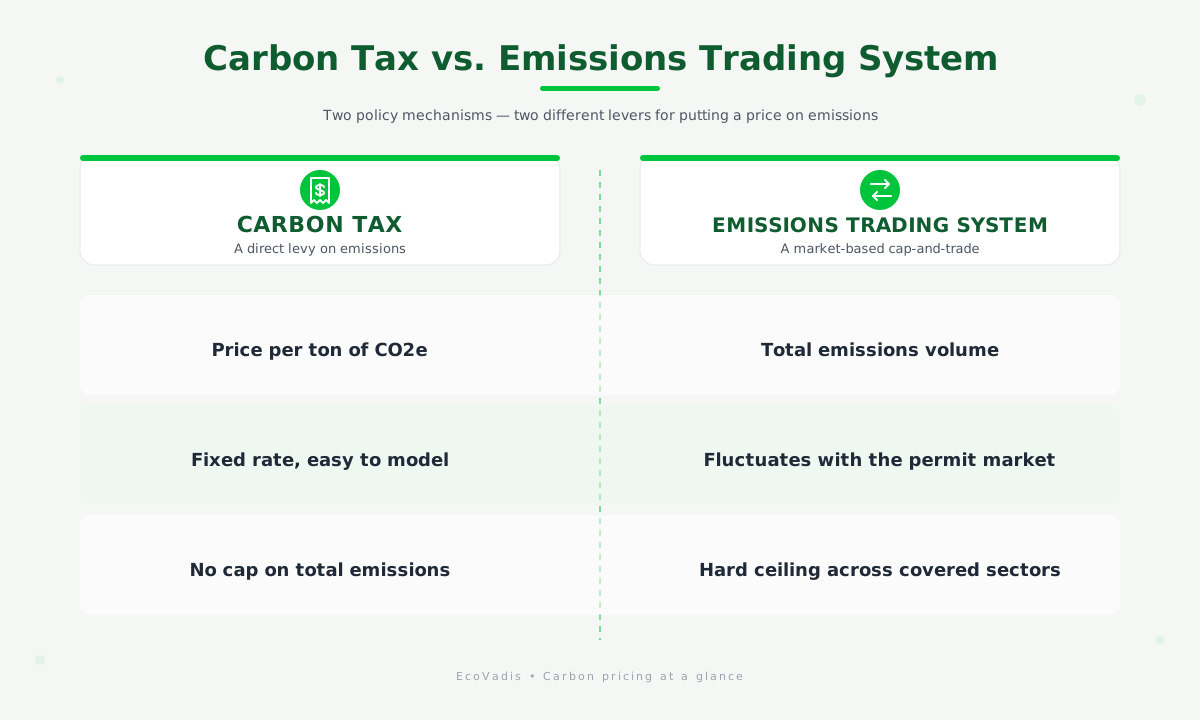
Carbon taxes and emissions trading systems (ETS), also called cap-and-trade, are the two primary tools governments use to price carbon. They differ in what they aim to control.
- Carbon tax: Fixes the price per ton of CO2e. Companies know their exact cost per unit of emissions, making liability predictable. Total emissions volume is not capped.
- ETS/Cap-and-trade: Sets a total emissions cap across covered sectors. Companies buy or trade permits to cover their share, but permit prices fluctuate with market conditions.
Both options create financial pressure to reduce emissions and decarbonize supply chains. For corporate planning purposes, a carbon tax produces a more predictable cost to model, while an ETS introduces price variability in exchange for a guaranteed emissions ceiling.
Carbon Taxes and the Supply Chain Emissions Problem
Carbon tax liability does not stop at a company’s own operations. For most businesses, the largest emissions exposure sits upstream, in the network of suppliers, manufacturers and logistics providers that make up their supply chain. EcoVadis’ Carbon Action Report finds that upstream Scope 3 emissions can be more than 21 times greater than Scope 1 and 2 combined.
When carbon taxes are levied on suppliers operating in regulated jurisdictions, those costs move downstream. Buyers absorb the increase through higher input prices, often without visibility into what is driving them or how much carbon exposure they are actually carrying.
Without verified supplier emissions data, the financial consequences are even greater. Under the EU’s Carbon Border Adjustment Mechanism (CBAM) and similar frameworks, importers that cannot document their suppliers’ actual emissions are assessed at default rates that assume worst-case emissions volumes. This means companies with verified data pay based on actual embedded carbon costs, while those without it pay a premium based on default reference values.
Where Carbon Taxes Apply in 2026
Carbon pricing mechanisms are now active in more than 50 countries, covering a range of industries and emissions sources. For companies managing global supply chains, three developments carry the most immediate cost implications.
The EU Carbon Border Adjustment Mechanism
CBAM entered its definitive phase in 2026, making it the most consequential carbon pricing development for importers trading with the EU. The mechanism applies to six sectors: steel, cement, aluminum, fertilizers, electricity and hydrogen. Importers in these categories must now report the embedded carbon content of their goods and purchase CBAM certificates to cover that carbon at EU carbon prices.
CBAM also requires organizations to document actual supplier-level emissions to accurately calculate their certificate obligation. Those that cannot are assessed at default rates based on the worst-case emissions intensity for their product category. In practical terms, that means paying for emissions your suppliers may not actually produce. The difference between verified data and a default rate often results in overpayment.
Carbon Pricing in Canada
Canada has been pricing industrial carbon emissions longer than most. Alberta, British Columbia and Quebec pioneered systems as early as 2007 and 2008. From 2019 until recently, every province and territory operated under a carbon pricing system that met federal minimum stringency standards. However, this uniform landscape fractured in 2025, creating a much more fragmented regulatory environment for corporate supply chains.
While the federal government officially removed the consumer carbon “fuel charge” in the spring of 2025, it did not entirely abandon its carbon pricing framework. The federal Output-Based Pricing System (OBPS) continues to act as a backstop in several jurisdictions for large industrial emitters, stepping in wherever local provincial programs fall short of the federal benchmark.
Emerging Carbon Fees in Asia
Carbon pricing is expanding across Asia, with Singapore and Taiwan representing the most immediate considerations for global supply chains. Singapore’s carbon tax applies to large industrial emitters and has been rising steadily. Taiwan introduced a carbon fee targeting facilities that exceed 25,000 metric tons of CO2e annually, with rates varying by industry. Neither market operates at EU scale, but the direction is consistent: carbon costs are increasingly a feature of doing business across Asia, and supply chain exposure in the region will only grow as rates and coverage expand.
While the United States and the United Kingdom have no federal carbon tax, subnational programs are active and expanding. Several U.S. states and regional initiatives price carbon at the local level, and the UK’s emissions trading system continues to develop post-Brexit. Companies with domestic supply chain exposure should monitor these programs alongside international developments.
The Carbon Tax Exposure Companies Miss
Most companies account for the carbon taxes they pay directly. Few have full visibility into what they are indirectly absorbing or where they are overpaying because they can’t prove otherwise.
- Direct costs (Scope 1): When a company’s own facilities or fleet are subject to a carbon tax, the liability is straightforward. Emissions are measured, reported and taxed directly. This is the cost most compliance teams plan for.
- Indirect costs (Scope 3): Suppliers operating in carbon-taxed jurisdictions usually build those costs into their prices. Buyers absorb the increase without a line item that explains it, making the exposure difficult to quantify and nearly impossible to negotiate.
- Default rate risk: Under CBAM, importers without verified supplier emissions data are assessed at a rate equal to the 10th percentile of the worst-performing importers in their product category. Companies with verified data pay based on what their suppliers actually emit.
Together, indirect costs and default rate risk are where carbon tax exposure quietly accumulates. Neither shows up as a discrete line item, but both affect what companies ultimately pay.
How Companies Can Reduce Carbon Tax Liability
Carbon tax liability is not fixed. Companies that invest in supply chain emissions data and supplier engagement have concrete options for reducing what they owe.
- Map supplier emissions before rates rise: With Scope 3 emissions accounting for a substantial share of emissions, collecting primary data from suppliers is the foundation for accurate carbon tax modeling. EcoVadis Carbon Action Manager helps companies collect verified Scope 1, 2 and 3 emissions data from suppliers and identify where carbon cost exposure is concentrated before new carbon pricing measures go into effect.
- Integrate carbon performance into sourcing decisions: The best way to avoid indirect carbon costs is to source from carbon-efficient suppliers. Using EcoVadis supplier ratings and scorecards, procurement teams can factor a vendor’s carbon maturity into the selection process. By actively shifting spend toward suppliers with lower emissions, companies can start reducing their downstream carbon tax exposure.
- Engage suppliers on emissions reduction: Reducing supplier emissions reduces pass-through costs and lowers the embedded carbon content of imported goods, directly reducing carbon tax obligations across regulated markets. Supplier scorecards and improvement plans give procurement teams a structured way to track progress and prioritize engagement where the financial impact is greatest.
Closing Thoughts
Carbon tax liability is increasingly a function of what a company knows about its supply chain. Verified emissions data determines whether carbon costs are predictable and manageable or invisible and compounding.
EcoVadis helps companies build that visibility through a comprehensive sustainability intelligence platform that spans supplier ratings, real-time ESG risk mapping and carbon data collection across global supply chains. For procurement and sustainability teams navigating rising carbon costs, tightening disclosure requirements and expanding regulatory coverage, supplier-level data is where carbon cost management begins.
Get started with EvoVadis today.
FAQs
What is the difference between a carbon tax and cap-and-trade?
A carbon tax sets a fixed price per ton of CO2e emitted. Companies pay that rate regardless of how much they emit. Cap-and-trade sets a ceiling on total emissions across covered sectors and lets companies buy and sell permits within that limit. A carbon tax makes costs predictable. Cap-and-trade makes total emissions predictable.
Which industries are most affected by carbon taxes?
Heavy industry carries the greatest direct exposure. Steel, cement, aluminum, chemicals and oil and gas face the highest carbon tax burdens because of their emissions intensity. Under CBAM, these sectors also face border carbon costs when exporting to the EU. Beyond direct emitters, any company sourcing from these industries absorbs carbon costs indirectly through supplier pricing.
What is the difference between a carbon tax and a carbon fee?
The terms are often used interchangeably, but there is a technical distinction in some jurisdictions. A carbon tax is typically a government-imposed levy collected as part of the tax system. A carbon fee may refer to a charge administered outside the traditional tax code, sometimes with revenue directed to specific funds or returned to households. Taiwan’s carbon fee mechanism is one example of the latter.
How are carbon tax rates determined?
Governments set carbon tax rates based on policy targets, typically aligned with national net-zero commitments or international agreements like the Paris Agreement. Rates are usually set to rise on a published schedule, giving companies a predictable trajectory for future costs. The EU, Canada and Singapore have all published multi-year rate increases, allowing companies to model carbon cost exposure well in advance.