
 ChatGPT
  Gemini
  Perplexity
  Claude
  Grok
Grok 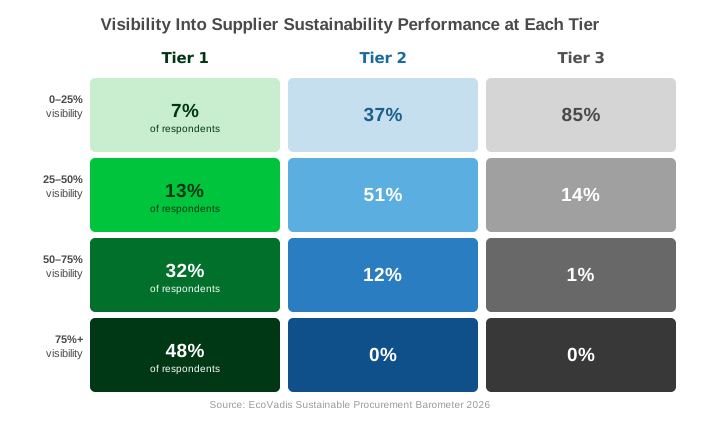
Gain insights from 30+ sustainability leaders, including superstars like Paul Polman, former CEO of Unilever, and Helena Helmersson, former CEO of H&M Group. Learn how to build a sustained advantage through responsible business practices.
20th July 2026
What Is Supply Chain Mapping And Why Does It Matter?
Read summarized version with:
Global supply chains have never been more exposed. According to McKinsey, 82% of organizations report their supply chains are affected by recent tariffs, with 20% to 40% of supply chain activity impacted. For procurement and sustainability leaders, that exposure starts with a fundamental question: do you actually know what’s happening in your supply chain?
Supply chain mapping answers that question, giving organizations the visibility to manage risk, meet regulatory requirements and source responsibly.
Key Takeaways
- Supply chain mapping goes beyond Tier 1 visibility, tracing materials and supplier relationships back to their point of origin across every tier of the network.
- Regulatory mandates including CSRD, CSDDD, LkSG and UFLPA now require demonstrable supply chain transparency, making mapping a compliance necessity.
- Supply chain disruptions average 6% to 10% of annual revenues. Proactive mapping helps organizations identify vulnerable suppliers and build contingency plans before disruptions hit.
- Supply chain mapping software makes continuous, multi-tier supply chain mapping scalable in a way that manual processes simply can’t match.
What Is Supply Chain Mapping?
Supply chain mapping is the process of identifying and documenting every supplier, material flow and sourcing relationship across a company’s supply network. It goes beyond direct (Tier 1) suppliers to capture sub-tier relationships, tracing raw materials and components back to their point of origin.
The output is a structured, visual representation of the full supply chain, often presented as a network diagram or interactive map. It shows supplier locations, sourcing dependencies and the flow of goods across geographies. Procurement and sustainability teams use these maps to assess supplier risk, track compliance and make informed sourcing decisions.
Benefits of Mapping the Supply Chain
For organizations managing complex, multi-tier supplier networks, supply chain mapping creates the intelligence needed to act on risk, satisfy regulators and meet growing stakeholder expectations. The benefits span every function that touches sourcing and procurement.
Full Visibility and Traceability
Visibility and traceability are related but distinct. Visibility means knowing who your suppliers are and where they operate. Traceability goes deeper, following materials and components back through sub-tier relationships to their point of origin.
Most organizations have adequate visibility into their Tier 1 suppliers, but the picture breaks down past that. According to EcoVadis’ Sustainable Procurement Barometer, only 12% of organizations have visibility into more than half of their Tier 2 suppliers. Supply chain mapping closes that gap, giving procurement teams a documented, structured view of the full network and the ability to verify where materials actually come from.
Regulatory Readiness
A growing body of regulation now requires companies to demonstrate transparency and traceability across their supply chains, not just report on internal ESG performance. Key mandates include:
- Corporate Sustainability Reporting Directive (CSRD): Requires EU companies to assess and disclose environmental and social risks across their full supply chain, including sub-tier suppliers, under a double materiality framework.
- Corporate Sustainability Due Diligence Directive (CSDDD): Mandates identification, assessment and mitigation of human rights and environmental risks throughout supply networks.
- Supply Chain Due Diligence Act (LkSG): Germany’s federal mandate requires proactive risk management to ensure ethical sourcing and protect worker rights.
- Uyghur Forced Labor Prevention Act (UFLPA): Restricts imports linked to forced labor in China’s Xinjiang region, placing the burden of proof on importers to verify clean supply chains.
Organizations that can’t map their supply chains can’t demonstrate compliance. At that point, regulatory risk becomes a significant business risk.
Proactive Risk Management
Supply chain disruptions carry a significant consequences, with research finding that disruptions average 6% to 10% of annual revenues, a cost most companies can’t easily absorb. Geopolitical instability, climate events and labor risks are rarely isolated, they concentrate in specific regions and supplier tiers.
Supply chain mapping surfaces those concentrations early, giving organizations a better idea of sourcing dependencies and geographic exposure. With that foundation, procurement teams can identify vulnerable suppliers, model disruption scenarios and build contingency plans before a crisis forces their hand.
ESG and Sustainability Alignment
Investors, customers and regulators no longer accept corporate sustainability commitments at face value and expect verifiable data to back them up. Supply chain mapping gives organizations the supplier-level visibility needed to track carbon emissions, monitor labor conditions and confirm responsible sourcing across every tier. For organizations subject to Scope 3 reporting requirements, that granularity isn’t optional.
How to Map Your Supply Chain: A Step-by-Step Approach
Supply chain mapping is not a one-time exercise. It is an ongoing process that requires structured data collection, continuous monitoring and regular updates as supplier relationships and risk conditions evolve.
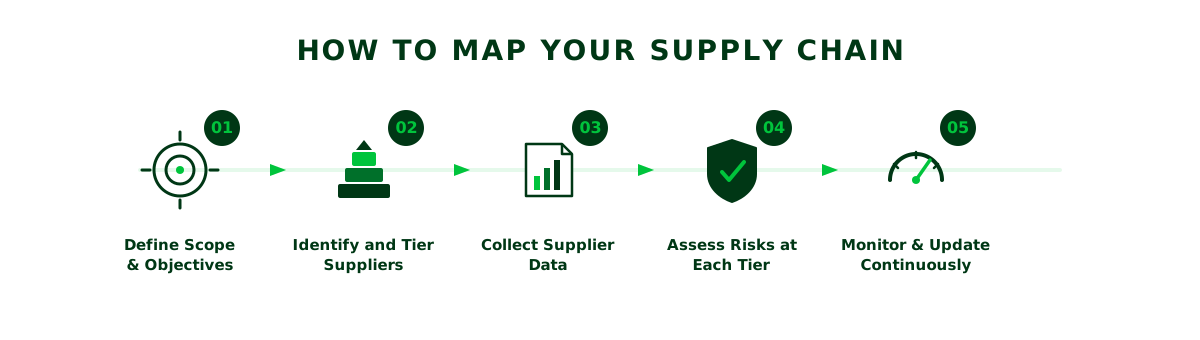
Step 1: Define Scope and Objectives
Start by determining what the mapping process needs to accomplish. Are you focused on regulatory compliance, risk exposure, ESG reporting or all three? Defining scope upfront determines how deep into the supply chain you need to go and which supplier tiers require the most scrutiny.
Step 2: Identify and Tier Suppliers
Compile a complete inventory of direct (Tier 1) suppliers, then work outward to identify Tier 2 and sub-tier relationships. Prioritize by spend, criticality and geographic concentration. Not every supplier requires the same level of scrutiny, but every supplier needs to be accounted for.
Step 3: Collect Supplier Data
Gather data on supplier locations, certifications, labor practices and environmental performance. Organizations typically rely on two approaches: self-assessment questionnaires, where suppliers report directly on their own practices, and third-party audits, where independent evaluators verify conditions on the ground. Questionnaires are scalable and cost-effective for broad coverage across large supplier bases. Audits provide greater rigor and are typically reserved for high-risk or high-spend suppliers where verification matters most. Many organizations use both in combination, applying the appropriate method based on supplier tier and risk profile.
Step 4: Assess Risks at Each Tier
With supplier data in hand, evaluate risk across essential dimensions, including geographic and geopolitical exposure, regulatory compliance, financial stability and ESG performance. Flag high-risk suppliers and sourcing concentrations that could create single points of failure.
Step 5: Monitor and Update Continuously
Supply chains change constantly. Suppliers are acquired, facilities relocate and risk conditions shift. Treat the map as a living document, updated regularly and monitored in real time where possible, so the picture it provides stays accurate and actionable.
How Supply Chain Mapping Software Can Help
For most organizations, mapping a supply chain manually isn’t realistic. Tracking relationships and risk conditions beyond Tier 1 requires continuous data collection, validation and monitoring at a scale that quickly exceeds what internal teams can manage alone. Supply chain mapping software makes that process accurate, scalable and continuously updated.
EcoVadis IQ Plus goes beyond static visualization, integrating AI-driven risk analytics, real-time news monitoring and access to the world’s largest sustainability performance database. Procurement and sustainability teams get a dynamic view of supplier risk across environmental, labor, human rights and governance dimensions, with actionable recommendations built in rather than bolted on.
Ready to get started? Learn how EcoVadis can help your organization build a more transparent, resilient supply chain.