
 ChatGPT
  Gemini
  Perplexity
  Claude
  Grok
Grok 

Gain insights from 30+ sustainability leaders, including superstars like Paul Polman, former CEO of Unilever, and Helena Helmersson, former CEO of H&M Group. Learn how to build a sustained advantage through responsible business practices.
16th June 2026
ESG Goals Explained: How to Set, Track and Prove Progress
Read summarized version with:
ESG goals were once treated as aspirational sustainability targets, something companies set to satisfy growing expectations from the public. That’s no longer the case. Investor scrutiny, procurement requirements and expanding disclosure regulations have made clearly defined ESG commitments a reality for businesses across every size and sector. Organizations that can’t define what they’re working toward and demonstrate progress against it are finding that gap increasingly difficult to explain.
This article explores the importance of ESG goals in modern business strategy and provides a guide for turning commitments into meaningful improvement.
Key Takeaways
- ESG goals translate sustainability strategy into specific, measurable commitments across environmental, social and governance dimensions.
- Without defined goals, companies struggle to satisfy investor scrutiny, meet procurement requirements or produce credible disclosures.
- Setting effective ESG goals requires knowing where you stand, what matters most to your business and who is accountable for results.
- Third-party assessment is what turns internal commitments into verified performance data.
What Are ESG Goals?
ESG goals are specific, measurable commitments that companies set across multiple interconnected dimensions to guide sustainability performance over time. They are distinct from broader ESG strategy or policy. ESG policy establishes a company’s principles and boundaries. ESG strategy defines the direction and priorities. Goals are where both become operational: they set what gets measured, who owns it and when results are expected.
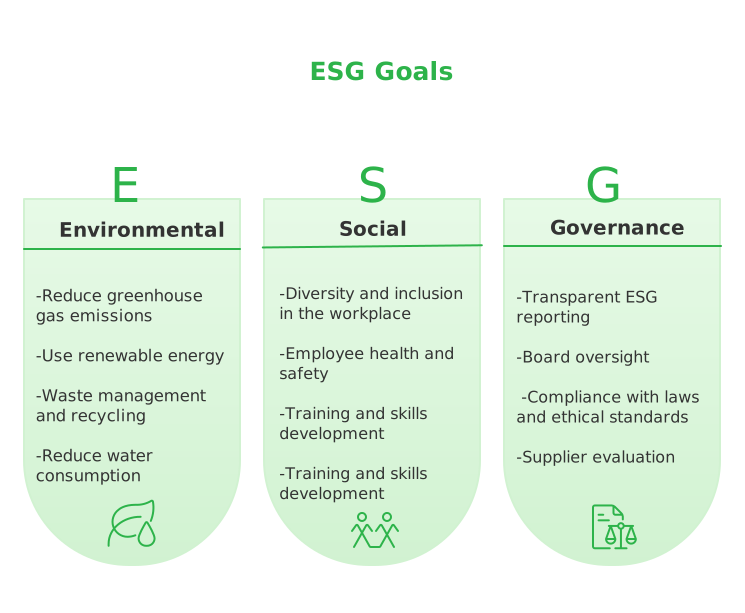
Components of ESG Goals
Goals look different depending on a company’s industry, size and maturity, but they consistently fall into three categories. Below are examples of what goals may look like in each category.
Environmental
Environmental goals address your company’s direct and indirect impact on natural systems, covering things like emissions, energy, water and waste.
- Reduce absolute Scope 1 and 2 greenhouse gas emissions 50% by 2030
- Achieve zero waste to landfill across all manufacturing sites by 2027
- Source 100% renewable electricity for owned operations by 2026
- Cut water consumption per unit of production 30% within five years
Social
Social goals focus on how your company treats its people and manages its responsibilities across the workforce and supply chain.
- Reach gender parity in management roles by 2030
- Conduct human rights due diligence across 100% of tier-one suppliers annually
- Reduce recordable workplace injury rates 25% over three years
- Provide verified skills training to all full-time employees each calendar year
Governance
Governance goals define how your company structures accountability, transparency and oversight of its sustainability commitments.
- Publish an annual sustainability report aligned with GRI Standards
- Establish board-level ESG oversight through a dedicated committee
- Achieve third-party verification of all material ESG disclosures
- Require all direct suppliers to complete an ESG assessment every two years
Why Do ESG Goals Matter?
ESG goals give companies something concrete to measure progress against and communicate to the audiences that are paying attention. Investor expectations, regulatory requirements and internal accountability all depend on having clear targets in place.
- Investor credibility. Investors and lenders increasingly evaluate ESG performance as part of broader risk assessment. Companies with defined, time-bound goals indicate that sustainability is managed with the same intention as financial performance.
- Regulatory alignment. Major disclosure frameworks including GRI and SASB are built around specific, measurable commitments. Companies that establish ESG goals early have a clearer path to meeting reporting requirements when they go into effect, rather than reverse-engineering them to fit disclosure obligations.
- Procurement requirements. Large enterprises routinely require suppliers to demonstrate ESG performance as a condition of doing business. Organizations with defined goals are better positioned to hold suppliers accountable and protect existing commercial relationships.
- Internal focus. Specific, time-bound goals give sustainability programs a defined target to work toward. That clarity helps shape decisions across procurement, operations and finance in ways that broad sustainability statements can’t.
Setting ESG Goals: A Step-by-Step Approach
Goal-setting is where many sustainability programs stall. The ambition is there but without a process, targets end up too broad to track or too vague to defend. A clear sequence fixes that.
1. Assess Your Current ESG Baseline
Before setting goals, understand where you stand now. Audit existing ESG data across environmental impact, labor practices and governance structures to establish what’s already being tracked, what’s missing and where the gaps are most significant.
2. Identify What’s Material to Your Business
Not every ESG issue carries equal weight for every company. A materiality assessment, combining input from internal stakeholders with a review of industry benchmarks and peer performance, surfaces the issues that are most relevant to your business and most credible to external audiences.
3. Align Goals With Recognized Frameworks
Goals tied to established frameworks carry more weight with investors, customers and regulators than internally defined commitments alone. Widely adopted standards include GRI, SASB, the Science Based Targets initiative and the UN Sustainable Development Goals, each offering a globally recognized structure for setting and communicating progress.
4. Define Metrics, Timelines and Ownership
A goal without a metric is just a statement. Each goal needs a specific, measurable target, a timeline that includes both near-term milestones and a long-term endpoint, and a named owner accountable for progress.
5. Engage Stakeholders Early
Goals developed in isolation rarely make it past the starting line. Loop in leadership, procurement and other relevant external stakeholders before goals are finalized. This helps surface any potential constraints and builds internal buy-in so goals have a realistic foundation.
6. Establish Reporting and Review Cycles
Setting goals is just the beginning. Review key ESG metrics quarterly and conduct a full review of all ESG commitments at least annually. That cadence keeps performance visible and helps identify gaps before they become reporting problems.
From Goal-Setting to ESG Performance
Defining ESG goals is the first step. Proving progress against them is where most companies run into difficulty. Measuring performance consistently and communicating results to investors, customers and regulators requires more than internal tracking.
Third-party assessment fills that gap. An independent rating evaluates performance across ESG dimensions, giving companies a credible, externally verified view of where they stand. EcoVadis Ratings map directly to those categories, making it easy to identify where progress is on track and where attention is needed. For emissions specifically, the Carbon Action Manager helps companies move from Scope 1, 2 and 3 commitments to documented reduction progress.
Companies that are ready to move from goal-setting to verified performance can start with an EcoVadis assessment. Reach out to us to get started.
FAQs
Q: What should an ESG policy include?
A: An ESG policy should include a clear scope defining what and who it covers, named accountability structures, a materiality assessment that reflects your specific industry risks and a defined review cycle. The strongest policies also extend requirements into the supply chain, setting explicit environmental and social standards for suppliers.
Q: Is an ESG policy legally required?
A: An ESG policy itself is not legally required. However, regulations like the CSRD, EU Taxonomy and California SB 253 and SB 261 are increasingly mandating ESG data disclosure. A formal ESG policy provides the internal roadmap for tracking and managing that data consistently, making compliance significantly more manageable when reporting obligations apply.
Q: What is the difference between an ESG policy and a CSR policy?
A: An ESG policy is a structured, risk-based framework often tied to measurable performance goals and/or regulatory requirements. A CSR policy traditionally focused on philanthropic initiatives and voluntary commitments. ESG policies and subsequent reporting apply quantitative rigor to broad intent, making them more relevant to investors, regulators and supply chain due diligence.
Q: Who should be responsible for writing an ESG policy?
A: An ESG policy should be developed through a cross-functional, collaborative process involving sustainability, legal, compliance, finance, supply chain and executive leadership. No single department owns ESG in isolation. Broad internal input ensures the policy reflects actual operational risk, while executive sign-off ensures organizational accountability and staying power.