
 ChatGPT
  Gemini
  Perplexity
  Claude
  Grok
Grok 

Gain insights from 30+ sustainability leaders, including superstars like Paul Polman, former CEO of Unilever, and Helena Helmersson, former CEO of H&M Group. Learn how to build a sustained advantage through responsible business practices.
16th June 2026
ESG Integration Strategy: How Leading Programs Get It Right
Read summarized version with:
Nearly every procurement organization now collects some level ESG data, but fewer have made it operational. According to the EcoVadis Barometer 2026, 98% of companies have started embedding ESG data into procurement processes, but only 6 to 25% have achieved full digital integration into the systems where buying actually happens.
The gap is not a policy problem. Sustainability criteria exist in strategy documents and reporting frameworks, but they rarely reach the sourcing events, contract terms and purchasing decisions where they would produce different outcomes. This article examines what genuine ESG integration looks like in the real world, where programs consistently fall short and what the highest-performing programs do differently.
Key Takeaways
- ESG integration is the process of embedding environmental, social and governance criteria into operational business decisions, not just strategy documents and reporting frameworks.
- Most programs stall at the strategic level and never reach the operational and transactional stages where ESG criteria actually influence purchasing decisions.
- Genuine integration requires ESG data to flow into the systems where sourcing, contracting and purchasing decisions actually get made.
- AI accelerates ESG risk screening and analytics, but its outputs are only as reliable as the underlying data quality.
What Is ESG Integration?
ESG integration is the process of embedding environmental, social and governance criteria into the decisions that organizations make every day. Those decisions may include:
- Which suppliers to qualify
- How to score competing bids
- What to put in a contract
- How to structure a category plan
- What criteria guide individual purchase approvals
A company can have an ESG reporting framework and an ESG management system and still lack meaningful ESG integration. The result might be detailed sustainability disclosures, but a procurement team that continues to make sourcing and supplier decisions with no ESG input at all.
According to EY’s 2025 CPO survey, 86% of CPOs identify category management and strategic sourcing as the primary vehicle for delivering long-term ESG value, yet most programs stall before reaching the transactional level where routine purchasing decisions actually happen. Effective ESG integration operates across all three levels, each harder to reach than the last.
- Strategic Integration: ESG priorities are embedded into corporate strategy through board oversight, executive accountability, materiality assessments and long-term sustainability goals. Many organizations have reached this stage.
- Operational Integration: ESG criteria influence procurement and supplier management processes, including supplier qualification, sourcing evaluation, contract requirements and category planning. Fewer organizations apply ESG consistently at this level.
- Transactional Integration: ESG factors shape day-to-day purchasing decisions made across the business, often by employees working under time pressure in systems not designed for sustainability oversight. Very few organizations achieve ESG integration at this scale.
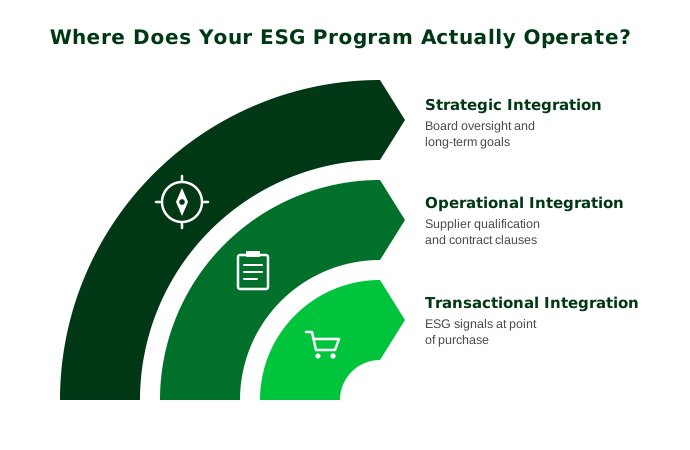
The ESG Integration Framework
An ESG integration framework works like a roadmap of the procurement lifecycle, pinpointing where ESG criteria need to appear to influence decisions rather than document them after the fact.
Supplier Qualification
ESG integration begins before a supplier relationship is approved. Companies increasingly embed ESG criteria directly into onboarding processes through sustainability score thresholds, third-party assessments and supplier risk classification before vendors enter the approved supplier base. This makes ESG a qualification requirement rather than a retrospective review.
Sourcing Events and RFPs
ESG scoring built into bid evaluation models changes what gets bought and from whom. When ESG performance is a weighted criterion in the RFP scoring matrix rather than a parallel track reviewed after the commercial shortlist is set, it produces different outcomes. Only 26% of buyers now cover more than half their spend with third-party ESG ratings, according to Barometer 2026 analysis. For the remaining majority, the sourcing process operates largely without ESG weighting, meaning its output cannot reflect ESG criteria, no matter how strong the policy is.
Contract Design
Contract terms are where ESG commitments become commercially enforceable. A supplier that understands its ESG score affects contract renewal, pricing or supply continuity behaves differently from a supplier that knows the score is tracked but carries no consequences. Procurement teams are increasingly expected to move from slogans to credible evidence, with greater reliance on third-party assurance and contract terms that tie ESG commitments to performance and remedies.
Category Strategy
Category-level integration means ESG considerations shape supplier consolidation decisions, geographic sourcing choices and innovation priorities at the strategy stage. A category plan built around the material ESG risks in that spend area produces systematically different supplier selection outcomes than one that applies ESG filters retrospectively.
Day-to-Day Purchasing
This is the hardest integration point and the one many programs fail to reach at all. Routine purchasing happens at a speed and volume that no compliance process can survive unless the ESG signal is surfaced automatically at the point of purchase, in the system the buyer is already using.
The integration between EcoVadis and Amazon Business demonstrates what this can look like in practice. EcoVadis Sustainability Ratings and Medals appear directly next to supplier listings in the Amazon Business purchasing interface. A buyer selecting between two comparable vendors sees the EcoVadis performance signal alongside product information and pricing, without opening a separate system, submitting a lookup request or consulting a sustainability team.
Strategies for ESG Integration
ESG integration strategies focus on embedding sustainability criteria into the procurement processes and purchasing behaviors where supplier decisions actually get made.
Move From Self-Reported Questionnaires to Verified Assessments
Programs built on supplier self-assessment questionnaires generate ESG data that is often inconsistent, unverifiable and increasingly difficult to defend in regulatory disclosures or investor reviews. 65% of institutions report the lack of standardized ESG data as a major obstacle to meaningful ESG integration.
The shift from questionnaire-based approaches to independently verified third-party assessments is the single most consequential change a procurement team can make to its integration data quality. Verification changes the confidence procurement teams have in the data, and that confidence is what determines whether the data actually gets used in sourcing decisions.
Connect ESG Data to the Systems Where Decisions Happen
ESG data that exists in a sustainability platform but does not flow into the ERP or procurement system where sourcing and approval decisions are made may be consulted occasionally, but will often be ignored. Fragmented systems are a growing compliance liability as expectations for auditability and traceability increase.
Decision-grade ESG integration requires data to be available in the same environment where purchasing happens. If a procurement manager can approve a high-risk supplier in the ERP system without seeing that supplier’s low ESG rating or unresolved labor violations, the ESG policy has no practical influence on the purchasing decision.
Attach Commercial Signals to ESG Performance
ESG integration is most effective when supplier performance affects commercial outcomes. Suppliers are far more likely to improve when ESG scores influence preferred-vendor status, contract eligibility or financing terms. ESG-linked supply chain finance programs are one example of this model, in which stronger ESG performance can reduce financing costs, while weaker performance increases them. That structure turns ESG from a periodic compliance exercise into an active business priority tied directly to commercial impact.
Build Coverage for the Long Tail, Not Just Strategic Suppliers
Strategic suppliers receive the most attention in ESG programs and are most likely to have been assessed. Smaller, lower-spend vendors represent the coverage gap that leaves significant ESG exposure unmanaged and regulatory due diligence requirements partially unmet.
The EU Omnibus Simplification Package has narrowed certain mandatory reporting thresholds, but the largest multinationals in scope continue to transmit their ESG obligations through supply chains via onboarding standards, contract terms and questionnaire requirements. Extending ESG coverage to smaller vendors requires tools scaled to their capacity, not full-assessment programs designed for strategic suppliers.
Build for AI Readiness as an Integration Prerequisite
55% of procurement buyers have moved from experimenting with AI to operational use for ESG analytics and risk screening, according to Barometer 2026. The quality of AI-assisted ESG decision-making is entirely determined by the quality of the ESG data being processed. Fragmented, self-reported or inconsistently formatted supplier ESG data does not improve when an AI model processes it.
The risk is not that AI fails to work. It is that AI works too well on bad inputs, producing fast, confident and incorrect outputs. Programs that invest in verified, structured ESG data integration before deploying AI tools will extract substantially more value from those tools than programs that treat AI as a substitute for data quality.
Challenges of ESG Integration
ESG integration usually breaks down in predictable places. The four most common barriers procurement teams face:
- Fragmented data across disconnected systems. ESG data typically sits across procurement platforms, sustainability tools, compliance databases and supplier portals that were not designed to connect with each other. Organizations spend more time collecting and reconciling ESG data than analyzing it, and as CSRD and CSDDD require documented evidence of how ESG data influenced specific procurement decisions, disconnected systems become a structural audit liability.
- Uneven supplier readiness. According to Barometer 2026, 30% of suppliers report no emissions data at all. Readiness gaps concentrate in smaller suppliers, in regions with less regulatory pressure to disclose and in tier 2 and tier 3 relationships where buyers have less direct commercial leverage to require improvement.
- Internal adoption friction. Integration that adds steps to routine purchasing is likely to get bypassed. Programs that rely on manual lookups, separate portals or additional approval layers for ESG screening will see adoption drop sharply below the strategic supplier tier, which is precisely where most of the unmanaged exposure sits.
- ESG rating divergence. Different rating providers can produce substantially different scores for the same supplier, not because of differences in actual performance but because of differences in measurement methodology. For procurement teams building ESG criteria into sourcing decisions, that divergence makes rating selection a consequential choice that requires justification.
EcoVadis Turns ESG Integration Into an Operational System
ESG integration depends on having reliable, verified supplier data available in the systems and moments where procurement decisions are made.
EcoVadis provides supplier sustainability intelligence across more than 150,000 companies rated across 220 industries and 180 countries. Analyst-verified ratings give procurement teams the data confidence needed to embed ESG criteria into supplier qualification, sourcing events and contract management. IQ Plus maps sustainability risks across the full supply base and extends lightweight ESG coverage to suppliers not yet ready for full assessment, addressing the long-tail gap without full-assessment overhead for every vendor.
The platform also supports corrective action plans, industry and geography benchmarking, and reporting-ready data aligned with GRI, CDP and the UN Global Compact.
Contact our team to see how EcoVadis can support ESG integration across your supplier network.
FAQs
What is the difference between ESG integration and ESG management?
ESG management governs performance across environmental, social and governance factors. ESG integration is whether ESG criteria actually influence sourcing, contracting and purchasing decisions. A company can have strong ESG management and minimal integration if sustainability data never reaches the procurement systems and workflows where decisions are made.
What does an ESG integration framework include?
A practical framework maps where ESG criteria need to show up across the procurement lifecycle:
- Supplier qualification: ESG score thresholds before vendors enter the approved base
- Sourcing events: ESG weighting in RFP scoring models
- Contract design: ESG performance clauses and KPI requirements
- Category strategy: ESG risk analysis built into category plans
- Day-to-day purchasing: ESG signals at the point of purchase
What are the most common challenges of ESG integration?
The five most common barriers are fragmented data across disconnected systems, uneven supplier readiness concentrated among smaller and tier 2 vendors, long-tail coverage gaps where the highest-risk suppliers go unassessed, internal adoption friction when compliance steps slow routine purchasing and ESG rating divergence where methodology differences between providers produce substantially different scores for the same supplier.
How does ESG integration connect to AI in procurement?
AI accelerates ESG risk flagging, supplier prioritization and pattern recognition across supply bases too large for manual review. But AI amplifies the quality of the data it processes rather than compensating for weak inputs. Programs integrating verified, consistently structured ESG data get substantially better AI outputs than those feeding models with self-reported questionnaire responses and fragmented supplier records.