
 ChatGPT
  Gemini
  Perplexity
  Claude
  Grok
Grok 

Gain insights from 30+ sustainability leaders, including superstars like Paul Polman, former CEO of Unilever, and Helena Helmersson, former CEO of H&M Group. Learn how to build a sustained advantage through responsible business practices.
3rd June 2026
ESG Rating Agencies: Evaluating Corporate Sustainability Performance
Read summarized version with:
Sustainable finance has moved from the margins to the mainstream. Capital is increasingly directed toward organizations that can demonstrate responsible environmental, social and governance practices, and regulators from Brussels to Sacramento are raising the bar on required disclosures.
ESG rating agencies provide an established evaluation process. These independent entities assess a company’s exposure to ESG-related risks and translate qualitative and quantitative data into scores that investors, procurement teams and regulators can act on. For businesses competing in global markets, understanding how these agencies work and what drives their ratings is essential.
Key Takeaways
- ESG rating agencies translate complex, inconsistent sustainability data into a standardized measure that investors, procurement teams and regulators can act on.
- ESG ratings directly impact profitability, influencing access to capital, supplier relationships and regulatory compliance.
- Rating agencies and ESG advisory firms serve fundamentally different roles. Knowing the difference determines how effectively a company can improve.
- Ratings are the starting point. What a company does with it determines whether ESG performance becomes a real business advantage.
What Are ESG Rating Agencies?
ESG rating agencies are independent organizations that evaluate how effectively a company identifies, manages and reports on ESG risks. They function as the sustainability equivalent of credit rating providers, applying proprietary frameworks to assess performance across a defined set of criteria. The output is a standardized score or grade that gives external stakeholders, from asset managers to procurement officers, a basis for comparison across industries and geographies.
The Role of ESG Rating Providers in Global Markets
ESG rating providers provide data analysis that few organizations can replicate internally. Their work typically breaks down into three core activities.
- Data aggregation: Rating agencies collect information from corporate disclosures, regulatory filings, NGO reports and media sources to build a comprehensive picture of performance across hundreds of suppliers and partners.
- Standardization: Sustainability data is notoriously inconsistent, often reported in different formats, to different standards and with varying degrees of detail. ESG rating providers normalize those inputs, making it possible to compare a manufacturer in Germany and a logistics firm in Brazil on the same set of criteria.
- Risk assessment: The resulting ESG scores serve two distinct analytical purposes. Impact assessment evaluates how a company’s operations affect the environment and society. Financial materiality measures how ESG factors affect the company’s own financial performance and risk profile. Most major ESG rating providers address both dimensions, though the weight assigned to each varies by methodology.
How ESG Ratings Support Corporate Sustainability
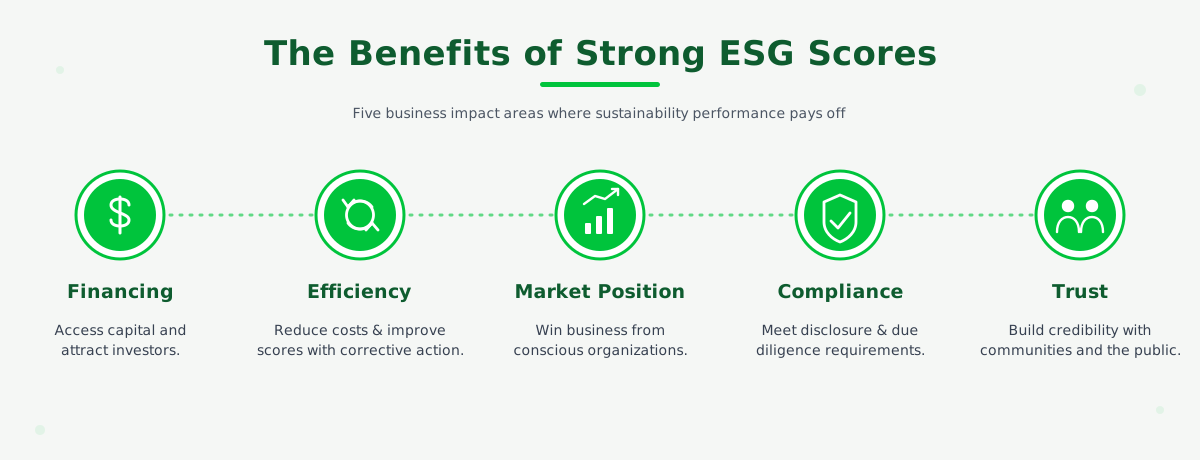
A strong ESG rating can positively impact business outcomes across multiple operational areas.
Capital and financing. Asset managers running ESG-screened funds use ratings to determine portfolio eligibility. Lenders, particularly those aligned with frameworks like the Principles for Responsible Banking, factor ESG performance into credit assessments. Companies with higher ratings tend to access capital at better terms and attract a broader investor base.
Operational efficiency. Tracking environmental and social metrics often surfaces inefficiencies that companies hadn’t yet quantified. Energy consumption, water use and waste generation frequently drop as a result of corrective action, producing cost savings and score improvements.
Brand and market position. Sustainability performance increasingly influences purchasing decisions, both at the consumer level and in B2B procurement. Organizations with higher scores are more likely to win business, as procurement teams across many industries now screen suppliers on ESG performance as a baseline qualification.
Risk and compliance. ESG ratings give companies a structured view of their regulatory exposure. As requirements like the EU’s Corporate Sustainability Reporting Directive (CSRD) and California’s SB 253 raise the bar on disclosure and due diligence, companies with mature ESG programs are better positioned to comply with minimal operational disruption.
Talent and trust. High ESG performance correlates with stronger employee retention and recruitment outcomes, particularly among younger workers. It also builds credibility with the communities where companies operate, which carries weight in markets where public trust affects the ability to do business.
How ESG Rating Agencies Assess and Score Companies
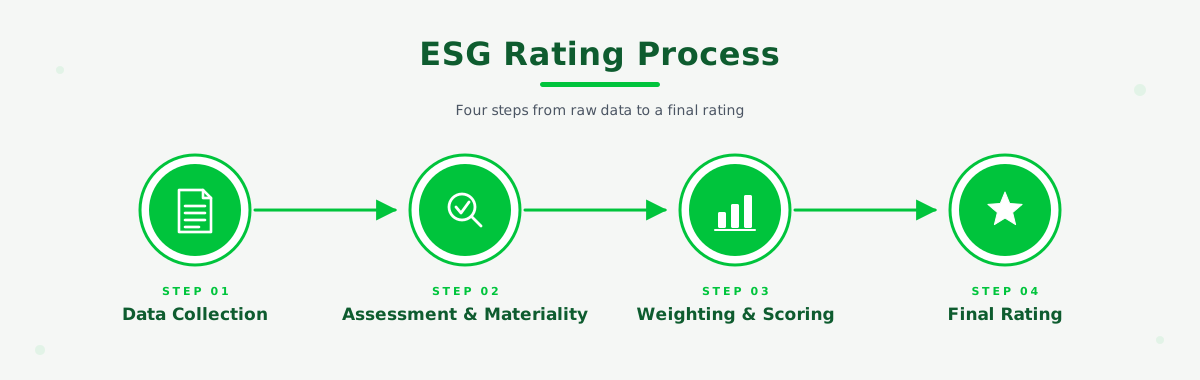
Each agency applies its own methodology, but the process generally follows a consistent structure across ESG analytics companies operating in this space.
1. Data Collection
Agencies gather information from two primary channels. Company-provided documentation includes sustainability reports, environmental impact assessments, governance structures, policies and program records. Third-party audit findings also fall into this category, offering insight into compliance and policy effectiveness.
The second channel covers external sources: regulatory bodies, NGOs, news outlets and certifications such as ISO 14001 for environmental management or ISO 26000 for social responsibility. Companies that use ESG reporting software to organize and structure internal data before submission tend to produce more complete, consistent documentation, which supports a more accurate assessment.
2. Assessment and Materiality
Analysts evaluate a company’s policies, practices and performance against relevant ESG criteria. Assessors consider which issues are material to a specific industry and geography, because sustainability risks vary significantly across sectors. A mining company carries far greater environmental exposure than a software firm, while in financial services, governance and data privacy likely matter more than emissions metrics.
3. Weighting and Scoring
ESG factors carry different weights depending on their relevance to the company being assessed. Industry-specific weighting ensures scores reflect legitimate risk exposure rather than a uniform checklist applied across all sectors.
In practice, this means two companies in the same revenue bracket can receive very different scores based purely on their industry’s risk profile. A high carbon footprint matters more for an energy company than a consulting firm. Labor practices carry more weight in manufacturing than in software development. The score is designed to reflect what actually matters for each unique business and sector.
4. Final Rating
Each agency produces a final rating by combining weighted scores across all ESG factors, expressed on a numerical scale or as letter grades, depending on the methodology. Advanced methodologies integrate both quantitative data, like emissions figures and diversity statistics, and qualitative assessments of policy effectiveness and governance quality. The final rating maps a company’s relative performance and identifies where risk is most concentrated, giving companies a clear basis for prioritizing improvement.
Rating Agencies and ESG Advisory Firms: Separate Roles, Shared Goals
ESG rating agencies and ESG advisory firms serve different functions, though they work toward the same outcome: verifiable and credible sustainability performance.
Rating agencies assess. They evaluate performance against established criteria and produce an independent score. Their value lies in their objectivity, which means they do not provide direct guidance to the companies they rate.
ESG advisory firms and consultants fill the strategy gap. These firms review a company’s score, identify areas of poor performance or increased risk and develop targeted corrective action plans. The goal is to turn a completed rating into a clear path forward.
EcoVadis is a leading global sustainability rating platform, helping companies assess their performance across environment, labor and human rights, ethics, and sustainable procurement categories. As an independent rating agency, EcoVadis does not offer direct consulting services. Instead, we connect rated companies with a network of Accredited Consulting Partners. These firms hold formal accreditation from EcoVadis and specialize in helping organizations improve scores in each rating category.
EcoVadis: Setting the Bar in Sustainability Ratings
EcoVadis is a global sustainability intelligence platform that combines analyst-validated ratings with a suite of tools to help companies move from assessment to measurable improvement. Each solution addresses a specific layer of ESG performance and supply chain risk.
- EcoVadis Ratings: Analyst-verified supplier assessments aligned with international frameworks and sustainability standards. Ratings are supported by news monitoring across 100,000+ sources, powerful compliance dashboards and corrective action plan management to track supplier progress over time.
- EcoVadis IQ Plus: AI-powered ESG risk mapping across 100% of a company’s supply base. IQ Plus delivers real-time risk intelligence and detailed supplier profiles that support compliance with CSRD, LkSG, Modern Slavery Acts and more.
- Worker Voice: A direct worker engagement platform that streamlines human rights due diligence across global supply chains. Worker Voice establishes always-on grievance mechanisms, auditable reporting and anonymous communication channels to reduce human rights risk and meet growing regulatory demands.
- Carbon Action Manager: A supply chain decarbonization tool that collects reliable Scope 1, 2 and 3 emissions data from suppliers and tracks progress toward reduction targets with 35+ metrics and customizable dashboards.
Together, these solutions give companies the visibility and structure to actively improve their ESG performance rather than simply report it.
In Conclusion
ESG rating agencies give today’s organizations a common language for evaluating sustainability performance. They aggregate data, apply consistent frameworks and produce scores that inform decisions across operations and the value chain. What a company does with that score is what separates a basic compliance exercise from a genuine market advantage. The businesses committed to robust ESG programs treat their ratings as a starting point for improvement, not the destination.
FAQs
Q: How often are ESG ratings updated?
A: Most ESG ratings are updated annually. Organizations that have identified high-risk or underperforming suppliers may request more frequent assessments from those specific partners to drive accountability and ensure progress on corrective actions.
Q: Are ESG ratings mandatory?
A: Ratings themselves are not mandatory, but they often support the data collection and validation required to meet growing ESG regulatory requirements. Frameworks like the EU’s Corporate Sustainability Reporting Directive and Corporate Sustainability Due Diligence Directive require companies to assess and disclose ESG risks across their supply chains. An independent rating provides a structured, credible way to meet those obligations.
Q: How do investors use ESG ratings?
A: Investors use ESG ratings to screen portfolios, assess risk and guide allocation decisions.
- Asset managers running ESG-mandated funds rely on ratings to determine which companies meet their eligibility criteria.
- Institutional investors use ratings to benchmark companies within a sector and monitor ESG risk exposure over time.
- In debt markets, lenders increasingly factor ESG performance into credit assessments, particularly for sustainability-linked loans where pricing is tied to specific performance targets.
Q: What’s the difference between ESG ratings and ESG reporting?
A: ESG reporting is the process by which a company discloses its sustainability data, policies and performance, typically through an annual report aligned with frameworks like the Global Reporting Initiative or the International Sustainability Standards Board.
ESG ratings are independent evaluations of performance, produced by a third party using its own methodology. A company controls what it reports. It does not control how a rating agency interprets and scores that information. Strong reporting practices generally support more accurate ratings, but the two serve different audiences and different purposes.

Ashley Raleigh is a supply chain professional with 10 years of experience across freight operations, logistics technology, and sustainability. Her work focuses on the evolving role of technology, strategy, and responsible practices in modern supply chains.