
 ChatGPT
 Gemini
 Perplexity
 Claude
 Grok



Gain insights from 30+ sustainability leaders, including superstars like Paul Polman, former CEO of Unilever, and Helena Helmersson, former CEO of H&M Group. Learn how to build a sustained advantage through responsible business practices.
20th October 2026
Supplier Collaboration in Procurement: A Practical Guide for 2026
Read summarized version with:
Supply chain disruptions cost businesses around $184 billion a year, and those risks rarely originate inside the buyer’s own operations. More often, they sit with suppliers, whose performance buyers depend on to keep their own operations running.
That dependency now runs through regulation and emissions targets too. Scope 3 emissions, the largest share of most corporate footprints, are generated entirely by suppliers, and disclosure rules increasingly require companies to show they are managing that exposure. Supplier collaboration is how procurement teams can more effectively control disruption, disclosure and emissions exposure at the source.
Key Takeaways
- Supplier collaboration means working continuously with suppliers to cut emissions, close compliance gaps and build resilience.
- Only 41% of suppliers say their large customers are highly committed to supply chain sustainability, according to the EcoVadis Sustainable Procurement Barometer.
- Data collection is no longer the constraint. 98% of organizations use ESG intelligence in procurement, so the advantage is now in acting on it.
- Organizations with high sustainability intelligence are 3.6 times more likely to engage suppliers strategically, and that engagement is paying off.
- The programs that work prioritize high-impact suppliers, pair expectations with support, tie contracts to performance and track progress continuously.
How Is Supplier Collaboration Different Than Supplier Management?
Supplier collaboration is the practice of working actively and continuously with suppliers to achieve shared operational, commercial and sustainability goals. It goes beyond vendor management and basic compliance monitoring.
Traditional supplier management asks, “Are our suppliers meeting our requirements?” Supplier collaboration asks, “How do we help our suppliers improve, and how do we create value together in the process?”
In sustainable procurement, collaboration focuses on four areas:
- Reducing Scope 3 emissions
- Closing compliance gaps
- Building supply chain resilience
- Co-developing innovation that neither party could achieve independently
Supplier management and supplier collaboration differ mainly in how they measure success. Supplier management relies on periodic audits and assessments, and it measures success by whether a risk has been identified, not whether it has been resolved. A team knows which suppliers pass and which fail, and it acts mainly when a threshold is breached. Collaboration requires continuous engagement, and it measures success by whether supplier performance actually improves.
| Supplier Management | Supplier Collaboration | |
| Purpose | Compliance and control | Shared improvement and value creation |
| Engagement | Periodic audits and assessments | Continuous, structured engagement |
| Data use | Score tracking | Intelligence-driven action |
| Commercial link | Transactional | Incentives tied to performance |
| Outcome | Risk visibility | Risk reduction and innovation |
The Supplier Engagement Gap
Most buyers assume their suppliers know what is expected of them. The data suggests otherwise. According to the EcoVadis Sustainable Procurement Barometer 2026, only 41% of suppliers say their large customers are highly committed to and actively engaged in supply chain sustainability. Nearly half say customers express commitment in principle but follow through inconsistently and only 17% feel genuinely incentivized by customer sustainability initiatives.
Consider those numbers from a procurement leader’s perspective. A supplier sustainability program and a scorecard mean little when suppliers see little incentive to improve. Without better contract terms or committed order volumes on the line, the program is unlikely to create meaningful, lasting change, and instead simply generates reports to sit in a file.
The engagement gap has three specific causes.
- Expectations without consequences: Buyers set sustainability requirements that are rarely tied to sourcing decisions, contract renewals or pricing. Suppliers learn quickly that the score carries less weight than the relationship.
- Assessment without support: Programs demand compliance data with no guidance on improvement. A supplier that’s handed a questionnaire with no context, no resources or no follow-up will complete it once and forget about it later.
- Attention spread too thin: Buyers give a critical Tier 1 manufacturer and a low-spend logistics provider the same generic outreach. That treats every supplier as equally important, so the highest-risk relationships that need direct engagement are rarely addressed.
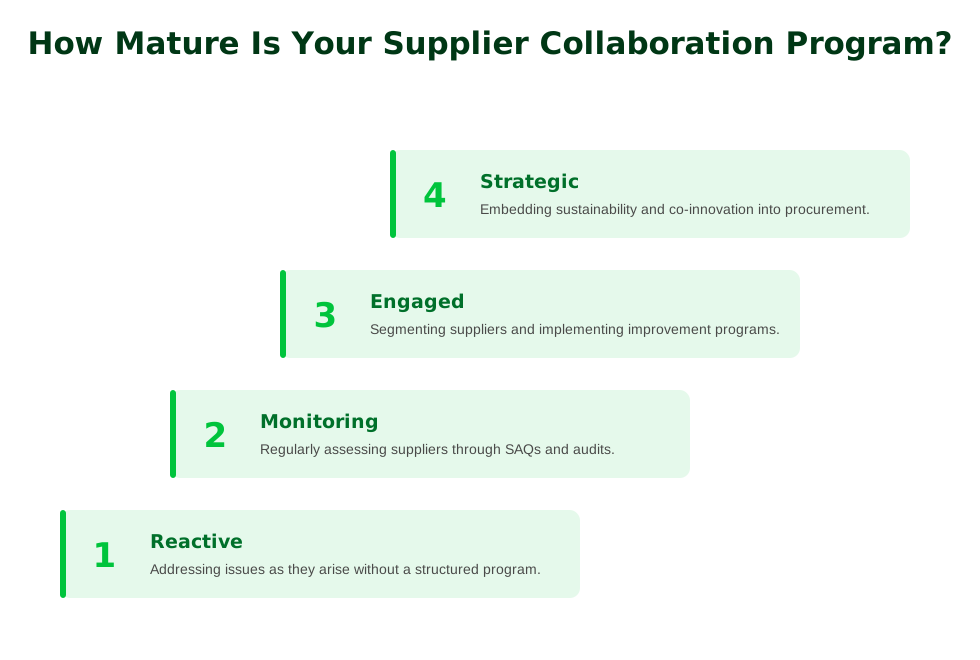
How to Turn Supplier ESG Data Into Action
Procurement has largely solved the data-collection problem. Nearly all organizations (98%) now embed ESG intelligence into at least one procurement process, according to Barometer 2026. Visibility into the supply base is climbing alongside it, with the share of organizations that can see performance across the majority of their Tier 1 suppliers rising from 27% to 48% in a single year.
Collecting supplier data and acting on it are different capabilities. Most procurement teams have built the first. Fewer have built the second, and that gap is where results are won or lost.
The organizations that close the gap are pulling ahead. Those with high sustainability intelligence are 3.6 times more likely to engage suppliers strategically than their peers. In practice, that means treating the assessment score as a starting point rather than a filing exercise:
- A weak assessment triggers direct support for that supplier, rather than sitting in a report.
- Strong performers earn a larger share of contracts, rewarding the suppliers already doing the work and showing the rest what good looks like.
- Limited engagement capacity goes to the suppliers whose risk or spend makes them worth the time, not to whoever is easiest to reach.
Data collection is now common practice, but what a team does with the data separates leaders from everyone else.
How Leading Teams Close the Supplier Emissions Data Gap
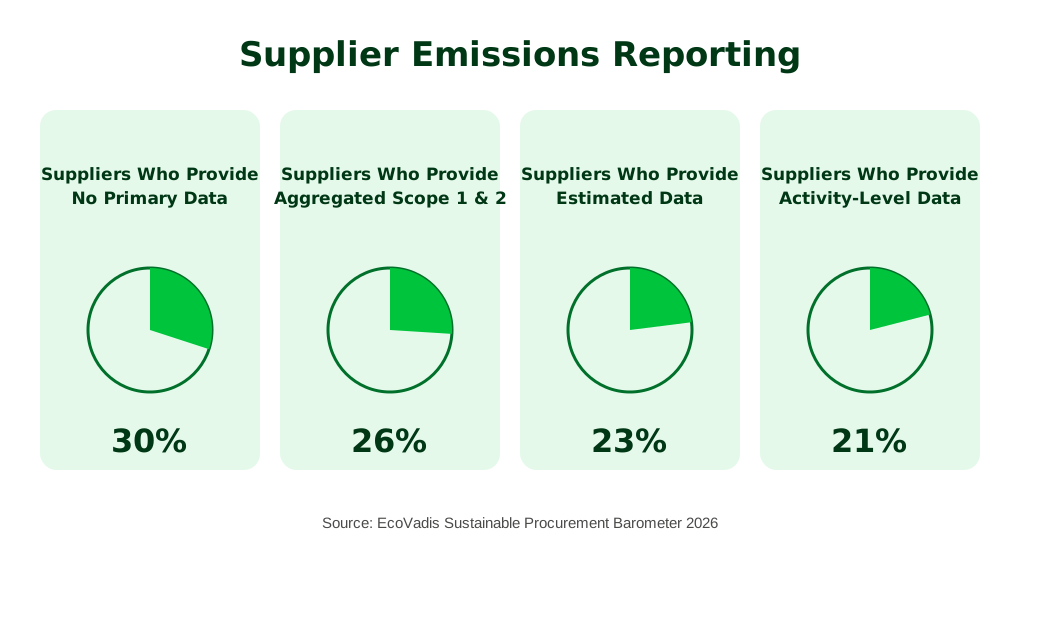
Suppliers remain the weakest link in emissions reporting. Only 1 in 5 suppliers provide primary carbon data across Scope 1, 2 and 3, and 30% provide no emissions data to buyers at all, according to Barometer 2026. That gap has direct regulatory consequences.
The CSRD requires value chain emissions disclosures for companies that meet the current thresholds of more than 1,000 employees and over €450 million in net turnover. Non-EU parent companies fall in scope above €450 million in net EU turnover with a qualifying EU subsidiary or branch.
CS3D adds due diligence obligations on environmental and human rights risks across supply chains. Following the EU’s 2026 Omnibus simplification package, it now applies only to larger companies, those with more than 5,000 employees and over €1.5 billion in turnover, with compliance required from July 2029. Both CSRD and CS3D require evidence of structured, documented supplier engagement that goes beyond an annual questionnaire.
The procurement teams closing this gap are restructuring engagement around four operational changes:
- Segmenting suppliers by risk, spend and decarbonization potential
- Replacing one-off assessments with continuous improvement programs
- Tying contract terms, preferred supplier status and volume commitments to sustainability performance
- Providing training and joint improvement plans alongside performance targets
When contracts and volume depend on their scores, suppliers begin to treat sustainability performance as a real priority.
Companies that have made this shift see supplier behavior change. For example, AstraZeneca embedded sustainability requirements directly into contracts, sourcing decisions and supplier performance management across approximately 95% of managed spend and 3,500+ suppliers.
- High-emitting suppliers received targeted decarbonization interventions.
- SMEs got tailored capability-building support.
- Performance was tracked through shared KPIs with leadership accountability attached.
Over 80% of spending is now with suppliers committed to science-based targets, and emissions intensity has fallen 52% since 2019.
Supplier Collaboration Benefits Beyond Risk Reduction
Risk reduction is only part of the case for supplier collaboration. EcoVadis Barometer data points to three more.
- Innovation is accelerating. Supplier innovation programs covering over a quarter of spend jumped from 9% of organizations in 2024 to 58% in 2026, as leading procurement teams co-develop low-carbon materials, redesign products for circularity and build sustainability criteria directly into category strategy.
- Innovation now drives the most ROI. Among top-performing organizations, 80% name it as their leading driver of program ROI, compared with 54% of other companies. Leaders also measure that value more rigorously: 81% quantify the financial ROI of specific initiatives, compared with 67% of other organizations.
- Collaboration lowers cost and lifts revenue. A supplier who redesigns a component to use less material cuts the buyer’s unit cost and emissions in the same move, and organizations with strong supplier collaboration report 3.6% higher revenue growth than their peers.
Five Practices Behind Effective Supplier Collaboration
Across the Barometer data, five practices separate programs that produce measurable results from programs that don’t.
- Prioritize high-impact suppliers: Concentrate engagement on the suppliers that carry the greatest risk, spend and emissions potential instead of spreading attention evenly. Segmentation comes first because every other practice depends on knowing which suppliers matter.
- Combine expectations with enablement: Pair each expectation with the means to meet it, like training, tools and joint improvement plans, alongside the target. A goal without a path to reach it often stalls.
- Use ratings and platforms to scale: Assessing every supplier directly exceeds any procurement team’s capacity. Third-party ratings let one assessment serve many buyers and create a consistent benchmark, increasing supplier participation and lowering engagement costs for both sides.
- Tie commercial outcomes to performance: Link preferred supplier status, contract terms and innovation partnerships to ESG performance, so improvement earns better business and stagnation costs it.
- Track progress collaboratively: Replace the annual audit with shared KPIs and regular performance reviews. Continuous tracking surfaces problems early enough to act on them.
How EcoVadis Enables Supplier Collaboration
Supplier collaboration is hard to scale manually. A company managing thousands of suppliers across dozens of countries cannot reasonably build a custom engagement program for each one, so the work has to run on shared data and standard tools.
EcoVadis is a sustainability intelligence platform that converts ESG data from companies across 180 countries into standardized, comparable ratings, each reviewed by in-house analysts and shared across a network of 55,000+ customers. A supplier assessed once shares that rating with every buyer, so organizations can work from defensible, verified data. The platform works across three stages:
- Map risk with IQ Plus: IQ Plus profiles risk across 100% of the supply chain and shows where it concentrates, so teams know which suppliers to engage first before any assessment starts.
- Assess performance with Sustainability Ratings: Ratings score suppliers 0 to 100 with medals and benchmark them against peers. Scorecards flag exactly where a supplier needs to improve, turning a rating into a work plan.
- Improve with corrective action plans and EcoVadis Academy: Action plans give suppliers a route to close those gaps and carry over into the next assessment, so progress compounds. Academy e-learning builds capability where suppliers lack it.
Procurement teams see where risk sits and prioritize the suppliers with the biggest impact, all on one shared network.
See how procurement teams use EcoVadis to scale supplier collaboration across global supply chains. Request a demo.
FAQs
How do we get suppliers to take sustainability collaboration seriously?
Commercial incentives are the most reliable mechanism. Suppliers respond to sustainability requirements when they are directly tied to contract renewals, preferred supplier status, pricing negotiations and access to new business. Training programs and capability-building support accelerate progress, but without a commercial signal behind the ask, most suppliers will treat sustainability engagement as a low-priority administrative task.
How does supplier collaboration work across different regions and cultures?
Supplier motivation varies significantly by market. China-based suppliers cite revenue and growth as their primary driver, while Indian and Brazilian suppliers are more purpose-driven. Japanese suppliers prioritize compliance and risk management above both. Engagement approaches and incentive structures need to reflect those differences. Performance expectations and measurement frameworks should stay consistent regardless.
What is the role of AI in supplier collaboration?
AI is becoming a practical procurement tool, not a future aspiration. Among buyers, 55% now use AI operationally in their sustainable procurement programs. The primary applications in supplier collaboration are risk monitoring across large supplier networks, identifying emissions hotspots in complex supply chains, flagging suppliers at risk of non-compliance before issues escalate and surfacing innovation opportunities by analyzing supplier capability data at scale.