
 ChatGPT
  Gemini
  Perplexity
  Claude
  Grok
Grok 

Gain insights from 30+ sustainability leaders, including superstars like Paul Polman, former CEO of Unilever, and Helena Helmersson, former CEO of H&M Group. Learn how to build a sustained advantage through responsible business practices.
8th June 2026
Decarbonization: A Corporate Roadmap to Measurable Results
Read summarized version with:
Decarbonization has evolved from a lofty corporate aspiration to a critical financial imperative. The costs of climate inaction are materializing faster than most organizations anticipated, with up to 25% of EBITDA at risk from climate-related disruption by 2050, and potential carbon-pricing liabilities already reshaping how investors and boards assess long-term value. The question for business leaders is no longer whether to decarbonize, but how to build a program that delivers results.
Key Takeaways
- Decarbonization requires reducing greenhouse gas emissions across operations and value chains, and has become one of the most pressing financial and operational priorities for business leaders today.
- Upstream Scope 3 emissions average 21 times greater than direct emissions, making supply chain decarbonization the most consequential action a company can take.
- Decarbonization programs succeed when they prioritize supplier engagement to collect verified emissions data and focus on science-based targets.
- Translating decarbonization commitments into measurable results requires the right operational infrastructure, from internal accountability structures to a time-bound climate transition plan.
What Is Decarbonization?
Decarbonization is the process of reducing or eliminating greenhouse gas emissions from a company’s operations and value chain. It targets emissions at every level, from energy use and manufacturing processes to procurement decisions and supplier practices.
Emissions are measured across three scopes:
- Scope 1: Direct emissions from owned or controlled sources, such as company vehicles and onsite fuel combustion
- Scope 2: Indirect emissions from purchased electricity, heat or steam
- Scope 3: All value chain emissions, including those generated by suppliers and the end use of products
For most industries, Scope 3 is the largest category by a significant margin, averaging 21 times greater than Scope 1 and 2 combined. It is also where companies have the most work to do.
Decarbonization vs. Net Zero
The two terms are related but not interchangeable.
Decarbonization prioritizes cutting emissions at the source through structural operational change. It is the work of identifying where emissions originate and systematically reducing them across operations and supply chains.
Net zero is a comprehensive climate goal where a company reduces its greenhouse gas emissions to the absolute minimum, then neutralizes any residual emissions (i.e., those that are too difficult or impossible to abate) through an equivalent amount of carbon removal. It’s important to note that reaching net zero requires decarbonization first. Carbon compensation measures should come into play only after a company has exhausted practical opportunities to reduce emissions at the source.
Why Corporate Decarbonization Can’t Wait
The financial case for acting now on decarbonization is no longer theoretical. EcoVadis and BCG analysis finds that unmanaged Scope 3 emissions could expose companies to more than $500 billion in global annual liabilities by 2030, equivalent to 15-20% of S&P 500 EBIT. For business leaders, the window to get ahead of that exposure is closing, as pressure is building across multiple fronts.
- Carbon pricing exposure: The EU Emissions Trading System and the Carbon Border Adjustment Mechanism (CBAM) are turning carbon intensity into a direct financial liability for companies and their suppliers.
- Mandatory disclosure: The EU’s Corporate Sustainability Reporting Directive (CSRD) and California SB-253 now require verified emissions reporting across all scopes, with supply chain data increasingly coming into scope in future years.
- Investor scrutiny: $222 trillion in global assets are now managed by institutions supporting ISSB/IFRS disclosure standards, and climate risk is increasingly priced into cost of capital and valuation.
- Customer and commercial pressure: B2B buyers are tightening supplier qualification criteria around carbon emissions, making transparency a factor in winning and retaining business.
Companies that move early on decarbonization efforts are already building cost-of-capital advantages and securing preferred supplier status with partners that have made climate performance a baseline requirement.
The Role of Supply Chain Decarbonization
Upstream Scope 3 emissions dwarf what most companies generate through their own operations, and no amount of progress on owned assets closes that gap without direct engagement across the value chain. The EcoVadis’ Carbon Action Report 2025 found that emissions disparity varies by sector, but the pattern is consistent:
- Retail supply chains generate Scope 3 emissions 55 times greater than direct emissions
- Food supply chains run 45 times higher
- Manufacturing supply chains generate 10 times more than Scope 1 and 2 combined
Effective supply chain decarbonization requires an intentional strategy. That typically involves segmenting suppliers by emissions footprint and climate risk exposure, and directing the most intensive engagement toward those that account for the largest portion of emissions and pose the greatest risk to the business.
How to Build a Corporate Decarbonization Strategy
Decarbonization strategies only deliver measurable results when they’re built on the right foundations and executed as a cross-departmental initiative, rather than an isolated sustainability function. The following steps outline a roadmap to help business leaders embed climate commitments into the company’s broader corporate strategy.
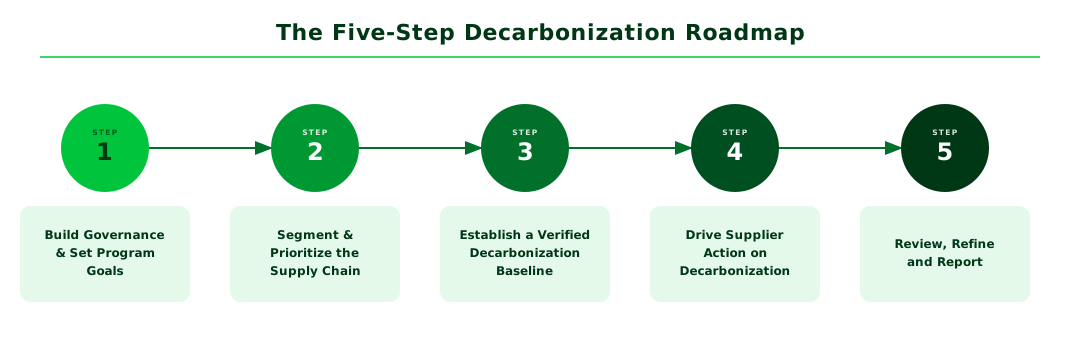
1. Build Governance and Set Program Goals
Effective decarbonization requires cross-functional ownership before anything else. That means establishing a team spanning procurement, finance and sustainability with defined responsibilities, securing executive buy-in for long-term commitments such as SBTi or net zero, and setting clear expectations for suppliers from the outset.
2. Segment and Prioritize the Supply Chain
Companies cannot engage every supplier at once. Use spend-based analysis or emissions risk mapping to identify the highest Scope 3 emitters across the value chain. Focusing resources on the most emissions-intensive supplier categories is what makes the program targeted rather than broad and diffuse.
3. Establish a Verified Decarbonization Baseline
With priority suppliers identified, companies can request primary emissions data directly, including corporate carbon footprints across all three scopes and product carbon footprints where applicable. Primary data replaces industry averages with supplier-specific figures, creating the verified baseline that credible target-setting requires.
4. Drive Supplier Action on Decarbonization
Group suppliers by carbon maturity and tailor engagement accordingly. Suppliers earlier in their decarbonization journey need upskilling resources and support to establish their own baselines. More advanced suppliers should be held to corrective action plans and progress monitored against reduction targets.
5. Review, Refine and Report
Monitor supplier progress annually and adjust procurement strategies as the data evolves. The verified primary data collected through this process forms the foundation for reporting under frameworks like CSRD and California SB-253, and for communicating decarbonization progress credibly to investors and customers.
Measuring and Reporting Decarbonization Progress
A decarbonization program is only as strong as the data behind it. Unmeasured emissions simply can’t be managed, and unverified progress can’t be reported to investors, regulators or customers with any confidence.
Most companies start their Scope 3 measurement journey using spend-based estimates and industry averages. That is a reasonable starting point, but it is not a destination. The goal is to progressively replace estimates with verified primary data collected directly from suppliers. A mature emissions measurement program should include:
- Third-party verified emissions data across all three scopes
- Product-level carbon footprinting for high-impact supplier categories
- Primary emissions data collected directly from suppliers at scale
- Integration with procurement workflows and board reporting cycles
EcoVadis Carbon Action Manager gives companies the infrastructure to collect, assess and act on supplier carbon data at scale, connecting emissions performance directly to procurement decisions. Contact us to get started with EcoVadis today.
FAQs
How do companies measure decarbonization progress?
While a fully verified emissions inventory is the gold standard, most companies must initially rely on secondary data (i.e., industry averages or spend-based estimates) to measure their complex Scope 3 supply chain emissions.
Even with estimated baselines, companies can set science-based targets and track reductions. Over time, they incrementally replace these estimates with primary supplier data to improve accuracy.
What are the biggest barriers to corporate decarbonization?
Most corporate decarbonization programs run into several critical obstacles:
- Data gaps: Without primary Scope 3 emissions data, target-setting is unreliable and progress is impossible to measure accurately.
- Supplier capability constraints: Many suppliers, particularly smaller ones, lack the resources or systems to track and report emissions data.
- Weak internal accountability: Without dedicated ownership, budget and executive compensation tied to emissions outcomes, decarbonization programs lose momentum across planning cycles.
- Regulatory complexity: Inconsistent requirements across regions make it difficult to build a single unified reporting and reduction strategy.
What role does procurement play in corporate decarbonization?
Procurement is the primary lever companies have for addressing Scope 3 supply chain emissions. Because most corporate emissions occur outside owned operations, the sourcing decisions, supplier qualification criteria and contract terms that procurement teams control determine whether a company’s decarbonization targets extend meaningfully into the supply chain.