
 ChatGPT
  Gemini
  Perplexity
  Claude
  Grok
Grok 

Gain insights from 30+ sustainability leaders, including superstars like Paul Polman, former CEO of Unilever, and Helena Helmersson, former CEO of H&M Group. Learn how to build a sustained advantage through responsible business practices.
12th May 2026
What Is Supply Chain Resilience? Pillars, Strategies and Examples
Read summarized version with:
In a contemporary landscape characterized by high volatility, supply chains are increasingly vulnerable to disruption. Events like geopolitical conflicts, public health crises, natural disasters and cyberattacks pose significant risks to production continuity and financial stability. Consequently, developing supply chain resilience is a critical strategic priority.
This blog explores the definition of resilience in supply chains, why it matters and practical steps organizations can take to build more flexible supply chains.
Key Takeaways
- Supply chain resilience is the ability to withstand disruptions, adapt quickly and maintain operations under pressure.
- Building resilience requires visibility, flexibility and collaboration across every tier of the supply chain.
- Core strategies include multi-sourcing, nearshoring, inventory buffers and real-time digital visibility.
- Strong resilience protects revenue, strengthens brand trust and creates a competitive advantage when disruptions hit.
What is Supply Chain Resilience?
Supply chain resilience is the ability of a supply chain to withstand disruptions, adapt quickly and recover rapidly, often emerging stronger than before. It involves a proactive strategic framework designed to maintain operational continuity and protect financial performance during volatile events.
Rather than focusing solely on cost-optimization, a resilient supply chain prioritizes flexibility and redundancy to mitigate risks.
The Four Pillars of a Resilient Supply Chain
These four pillars are key to helping supply chains handle and bounce back from unexpected problems like disasters or sudden demand changes.
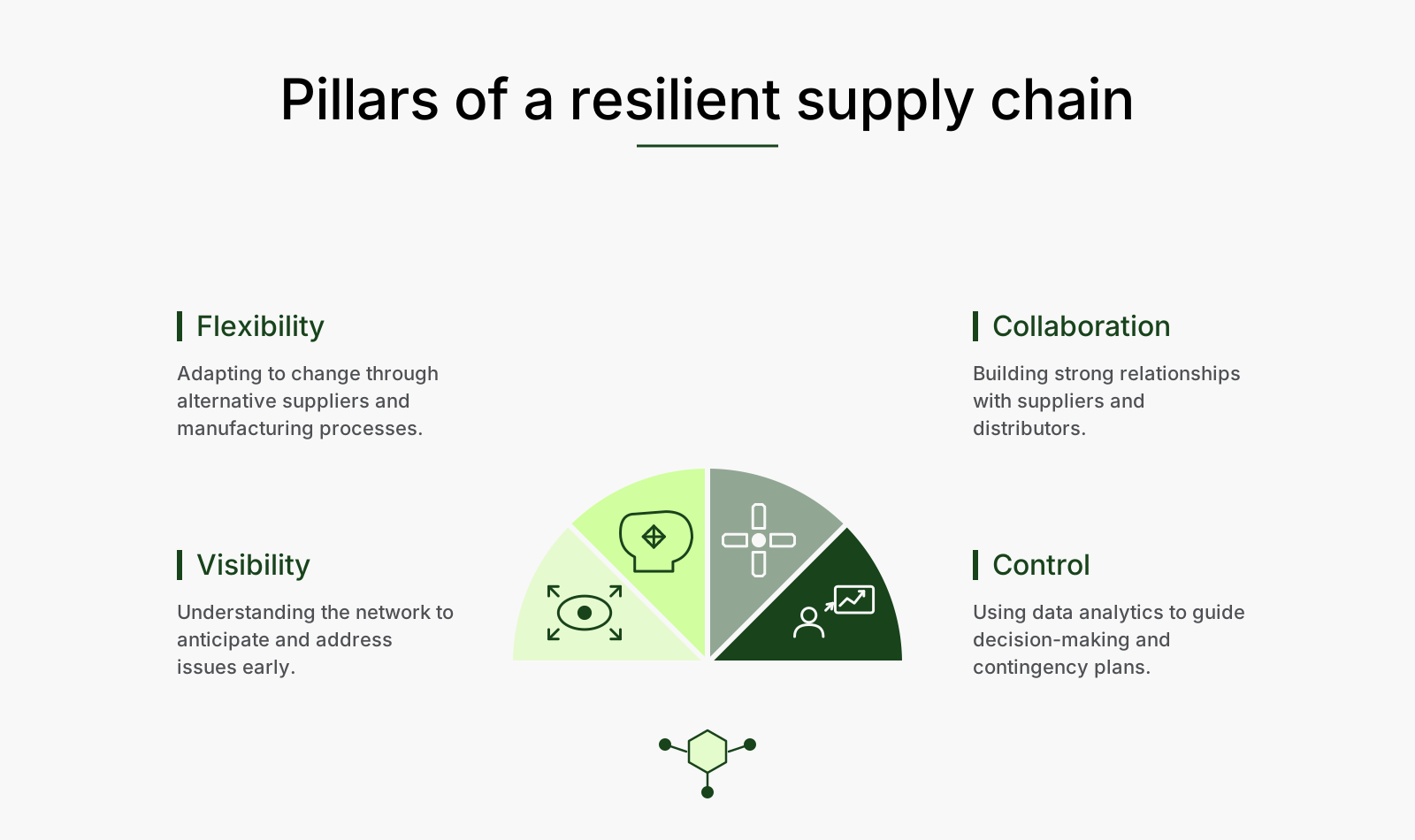
- Visibility (End-to-End Transparency): True resilience means understanding your entire ecosystem, including suppliers’ suppliers, to find hidden problems. This foresight helps you anticipate and address potential crises early.
- Flexibility: It means adapting to change easily, without high costs or delays. This includes having alternative suppliers, transport routes and adaptable manufacturing.
- Collaboration: A supply chain is inherently a connected network, requiring collaboration among its participants. This means building strong, trusting relationships with everyone involved, including suppliers, distributors and even other companies in the same industry.
- Control: It is the framework for making decisions and acting on gathered information. It uses analytics to track KPIs and activate contingency plans when limits are reached.
Why Supply Chain Resilience Matters
In an era defined by volatility, supply chain resilience has evolved from a strategic advantage into a fundamental assessment. Regulatory shifts like the EU’s Omnibus package, which scaled back CSRD and CSDDD reporting requirements for many companies, have created uncertainty rather than clarity. Organizations that built resilience around compliance timelines are now reassessing their approach.
The following factors demonstrate why resilience remains critical regardless of where regulations land:
Protecting Financial Stability and Revenue
A recent study found that supply chain disruptions cost an average of $1.5 million daily in 2025. A resilient supply chain helps reduce these major financial losses. Resilience ensures that, even during a crisis such as a port strike or factory fire, you have sufficient backup stock or alternative supply chains to keep products on shelves.
For instance, like many other companies, Apple previously relied heavily on manufacturing and suppliers in China. Following the 2011 Thailand floods and subsequent COVID-19 lockdowns, the company diversified its supplier base by including India, Vietnam and other locations.
Currently, Apple manages to get through difficult times without significant earnings declines, which tends to foster more investor confidence.
Safeguarding Brand Reputation and Trust
Supply chain disruptions can lead to significant public relations challenges, particularly on social media platforms. Even minor supply chain issues pose a reputational risk. Supply chain resilience can prevent this from happening and help you maintain a positive image with your customers and the general public.
Gaining a Competitive Advantage
A resilient company can act proactively while its competitors are reactive. As a result, they often gain a substantial market advantage.
During the 2021 semiconductor shortage, companies with resilient sourcing strategies, like Toyota, were able to continue production while their competitors’ lines sat idle. This allowed them to capture market share that may never shift back.
Enabling Innovation and Agility
A resilient supply chain is flexible. Having a diverse supplier network means you have connections with numerous options. As a result, it will be simpler to switch to new materials or technologies when customer preferences change.
Additionally, resilient systems are built on standardized integration frameworks. This modular architecture allows companies to seamlessly onboard new suppliers or integrate localized production hubs without disrupting the entire network.
This agility enables organizations to scale into new geographic markets with minimal friction, ensuring they can respond to local regulatory changes or carbon-reduction mandates with speed and precision.
National and Global Security
Supply chain resilience is a fundamental of national security because it ensures a country can maintain its defense systems, energy grids and healthcare without depending on unstable or hostile foreign sources.
When critical supplies, like semiconductors or rare minerals, are concentrated in a single region, they can be used as “geopolitical leverage” to weaken a nation during a conflict. A resilient global network can mitigate economic instability and resource scarcity, which often lead to civil unrest and international conflict.
Supply Chain Efficiency vs. Resilience: The Strategic Shift
The global economy has moved from an era that obsessed over efficiency to a modern one that prioritizes resilience amid increased global volatility.
The table below highlights the differences between prioritizing pure efficiency and committing to organizational resilience:
| Feature | Lean (Traditional) | Resilient (Modern) |
| Primary Focus | Cost Reduction | Business Continuity |
| Sourcing | Single Sourcing
(Global) |
Multi-sourcing (Regional/
Global) |
| Inventory | Minimum (Just-in-
Time) |
Strategic Buffers (Just-in-
Case) |
| Flexibility | Low (Rigid structures) | High (Agile networks) |
Challenges of Resilience in Supply Chain
While the benefits of a resilient supply chain are clear, building one is far from easy. It often requires a fundamental shift in business philosophy, moving away from short-term cost savings toward long-term survival.
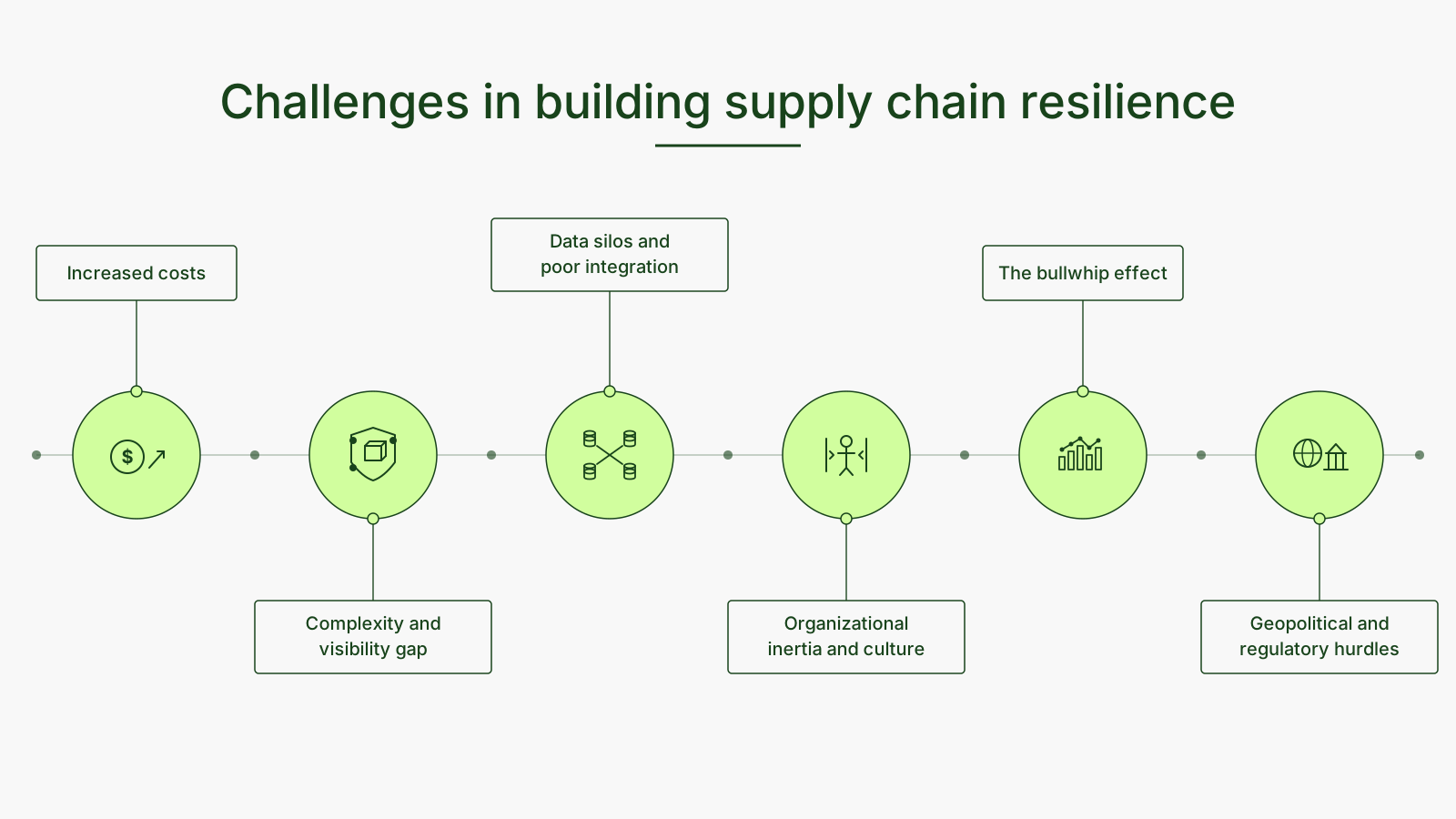
Here are the challenges organizations face when trying to acheive resilience:
Increased Costs
The financial commitment of building resilience can be a significant challenge. Some costs to consider include:
- Inventory Carrying Costs: Moving from “Just-in-Time” to “Just-in-Case” means holding more stock. This ties up capital that could be used for R&D or marketing and increases warehousing expenses.
- Supplier Diversification: Managing multiple vendors rather than a single partner means losing the economies of scale that come with bulk-buying discounts. It also increases administrative costs for auditing and coordinating with a larger supplier base.
- Redundancy Costs: Maintaining backup suppliers or idle production capacity feels like a waste of money during stable times, making it a hard sell to CFOs and shareholders.
Complexity and the Visibility Gap
Most companies have reasonable visibility into their direct suppliers. The problem is what comes next. According to the EcoVadis 2026 Sustainable Procurement Barometer, while nearly 80% of buyers can see the sustainability performance of more than half of their Tier 1 suppliers, that figure drops to just 12% at Tier 2. Tier 3 remains largely unseen.
That gap is where risk lives. Raw materials, labor conditions and emissions buried deep in the supply chain can expose a company to disruptions it never saw coming. Comprehensive supplier risk mapping is how organizations start closing that gap.
Data Silos and Poor Integration
Resilience requires real-time data, but many organizations still operate in silos. Procurement, logistics and sales often use different software that is incompatible, making it hard to share information quickly
This is worsened when suppliers are reluctant to share their own data due to privacy or competition. Without a shared truth connecting everyone, it is nearly impossible to coordinate a fast, effective response to a disruption.
To resolve it, use a single digital platform that connects all your departments and allows your software to talk to your suppliers’ systems. By creating clear rules on how to share data safely, you build the trust needed to coordinate quickly during a crisis.
Organizational Inertia and Culture
This challenge is essentially a “collision of priorities” between how companies have been run for decades and what they need to do to survive today. The biggest barrier to a resilient supply chain often isn’t technology or money, but human habit and corporate structure.
For the last 30 years, the goal of supply chain management was lean, eliminating every penny of presumed waste. In that mindset, having extra inventory or multiple suppliers was seen as a failure.
Resilience requires redundancy (extra stock, extra suppliers). For a traditional manager, redundancy might seem like inefficiency, but it actually serves as a form of insurance.
The Bullwhip Effect
The Bullwhip Effect is a supply chain phenomenon where small changes in consumer demand create increasingly large and distorted fluctuations as they move up toward manufacturers.
When a disruption occurs, every company in the supply chain might overreact by ordering twice the amount they require to create a safety stock. This leads to manufactured shortages and extreme demand fluctuations, destabilizing the entire supply chain and causing significant disruption for manufacturers.
To resolve the Bullwhip Effect, share real-time sales data across the supply chain and use a shared forecast to respond to actual customer demand, not distorted orders.
Geopolitical and Regulatory Hurdles
Geopolitical and regulatory hurdles pose a challenge for most businesses trying to relocate production to new countries. Companies often run into red tape like confusing tax laws and trade tariffs or find that the new location lacks reliable power and skilled workers.
To overcome this, you should perform deep research into a country’s local laws and infrastructure before moving, while keeping your operations flexible enough to adapt to sudden regional changes.
Supply Chain Resilience Strategies
You shouldn’t wait until a disruption occurs to build a resilient supply chain. Always have a strategy that includes a mix of structural, technological and strategic shifts.
Here are the primary strategies for building a resilient supply chain:
Multi-Sourcing and Diversification
The era of relying on a single, low-cost supplier is ending. If that partner or region is hit by supplier insolvency, regional conflict or evolving trade regulations, your entire production line stops. Diversify suppliers across different countries, even continents, to avoid localized disasters or political instability.
Samsung is a great example of successful diversification. They moved most of their production from China to Vietnam and India, ensuring their phones could still be built even if one region faced trade wars or lockdowns.
Near-shoring and Regionalization
When considering diversification, one strategy is to move production to a country near your primary market. Currently, U.S. companies with at least one production line in Mexico are better positioned for resilience than those that rely solely on Chinese suppliers. Reducing the physical distance between production and the end consumer decreases lead times and transportation risks.
Moving from “Just-in-Time” to “Just-in-Case”
Transitioning from a Just-in-Time to a Just-in-Case strategy requires a thorough understanding of both approaches and their differences.
- Just-in-Time (JIT): A lean strategy where materials arrive only as they are needed for production. It minimizes inventory costs and storage but is highly vulnerable; if one supplier fails, the whole line stops.
- Just-in-Case (JIC): This approach means intentionally keeping extra stock of essential parts to protect against unpredictable disruptions.
Moving from JIT to JIC is essentially buying insurance. Paying slightly more for storage now acts as insurance against future losses, such as those caused by supplier insolvency or regional conflict.
Digital Visibility and the Control Tower
Visibility enables companies to monitor operations in real time, but true resilience requires supply chain transparency, where data is traceable and shared across the entire network. To implement this level of transparency, companies should leverage IoT sensors, cloud platforms and sustainable management software to track shipments and inventory in real time.
Product and Process Standardization
To build a more resilient supply chain, companies should focus on product and process standardization. By using standard parts instead of custom, one-of-a-kind components, you avoid being locked into a single supplier and can more easily source from multiple vendors.
Designing products for interchangeability also allows you to swap in alternative parts without stopping production for a redesign. This flexibility ensures that if one supplier fails, your business can keep running without a major interruption.
Collaborative Partnerships
Your supply chain is only as strong as its most vulnerable link. If a Tier 2 or Tier 3 supplier collapses under the weight of a disruption, your entire production line stalls. Moving from a transactional relationship to a collaborative partnership means shifting your focus from “What can you do for me?” to “How can we survive together?”
Don’t just demand higher standards; help your suppliers meet them. Help suppliers optimize manufacturing by sending experts or sharing sales forecasts for better inventory and labor management.
Bottom Line
In a landscape defined by frequent disruption and evolving regulations, supply chain resilience is a critical competitive advantage. It is achieved by integrating real-time visibility, operational flexibility, and proactive collaboration with a diversified supplier base.
Rather than attempting to eliminate all risks, a resilient strategy focuses on the ability to adapt and maintain continuity during unforeseen events. Organizations that prioritize these capabilities will not only withstand volatility but will also be better positioned for sustainable growth and long-term market trust.

Ashley Raleigh is a supply chain professional with 10 years of experience across freight operations, logistics technology, and sustainability. Her work focuses on the evolving role of technology, strategy, and responsible practices in modern supply chains.