
Sustainability Reporting Gap: Why Your Work Isn’t Showing Up in Your Score
Read summarized version with:
 ChatGPT
 Gemini
 Perplexity
 Claude
 Grok
According to the Supplier Intelligence Report 2026, 80% of assessed companies have active ethics practices in place, but only 38% document and report on them. The pattern holds for labor and human rights as well: 97% have measures active, only 75% formally report them. The work is happening across global supply chains. It just isn’t visible. That distinction is becoming more consequential.
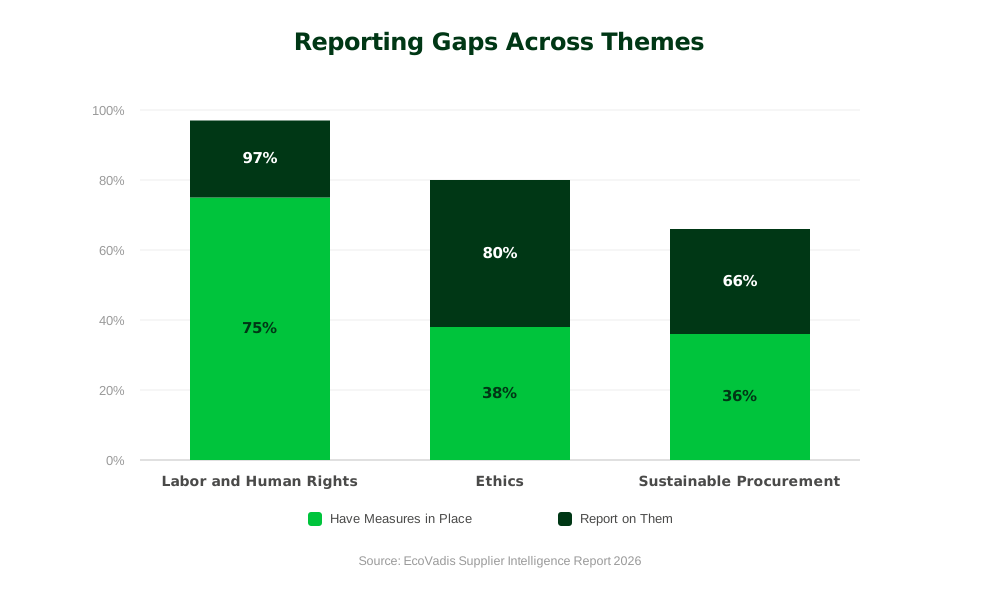
Documentation Determines Visibility
Sustainability teams often assume that doing the work is the hard part, and reporting on it is secondary. The data suggests the opposite is true. 68% of buyers report they are operationally deploying AI tools. Automated systems evaluate what’s recorded and verified, not what a team knows is happening internally. An undocumented practice, however real, is functionally invisible to the system deciding whether you get selected, retained, or flagged for follow-up.
The EcoVadis methodology reflects this: it scores analyst-verified, uploaded documentation rather than informal practice. That’s the only way a rating can be consistent and defensible across thousands of suppliers.
The Upside is Measurable
Closing the reporting gap isn’t just risk mitigation, it shows up in your score, too. Companies that move from informal practices to documented ones see it reflected quickly. Small companies, specifically, score an average of 7.4 points higher on their second EcoVadis rating than their first, using the same baseline resources they started with. The improvement comes from documentation literacy, not additional budget or headcount.
Where to Start Closing the Gap
Closing a 42-point reporting gap doesn’t require a complete rebuild. It typically starts with three things: putting existing policies and protocols in writing, gathering the evidence already sitting in employee handbooks and internal files, and treating documentation as part of the sustainability work. Teams that make this shift tend to see it reflected in their next assessment cycle, not years down the line.
For suppliers working through this, the EcoVadis Community offers dedicated discussion forums including the EcoVadis Questionnaire and Understanding & Leveraging Your Scorecard. Here you can get instant insights into what counts as evidence, what analysts are looking for, and what closed a similar gap for a company like yours. You don’t have to guess at what “good documentation” looks like when peers who’ve already closed the gap are there to tell you.