
 ChatGPT
  Gemini
  Perplexity
  Claude
  Grok
Grok 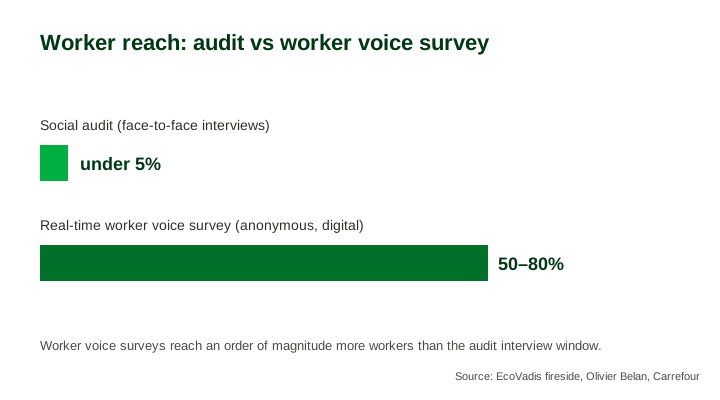

Gain insights from 30+ sustainability leaders, including superstars like Paul Polman, former CEO of Unilever, and Helena Helmersson, former CEO of H&M Group. Learn how to build a sustained advantage through responsible business practices.
28th August 2026
How Direct Worker Engagement Strengthens Human Rights Due Diligence
Read summarized version with:
Human rights due diligence has moved from a voluntary best practice to a regulatory requirement in many markets. Regulations like CSDDD, LkSG, and the various Modern Slavery Acts now expect companies to demonstrate that they understand working conditions across their supply chains, not just at headquarters level, but at the factory and community level, in the markets where goods are actually produced.
Meeting that expectation requires more than documentation. It requires a genuine channel to workers themselves.
What worker voice means in practice
EcoVadis’s Worker Voice solutions give companies a structured way to collect direct, anonymous feedback from workers and communities across their supply chains. Through mobile-based surveys, grievance mechanisms, and two-way communication tools, it surfaces real-time insights on working conditions, health and safety, well-being, and environmental impact.
The platform currently reaches 5.7 million people across 5,000+ workplaces, with over 18 million data points collected. That scale reflects a core principle: worker engagement only works if workers can actually participate.
Connectivity is part of the solution
For Worker Voice to work at this scale – especially across emerging markets – the communications infrastructure beneath it has to be genuinely global. Workers complete surveys and access grievance channels primarily via mobile. In many regions, that means navigating complex telecom environments where standard cloud communications don’t always connect reliably without specialist routing and local number availability.
This is where our partnership with BICS, a Proximus Global company, becomes directly relevant. For three years, BICS has provided the cloud and mobile numbering and international voice termination that keeps EcoVadis’s engagement tools, surveys, and hotlines running, including in the markets where they’re needed most.
As Konstantinos Lentas, our Senior Telecom Engineering Manager, explains:
“Human rights due diligence depends on trust at scale. For three years, BICS has kept our engagement tools, surveys, and hotlines running reliably worldwide, including in the hardest-to-reach markets. That reliability lets us focus on what we do best: building the technology that brings worker voices into supply chains everywhere.”
Why this matters for procurement teams
Regulations requiring human rights due diligence are asking companies to demonstrate something specific: that they have credible, ongoing visibility into labor conditions across their supply chains. Anonymous worker surveys and accessible grievance mechanisms are increasingly recognized as part of how that visibility is established.
The data those tools generate – on working conditions, reported misconduct, health and safety concerns – feeds directly into how EcoVadis assesses performance on labor and human rights, one of the four themes in every EcoVadis rating. But beyond the rating, it’s the kind of insight that helps procurement teams identify where to focus improvement efforts, and demonstrate to regulators and stakeholders that their due diligence is grounded in real evidence.
For supply chain sustainability programs to hold up to scrutiny, the tools behind them need to reach workers where they actually are.
Learn more about how EcoVadis’s Worker Voice solution supports human rights due diligence and supply chain transparency at ecovadis.com.