
The Carbon Maturity Ladder: 5 Breakthrough Actions
Read summarized version with:
 ChatGPT
 Gemini
 Perplexity
 Claude
 Grok
EcoVadis & Kearney’s 2026 Carbon Action Report finds many companies stall halfway up the carbon maturity ladder. Five specific actions predict who breaks through.
For companies trying to accelerate Scope 3 progress, the hardest part is typically not getting started but breaking through the intermediate plateau. Analysis of roughly 56,000 companies rated through the EcoVadis Carbon Action Manager over the past year shows that the early steps on EcoVadis’ five-level carbon maturity ladder are relatively accessible, but many companies stall moving from Intermediate to Advanced. The 2026 Carbon Action Report identifies the five actions that separate those who break through from those who remain stalled.
Key takeaways
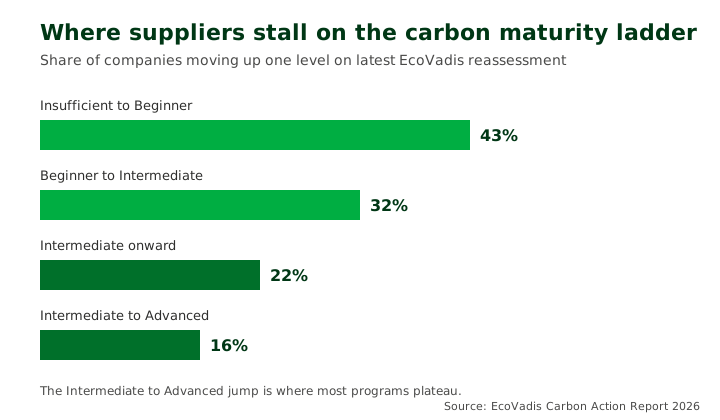
- Only 16% of companies at the Intermediate level moved up to Advanced upon their latest EcoVadis reassessment, versus 32% moving from Beginner to Intermediate.
- Five actions predict a breakthrough on the carbon maturity ladder: linking management pay to emission reductions, partnering with suppliers on reduction initiatives, collecting primary Scope 3 data, adopting a time-bound low-carbon transition plan, and creating a dedicated GHG management budget.
- Companies with Leader-tier maturity reduce operational emissions 4x faster than those at the lowest levels, and hit science-based targets 77% of the time versus 54% for less mature peers.
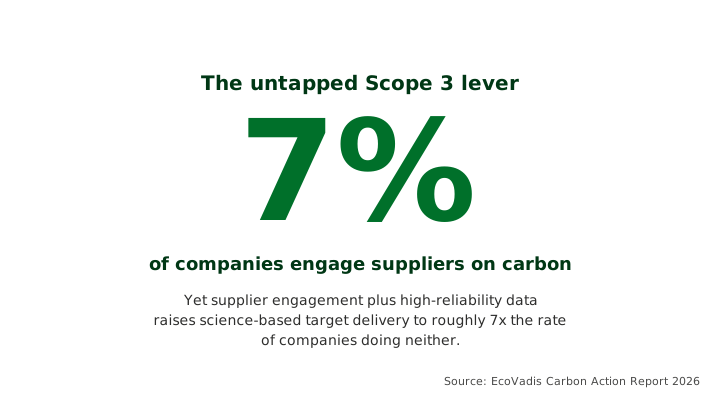
- Only 7% of companies currently engage suppliers on carbon, leaving the highest-impact Scope 3 lever untouched for most buyers.
- Supplier engagement combined with high-reliability or verified data raises science-based target delivery to roughly 7x the rate of companies doing neither.
Why supplier carbon maturity matters
EcoVadis measures carbon maturity across five levels – Insufficient, Beginner, Intermediate, Advanced, and Leader – based on a company’s performance on carbon governance, actions, and reporting. Strong performance correlates with faster emissions cuts, better data flowing to buyers, and stronger commercial relationships.
The 2026 Carbon Action Report shows why this matters commercially. Verified Scope 1&2 data is a clear sign of carbon maturity, and it is increasingly a commercial signal too: companies with high-reliability or verified operational data have three times as many buyer connections as those with low-reliability data. Buyers who understand the ladder can target support where it has the most impact, and suppliers who climb it are positioned to win more business. For more on how this shift is playing out across the network, see EcoVadis’ analysis of how carbon is emerging as a competitive dimension.
The Intermediate bottleneck: where most programs stall
Progression rates across the maturity ladder tell a clear story. 43% of Insufficient-level companies moved up to Beginner on reassessment, and 32% of Beginner companies moved to Intermediate. But only 22% of Intermediate companies moved forward, and just 16% made the jump from Intermediate to Advanced.
Why the drop-off? Early wins are accessible: 81% of companies at the Beginner level have taken initial actions on Scopes 1&2, even though only 9% have a target or plan. That gap closes at Intermediate, where 68% have a carbon target or plan. But going further requires structural change: linking pay to performance, budgeting for GHG reduction initiatives, collecting primary data from suppliers, and building a time-bound transition plan. These are decisions for leadership and finance, not just the sustainability team.
“Decarbonization is a journey, especially when your industry is not fully mature. You need to start with something, and then push suppliers to move forward one step at a time.”
Laurent Guiouiller – Sustainable Procurement Director, Accor
Source: 2026 Carbon Action Report
The top five actions that predict a breakthrough
EcoVadis analyzed which specific practices correlate with companies moving up from Intermediate to Advanced. Five key actions stand out:
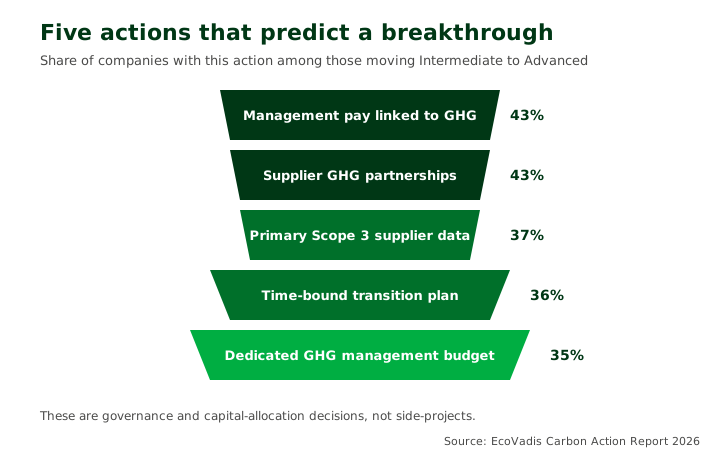
- Linking management pay to emission reductions: 43% of companies that took this step moved up on reassessment. When compensation is tied to emissions performance, carbon becomes a business priority rather than a reporting obligation.
- Partnering with suppliers on reduction initiatives: Also present in 43% of companies that moved up. This is the point where the carbon maturity ladder starts to reinforce itself: a mature buyer builds capability in its own suppliers, whose improved data then feeds back into the buyer’s Scope 3 accounting.
- Collecting primary Scope 3 data from suppliers: 37% of breakthrough companies do this. It matters because across the whole network, fewer than one in ten Scope 3 figures are built from primary supplier data. That gap is a major reason companies may be underestimating Scope 3 by up to 2.7x.
- Developing a time-bound, low-carbon transition plan: 36% of breakthrough companies have one. A dated plan creates accountability that cascades through budgeting and operational decisions.
- Creating a dedicated GHG management budget: 35% of breakthrough companies have a ring-fenced budget. Without it, carbon work competes for resources every quarter and loses.
These actions are not independent silver bullets and drive the most impact when combined. The report groups carbon practices into five themes: governance, targets and plans, reporting, Scopes 1&2, and Scope 3. Companies acting across all of them reduced operational emissions by 7.8% over two years, versus 4.4% for those acting on three or fewer. They are also 25x more likely to keep pace with reduction targets.
How leading buyers help suppliers climb the ladder
The report profiles several buyers using structured maturity frameworks to move their supply base upward. Their approaches share three features:
Cross-functional governance. At Hitachi Rail, the Head of Supplier Sustainability sits inside procurement, so decarbonization targets flow directly into buying decisions. Atos runs bi-weekly sessions between procurement and sustainability to review individual supplier emissions figures. BD embeds its supplier sustainability team into procurement with CPO-level involvement when engagement stalls. This is the practical shape of supplier relationship management when carbon is on the agenda.
Formal accountability. Colt Technology Services embeds a sustainability schedule into supplier contracts, requiring high-emitting suppliers to commit to science-based targets and share data. Volvo Cars sets carbon targets at the start of every vehicle program alongside cost, quality, and technical requirements. Both approaches turn “we care about carbon” into contractual obligation. For teams starting from scratch, our guide on how to design a supplier code of conduct is a useful reference.
Engagement tailored to supplier maturity. BD uses a five-level maturity ladder of its own, securing upfront target commitments even from Stage 1 partners and co-creating “glide paths” to build capability. Accor’s supplier decarbonization runs through three pillars (Measure, Reduce, Promote) starting with a maturity assessment.
“Assessing maturity is the basis for the next step. The idea is to push suppliers forward until they are sufficiently advanced to actually decarbonize.”
Laurent Guiouiller – Sustainable Procurement Director, Accor
Source: 2026 Carbon Action Report
What climbing the ladder unlocks
The payoff for helping suppliers move up is measurable. Companies with high-reliability or verified Scope 1&2 data reduced gross Scope 1&2 emissions by 4.4% over two years, versus 2.6% for those with low- or medium-reliability data. Leader-tier maturity compounds this: these companies reduced operational emissions 4x faster than the lowest-maturity peers.
Data reliability also predicts engagement. Companies with verified Scope 1&2 data are roughly 8x more likely to broadly engage suppliers on carbon than low-reliability peers (37% vs. 4.5%), 13x more likely to select suppliers based on carbon performance, and 14x more likely to partner on reduction initiatives. In other words, the ladder is self-reinforcing as suppliers that climb it become the buyers pulling others up.
“So many rushed to set science-based targets with supplier engagement goals without thinking of what comes next. If you’re not thinking about it now, you are at a disadvantage in the marketplace.”
Amelia Nunn – Associate Director of Responsible Sourcing, BD
Source: 2026 Carbon Action Report
The regulatory backdrop is tightening
Building carbon maturity is also a hedge against rising compliance costs. The EU’s Carbon Border Adjustment Mechanism entered its definitive phase in January 2026, with importers required to purchase certificates for the embedded carbon in imported products from 2027. Recent changes to CBAM have simplified the scheme for smaller importers, but the direction of travel is unchanged. Under both CSDDD and CSRD, and comparable frameworks emerging elsewhere, supplier emissions data is increasingly expected even as the scope of these rules is simplified. According to the Science Based Targets initiative, more than 12,000 companies now have validated reduction targets.
How to start moving your suppliers up the carbon maturity ladder
If you’re a procurement or sustainability leader trying to escape the Intermediate bottleneck, the 2026 Carbon Action Report points to a practical sequence:
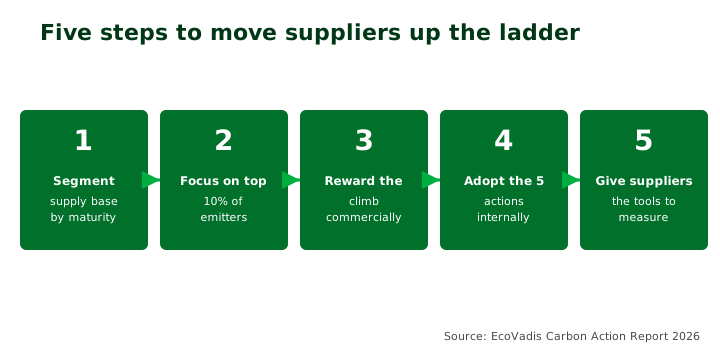
- Segment your supply base by maturity. You cannot ask a Beginner-level supplier for product-level carbon data. Assess each supplier’s carbon maturity and tailor your engagement accordingly.
- Focus on the top 10% of emitters first. They account for 95% of reported Scope 1&2 emissions in the network and are already connected to 72 buyers on average. Helping one high-emitting supplier improve data reliability benefits dozens of buyers at once.
- Reward the climb commercially. Verified suppliers have three times as many buyer connections as low-reliability peers.
- Adopt the five breakthrough actions internally. You cannot ask suppliers to link management pay to GHG reductions if you have not done so yourself.
- Give suppliers the tools to measure. The EcoVadis Carbon Action Manager and free PCF Calculator help suppliers at every maturity level produce reliable data.
Download the 2026 Carbon Action Report to get all the insights and an operational playbook from Scope 3 leaders.
FAQs
What is the carbon maturity ladder?
The carbon maturity ladder is the EcoVadis framework that grades companies across five levels (Insufficient, Beginner, Intermediate, Advanced, and Leader) based on their carbon governance, actions, and reporting. It helps buyers assess where each supplier sits on their decarbonization journey and tailor engagement accordingly. According to the 2026 Carbon Action Report, higher-maturity suppliers report more reliable data and cut operational emissions significantly faster than lower-maturity peers.
Why do so few companies reach the Advanced level?
Only 16% of companies at the Intermediate level moved up to Advanced on their latest EcoVadis reassessment, versus 32% of Beginners moving to Intermediate. The gap exists because progressing beyond Intermediate requires structural change: linking management pay to GHG performance, creating a dedicated GHG budget, collecting primary Scope 3 data, developing time-bound transition plans, and partnering with suppliers on reduction initiatives.
Which five actions predict a breakthrough to Advanced maturity?
The 2026 Carbon Action Report identifies five practices that separate breakthrough companies from those that plateau, spanning management pay, supplier partnerships, primary Scope 3 data, time-bound transition plans, and dedicated GHG budgets. See “The top five actions that predict a breakthrough” section above for the correlation figures behind each one.
How does supplier engagement affect Scope 3 target delivery?
Only 7% of companies currently engage suppliers on carbon, and combining that engagement with high-reliability data raises science-based target delivery to roughly 7x the rate of companies doing neither. Engagement is the highest-impact Scope 3 lever available, yet it remains untouched for most buyers.
Where should procurement teams start?
Start by segmenting your supply base by carbon maturity and focusing on the top 10% of emitters, who account for 95% of reported Scope 1&2 emissions across the EcoVadis network. Tailor engagement to each supplier’s maturity level, embed carbon requirements into contracts, and reward suppliers commercially for verified data. Tools like the EcoVadis Carbon Action Manager and PCF Calculator help suppliers at every stage produce more reliable emissions data.