
 ChatGPT
 Gemini
 Perplexity
 Claude
 Grok


Gain insights from 30+ sustainability leaders, including superstars like Paul Polman, former CEO of Unilever, and Helena Helmersson, former CEO of H&M Group. Learn how to build a sustained advantage through responsible business practices.
20th October 2026
Supplier Onboarding Software: What Procurement Leaders Need to Know
Read summarized version with:
Supplier onboarding is the first point where a buyer collects and verifies the data that governs a relationship. This is where the legal identity, tax registration, certifications and ESG credentials enter the system, and every later decision draws on what gets captured here.
However, companies often treat the step as an administrative formality before the real work begins, which can be dangerous. An unverified certificate or a missed risk flag may slip through at onboarding, only to resurface months later as a failed audit, a regulatory reporting issue or a Scope 3 blind spot.
Supplier onboarding software treats this first step as a control point for those potential mishaps. It becomes the first line of defense against supplier risk, compliance issues and ESG data gaps. This guide explores what supplier onboarding software does and how onboarding supports compliance with an evolving set of global regulations.
Key Takeaways
- Supplier onboarding software turns the intake process into a control point, verifying supplier identity, compliance and ESG data before a relationship begins.
- CSRD, CSDDD and the EU Deforestation Regulation require supplier-level data that is far harder to collect retroactively than to capture at onboarding.
- Advanced supplier management platforms verify data at intake, route it through governed approvals and monitor for accuracy throughout the partnership.
- Verifying supplier data at entry, and keeping it current after, produces a defensible audit trail and a supply base a buyer can stand behind.
What is Supplier Onboarding Software?
Supplier onboarding software automates the collection, verification and approval of the documents a supplier must provide before starting a business relationship. That may include:
- Business registration and legal entity verification
- Tax documentation and VAT validation
- Banking details and payment information
- Insurance certificates and compliance declarations
- Industry certifications such as ISO and SOC 2
- ESG disclosures and sustainability performance data
However, data collection is only the first step. Onboarding processes tend to weaken at the verification, approval and ongoing monitoring stages. A capable onboarding system does four things:
- Verifies what suppliers submit against authoritative sources
- Routes approvals across procurement, finance, legal and compliance with a full audit trail
- Monitors supplier data and public records for changes after onboarding
- Feeds clean records directly into ERP and procure-to-pay system
The Problem with Manual Supplier Onboarding
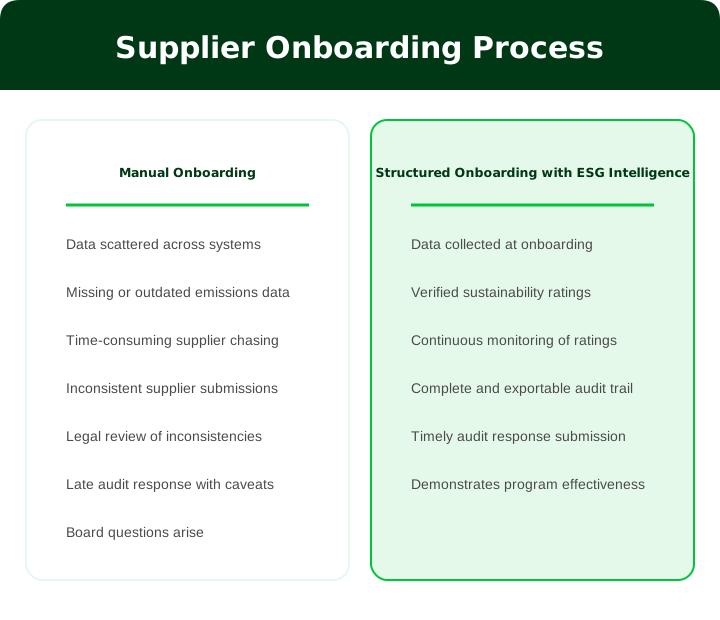
Manual email-and-spreadsheet onboarding processes are slow and error-prone, and the errors usually compound. Hand-keyed data averages a 3.9% cell error rate, and at procurement volumes those errors accumulate fast. Supplier data ends up fragmented and untrusted. Approvals crawl across procurement, finance, legal and compliance because no one can see the full pipeline. Certifications expire unnoticed.
The larger problem for sustainability programs is what manual onboarding fails to capture. A spreadsheet can manage basics like a company name and tax ID, but it can’t accurately capture complex ESG data, emissions baselines, sustainability certifications or due diligence records.
Internal sustainability targets depend on quality data, which regulations increasingly require buyers to report across their supply chains. A supplier onboarded without emissions data or a reliable sustainability rating becomes a blank space in the buyer’s reporting, leaving teams to chase down data retroactively.
The Cost of Getting Supplier Onboarding Wrong
Weak supplier onboarding accumulates across finance, compliance and procurement. When it comes to sustainability, though, the largest exposure is regulatory. Three EU regulations now require buyers to hold supplier-level data across their supply chains:
- CSRD applies to companies with over 1,000 employees and €450 million in net turnover, with newly in-scope companies reporting from financial year 2027.
- CSDDD adds due diligence obligations for the largest companies, those above 5,000 employees and €1.5 billion in turnover, from 2029.
- The EU Deforestation Regulation applies from December 2026 for large and medium companies.
Each regulation demands supplier data that can be difficult produce at audit if onboarding wasn’t done well. And the consequences can be severe: CSDDD noncompliance carries fines of up to 3% of net worldwide turnover under Omnibus I reforms.
In addition to regulatory risks, weak onboarding processes and poor supplier monitoring can lead to reputational risks with investors, customers and the broader public. Bad publicity of a supplier’s human rights or environmental practices reflects poorly on their buyers as well, and can tarnish a brand’s image.
Onboarding may create downstream risk if any of the following are true:
- Suppliers submit documents by email and someone keys the data in by hand
- ESG data collection runs separately from supplier registration
- New suppliers begin transacting before compliance and legal sign off
- No one can say how many suppliers currently hold expired certifications
- No complete audit trail exists for suppliers added in the last 12 months
What Best-in-Class Supplier Onboarding Software Does Differently
A basic supplier portal collects documents and files them. It doesn’t check them, route them or watch them after the fact. Advanced software treats onboarding as a control point instead of a filing cabinet.
1. Capture clean data without manual entry
A self-service supplier onboarding portal guides suppliers through registration in their own language, with automated reminders that reduces the risk of incomplete entries. AI document extraction reads uploaded certificates and filings and pulls the data into the right fields, so nothing has to be keyed in by hand.
At intake, automated verification checks tax IDs, sanctions lists, financial health and bank details against authoritative sources. The data is confirmed before it enters the record, not months later under audit.
2. Govern the data as it moves
Not every supplier carries the same risk, so not every supplier should move through the same process. Supply chain mapping helps identify risk and routes strategic or regulated suppliers through deeper scrutiny, while low-risk vendors follow a lighter path, so the team’s effort goes where the risk actually exists.
From there, workflow automation carries each supplier through the required approvals across procurement, finance, legal and compliance, recording a full audit trail at every step. The verified record then lands directly in the systems the business runs on, like SAP, Oracle or other ERPs.
3. Keep the record accurate over time
Certifications lapse, ownership changes, sustainability ratings shift. Continuous monitoring revalidates supplier data on an ongoing basis, including third-party ESG ratings, so sustainability performance stays a live qualification rather than a snapshot taken once at intake.
How EcoVadis Fits Into Supplier Onboarding
One of the hardest parts of onboarding is verifying the ESG and compliance data a supplier submits. EcoVadis’ sustainability intelligence platform hosts a suite of tools that help identify risk and engage suppliers throughout the partnership lifecycle.
The platform maps risk across the full supply base to flag which suppliers need attention first. It delivers a verified sustainability rating so procurement can qualify suppliers on evidence rather than a self-reported form, then gives suppliers a path to improve through corrective actions and training, so a weak score becomes a starting point rather than a dead end.
Get started with EcoVadis to see how verified ESG data can strengthen your onboarding process.
FAQs
Why is supplier onboarding important?
Supplier onboarding is important because it’s the only point in the relationship where a buyer can verify who a supplier is, confirm they’re compliant and capture ESG data before any money changes hands. Issues missed at onboarding tend to resurface later as a failed audit, a missing Scope 3 data point or a lapsed certification. Done well, onboarding turns intake into a control point that guides the rest of the supplier partnership.
What’s the difference between supplier onboarding and vendor management?
Supplier onboarding and vendor management cover different phases of the same relationship. Onboarding is the intake process: collecting, verifying and approving a supplier’s information before the relationship begins. Vendor management is what happens after: the ongoing work of monitoring performance, managing the commercial relationship and reassessing risk over time.
How does supplier onboarding fit into sustainable procurement?
Supplier onboarding gives sustainable procurement teams a chance to capture ESG data early. If ESG data collection runs separately from onboarding, a team ends up pursuing ratings and emissions data after suppliers are already transacting, which is slower and less reliable than capturing it at intake. Embedding ESG requirements into onboarding makes sustainability performance a qualification criterion from day one.
How often should supplier information be reviewed after onboarding?
Most companies review supplier records annually, but that leaves months where a lapsed certification or emerging risk goes unnoticed. Supplier management software closes that gap with continuous monitoring, scanning public records and news sources in real time so issues surface as they happen instead of waiting for the next scheduled review.

Ashley Raleigh is a supply chain professional with 10 years of experience across freight operations, logistics technology, and sustainability. Her work focuses on the evolving role of technology, strategy, and responsible practices in modern supply chains.