
 ChatGPT
  Gemini
  Perplexity
  Claude
  Grok
Grok 

Gain insights from 30+ sustainability leaders, including superstars like Paul Polman, former CEO of Unilever, and Helena Helmersson, former CEO of H&M Group. Learn how to build a sustained advantage through responsible business practices.
3rd June 2026
ESG Policy: How to Move From Commitment to Performance
Read summarized version with:
A broad sustainability commitment on a website does not help an organization manage risk. It does not satisfy possible investors, protect a supply chain or meet regulatory disclosure requirements. An ESG policy does.
Three-quarters of business leaders consider ESG factors important to their business strategy, and the organizations translating that priority into progress are the ones with a formal structure behind it. An ESG policy is that structure. It defines how an organization manages environmental, social and governance risks, sets internal standards and assigns clear accountability for result
Key Takeaways
- An ESG policy is not a sustainability statement. It is a governing document that defines standards and drives performance improvements across an organization.
- Regulatory pressure is accelerating globally. From the CSRD to California’s SB 253 and SB 261, formal ESG policies are the foundation of compliance readiness.
- A strong ESG policy extends beyond internal operations, setting enforceable standards for suppliers and creating a more resilient, transparent supply chain.
- An ESG policy is only as strong as the verification behind it. Third-party assessments help turn internal commitments into credible, auditable performance records.
What is an ESG Policy?
An ESG policy establishes how an organization identifies, manages and acts on its sustainability responsibilities. It defines the standards that employees, leadership and suppliers are expected to meet, and it names who is accountable for tracking and reporting on them. Think of it as the document that makes credible external reporting possible, because without defined internal standards, there is nothing meaningful to report against.
The Pillars of ESG Policy
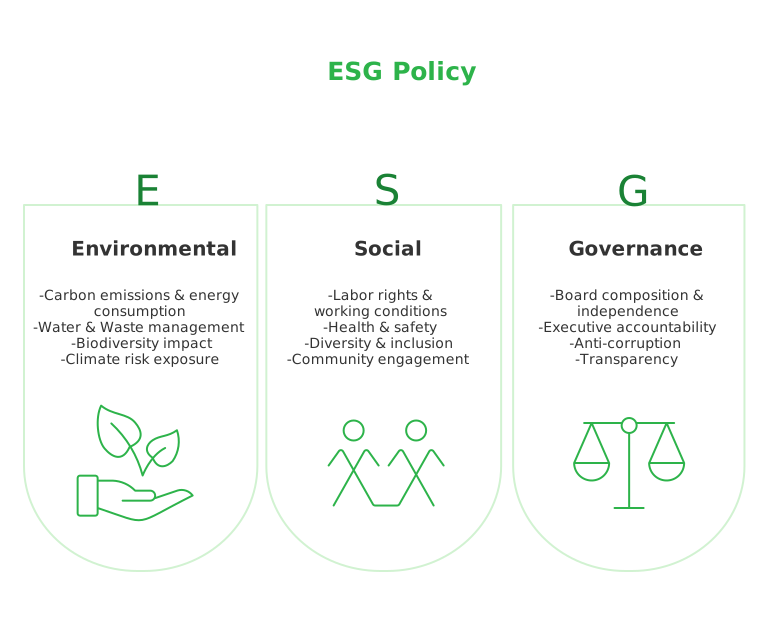
An ESG policy is organized around three distinct areas, each addressing a specific category of risk and operational responsibility. Together, they cover a multitude of factors that reflect how your business impacts the environment, treats its people and is governed internally. Here is what falls under each:
- Environmental: Carbon emissions and energy consumption, water and waste management, biodiversity impact, climate risk exposure and supply chain environmental standards.
- Social: Labor rights and working conditions, health and safety, diversity and inclusion, community engagement and supplier social practices.
- Governance: Board composition and independence, executive accountability, anti-corruption and ethics policies, transparency in decision-making and shareholder rights.
ESG Policy vs. ESG Reporting
ESG policy and ESG reporting are related but serve different purposes. A policy is an internal document that sets the rules, defines accountability and guides actions. Reporting comes after. It is the external disclosure that tells the public how your organization performed against policy standards. One without the other leaves a critical gap.
- ESG policy: An internal governing document that defines standards, assigns accountability and guides organizational behavior across ESG areas.
- ESG reporting: An external disclosure that communicates performance results to investors, regulators and other stakeholders, measured against the standards the policy establishes.
The Business Case for ESG Policies
Modern organizations recognize that ESG cannot be treated as a side project. It is increasingly a primary indicator of long-term resilience and operational health. An ESG policy provides a roadmap to move from broad commitment to measurable performance, effectively improving multiple operational outcomes.
Regulatory Alignment
ESG regulation is expanding across most major global markets, and the obligations vary significantly by region. Key regulations include:
- Corporate Sustainability Reporting Directive (CSRD): Requires large EU companies and qualifying non-EU companies to report on sustainability risks and impacts under the European Sustainability Reporting Standards.
- EU Taxonomy: A classification system that defines which economic activities qualify as environmentally sustainable, used by investors and financial institutions to evaluate alignment.
- Sustainable Finance Disclosure Regulation (SFDR): Requires financial market participants to disclose how sustainability risks are integrated into investment decisions.
- California SB 253 and SB 261: Require large companies operating in California to disclose Scope 1, 2 and 3 emissions and climate-related financial risks, setting the current benchmark for ESG regulation in the U.S.
Non-compliance with applicable regulations creates substantial legal and reputational risk. A formal ESG policy keeps your business ahead of requirements rather than scrambling to meet them.
Capital Access
Despite evolving regulations, investors are still paying attention to ESG initiatives. In fact, 84% of investors globally believe companies should maintain or increase investment in climate adaptation. A documented ESG policy signals to lenders and institutional investors that your organization is making a specific, strategic commitment to managing ESG risks, rather than merely acknowledging them.
Risk Assessment
An ESG policy helps companies identify vulnerabilities that could turn into significant financial liabilities. Mapping exposure across labor practices, environmental impact and governance structures gives you a clearer picture of where operational risk lives and what needs to be addressed first.
Supply Chain Resilience
An ESG policy does not stop at your front door. It should extend accountability deep into the supply chain by setting clear environmental and social standards for all suppliers, both direct and indirect. Companies that include sustainable procurement requirements in their ESG policy are better positioned to identify exposure, reduce disruption and build a more resilient supplier base.
Stakeholder Trust
Consumer skepticism about ESG efforts is real: 52% of consumers worldwide believe organizations are greenwashing their sustainability initiatives. Businesses with a formal ESG policy, verified performance data and consistent ESG communications are better positioned to counter that skepticism with documented, auditable proof rather than cliche marketing claims.
Core Components of an ESG Policy
A well-designed and comprehensive ESG policy answers four critical questions: what does it cover, who owns it, what matters most and when does it get revisited.
- Scope and Applicability: Defines which entities, regions and supply chain segments the policy governs. Without clear boundaries, enforcement can be inconsistent across the organization.
- Accountability Structures: Names the executive roles, committees or departments responsible for specific policy outcomes. A commitment without a named owner rarely gets met.
- Material Issues: Documents the specific ESG topics your organization has identified as most significant to its operations and stakeholders based on industry standards and requirements. Materiality keeps the policy focused rather than exhaustive.
- Review Cycle: Sets a defined timeline for updates, typically annual or biannual, ensuring the policy keeps pace with regulatory changes and evolving business priorities.
How to Develop an ESG Policy
Building an ESG policy requires cross-functional input, strategic alignment and a clear process for turning organizational priorities into binding commitments. These five steps outline how you can approach it.
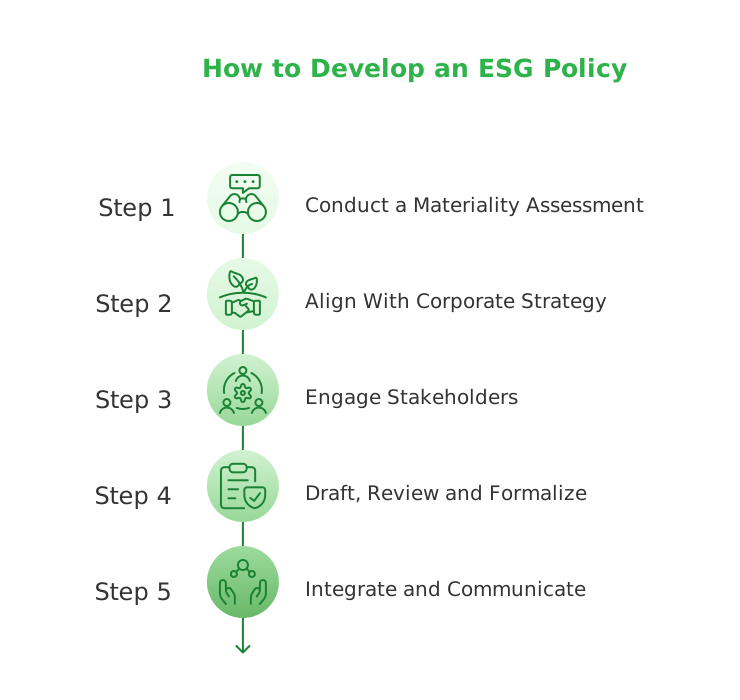
Step 1: Conduct a Materiality Assessment
A materiality assessment identifies which ESG issues are most significant to your business and stakeholders. This is not a universal list. A manufacturing company faces different material risks than a financial services firm. Industry standards, peer benchmarking and direct stakeholder input all inform which topics deserve priority in the policy.
Step 2: Align With Corporate Strategy
An ESG policy that operates independently of business strategy can quickly lose momentum. ESG commitments should map directly to business objectives, whether that means reducing operational costs through energy efficiency, building supply chain resilience or meeting investor expectations on governance.
Step 3: Engage Stakeholders
Employees, investors and suppliers each carry a different perspective on ESG risks and opportunities. Engaging them early helps surface blind spots, build internal buy-in and guarantee the final policy reflects your organization’s full operational reality and is meaningful to the people who matter most.
Step 4: Draft, Review and Formalize
The drafting process should involve legal, compliance and executive leadership. Sign-off at this level signals true commitment and ensures the policy can withstand regulatory scrutiny and stakeholder due diligence.
Step 5: Integrate and Communicate
A finalized policy needs a clear rollout plan. Internally, that means comprehensive training, designated ownership and integration into existing operational workflows. Externally, publishing the policy demonstrates transparency and gives customers, investors and partners something concrete to evaluate.
From ESG Policy to Measurable Performance
Writing an ESG policy is only the starting point for sustainability initiatives. The real work is demonstrating that the commitments inside the document are actually being met. That requires external verification, not just internal reporting.
ESG ratings and third-party audits provide the independent validation that turns a policy into a credible performance record. They surface gaps between what your organization has committed to and what it is actually delivering, giving leadership a clear basis for improvement rather than assumption.
EcoVadis Ratings evaluate supplier and company performance across four categories: environment, labor and human rights, ethics and sustainable procurement. Each maps directly to the core commitments an ESG policy establishes, making the assessment a practical tool for measuring whether your policy is producing results and where it needs to be strengthened.
See how your ESG commitments hold up under independent review. Get started with EcoVadis Ratings today.
FAQs
Q: What should an ESG policy include?
A: An ESG policy should include a clear scope defining what and who it covers, named accountability structures, a materiality assessment that reflects your specific industry risks and a defined review cycle. The strongest policies also extend requirements into the supply chain, setting explicit environmental and social standards for suppliers.
Q: Is an ESG policy legally required?
A: An ESG policy itself is not legally required. However, regulations like the CSRD, EU Taxonomy and California SB 253 and SB 261 are increasingly mandating ESG data disclosure. A formal ESG policy provides the internal roadmap for tracking and managing that data consistently, making compliance significantly more manageable when reporting obligations apply.
Q: What is the difference between an ESG policy and a CSR policy?
A: An ESG policy is a structured, risk-based framework often tied to measurable performance goals and/or regulatory requirements. A CSR policy traditionally focused on philanthropic initiatives and voluntary commitments. ESG policies and subsequent reporting apply quantitative rigor to broad intent, making them more relevant to investors, regulators and supply chain due diligence.
Q: Who should be responsible for writing an ESG policy?
A: An ESG policy should be developed through a cross-functional, collaborative process involving sustainability, legal, compliance, finance, supply chain and executive leadership. No single department owns ESG in isolation. Broad internal input ensures the policy reflects actual operational risk, while executive sign-off ensures organizational accountability and staying power.

Ashley Raleigh is a supply chain professional with 10 years of experience across freight operations, logistics technology, and sustainability. Her work focuses on the evolving role of technology, strategy, and responsible practices in modern supply chains.