
 ChatGPT
  Gemini
  Perplexity
  Claude
  Grok
Grok 
Gain insights from 30+ sustainability leaders, including superstars like Paul Polman, former CEO of Unilever, and Helena Helmersson, former CEO of H&M Group. Learn how to build a sustained advantage through responsible business practices.
16th June 2026
Net Zero vs. Carbon Neutral: Difference for Modern Supply Chains
Read summarized version with:
Net zero and carbon neutral are often used interchangeably in corporate sustainability communications, but they aren’t the same commitment. The two terms apply different rules to offsetting, have different Scope 3 obligations and increasingly carry different regulatory standing in the jurisdictions where your suppliers operate and your products are sold.
That distinction now has regulatory teeth. From September 2026, offset-based carbon-neutral product claims will be a blacklisted commercial practice under EU law, meaning the language companies use to describe their climate commitments carries legal consequences, not just reputational ones.
This guide explores the difference between net zero and carbon neutral and why capturing data on Scope 3 carbon emissions is essential to achieving them.
Key Takeaways
- Carbon neutral and net zero are not interchangeable. They differ on which gases are covered, whether Scope 3 is required, what kind of offsets are permitted and what reduction must happen before offsetting.
- The most consequential operational difference is Scope 3. Carbon-neutral frameworks require partial Scope 3 coverage. SBTi net zero requires full value chain coverage with the same 90% reduction pathway as Scopes 1 and 2.
- Carbon negative goes further than carbon neutral and net zero, requiring net removal of more emissions from the atmosphere than an organization produces.
- Net zero requires deep absolute reductions across all greenhouse gases and all three Scopes before using permanent carbon removal for the residual.
What Is Carbon Neutral?
Carbon neutrality (or net carbon neutrality) means achieving a balance of zero carbon dioxide emissions, typically by measuring CO2 output and offsetting it through carbon credit purchases. These credits fund external projects such as reforestation, renewable energy development or methane capture.
The most widely used carbon-neutral standards, PAS 2060 and ISO 14064, use CO2 equivalent accounting and can cover all greenhouse gases rather than CO2 alone. In practice, many corporate carbon-neutral programs focus on the emissions categories they can most easily measure, and Scope 3 supply chain emissions are typically optional rather than required.
There is no obligation under carbon-neutral standards to reduce gross emissions before purchasing offsets. A company calculates its footprint and buys equivalent credits from recognized carbon registries. Avoidance credits, which fund projects that prevent emissions from occurring rather than removing existing carbon from the atmosphere, qualify under most carbon-neutral frameworks.
Carbon Neutral Examples
Several large organizations have pursued carbon-neutral certifications or made carbon-neutral claims in recent years, with varying levels of credibility:
- Microsoft: Microsoft declared carbon neutrality in 2012 across its direct operations, running an internal carbon fee program that funds renewable energy and offsets. It has since moved toward a more ambitious net-zero and carbon-negative commitment.
- Apple: Apple has committed to making all its products carbon-neutral by 2030, covering the full product lifecycle, including supply-chain emissions. It uses a combination of supply chain decarbonization and carbon removal, rather than relying solely on avoidance offsets, which aligns the commitment more closely with the rigor required by net-zero standards.
- IKEA: IKEA set a target to be carbon neutral in its operations by 2030 and has invested in renewable energy and sustainable materials. It has subsequently expanded its ambition to climate positive, meaning it aims to remove more carbon than it emits, a standard that goes beyond both carbon neutral and net zero.
What Is Net-Zero?
Net zero means cutting greenhouse gas emissions across all three scopes as close to zero as possible, then permanently removing whatever remains. It covers all greenhouse gases (not just CO2) and typically requires deep absolute reductions before any form of offsetting.
Under the SBTi Corporate Net-Zero Standard, the most widely recognized framework for corporate net zero commitments, organizations must reduce emissions by at least 90% across Scopes 1, 2 and 3 by 2050 relative to a base year, then neutralize the remaining residual through permanent carbon removal. Near-term targets require absolute annual reductions across all three scopes, with Scopes 1 and 2 held to a higher rate of contraction than Scope 3. As of April 2026, the fixed reduction rates previously tied to 1.5°C pathways have been replaced by a variable approach under the updated Absolute Contraction Approach.
The Scope 3 requirement is the most consequential difference between net zero and carbon neutral. It covers all indirect emissions across the value chain, including supply chain emissions, product use and end-of-life disposal. For most companies, Scope 3 accounts for 90% or more of their total emissions footprint, which means a serious net-zero commitment cannot be achieved without meaningful supplier engagement and verified primary emissions data across the supply chain.
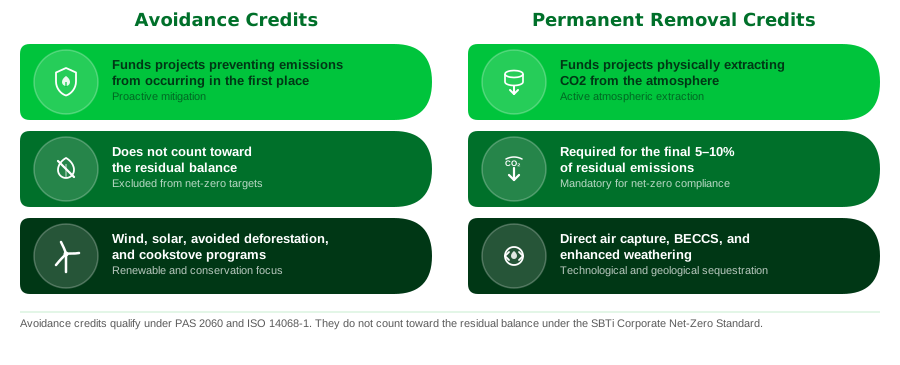
Where net zero does permit offsetting, the rules are strict. Only permanent carbon removals that physically extract carbon from the atmosphere count toward the residual balance. Avoidance credits, such as funding a wind farm that prevents emissions, do not qualify. That is a fundamental departure from how carbon neutrality treats offsets, where avoidance credits remain an accepted tool.
What a Credible Net Zero Commitment Requires
The gap between announcing a net-zero target and building the infrastructure to support it is where most programs fall short. These operational requirements determine whether the commitment is credible.
- Validated targets aligned to 1.5 degrees Celsius: Near-term SBTi targets have historically required annual reductions of 4.2% for Scopes 1 and 2 and 2.5% for Scope 3, with SBTi’s April 2026 update now calibrating rates to each company’s base year rather than applying fixed percentages. Long-term targets require 90% absolute reduction by 2050. Unvalidated targets are increasingly under scrutiny from investors and regulators.
- Primary supplier carbon data for Scope 3: Spend-based estimates can produce Scope 3 figures that vary dramatically across companies with similar supply chains. Collecting primary data directly from suppliers is what makes emissions figures defensible under regulatory or assurance review.
- Supplier engagement at scale: Companies that actively engage suppliers on carbon are nine times more likely to be on track to reduce their Scope 3 emissions than those that do not. Structured engagement means carbon data collection, supplier-specific reduction support and corrective action tracking.
- Permanent removal credits for the residual: The final 5 to 10% must be neutralized through high-durability removals such as direct air capture or bioenergy with carbon capture and storage. Avoidance credits do not qualify under SBTi and are prohibited for product-level claims under the ECGT.
- Independent assurance built in from the start: CSRD requires limited assurance now, moving toward reasonable assurance by 2028. Retrofitting audit-ready processes after the program is built costs significantly more than designing them from the beginning.
Net Zero Examples
Below are several companies on track to achieve net zero emissions:
- Maersk: Maersk holds one of the most rigorously verified net-zero commitments in shipping. It became the first company in the maritime sector to have climate targets validated by SBTi under the initiative’s new Maritime Guidance, with documented absolute reduction targets across all three Scopes. Near-term validated targets require a 34.7% absolute reduction in Scope 1 emissions and a 21.9% reduction in Scope 3 emissions by 2030, both relative to a 2022 baseline. The company’s net-zero year is 2040, a decade ahead of the SBTi’s standard timeline.
- BASF: BASF has set a net zero target covering Scope 1, 2 and Scope 3.1 (purchased goods and services) by 2050, with a near-term target of 25% absolute reduction in Scope 1 and 2 by 2030 baseline and a 15% reduction in specific Scope 3.1 emissions per kilogram of raw materials purchased by 2030. By 2024, BASF had already reduced its Scope 3.1 intensity from 1.67 to 1.58 kilograms of CO2 per kilogram of raw materials, tracking toward the ultimate 1.39 target.
Carbon Net Zero vs Carbon Neutral
Carbon net zero and carbon neutral differ across several dimensions that impact procurement and sustainability teams. The table below maps the key distinctions.
| Dimension | Carbon Neutral | Net Zero |
| Gases covered | All GHGs (CO2e), but Scope 3 partial or optional | All GHGs across Scopes 1, 2 and 3 |
| Scope 3 requirement | Partial: emissions above 1% of total footprint | Mandatory: full value chain coverage |
| Reduction obligation | Reduction plan required; 100% offsetting allowed in year one, year-on-year reductions required thereafter | 90% absolute reduction required first |
| Permitted offsets | Avoidance and removal credits | Permanent removals only |
| Verification standard | PAS 2060 / ISO 14068-1 | SBTi Corporate Net-Zero Standard |
| Regulatory standing (EU) | Product-level claims blacklisted from Sept 2026 (ECGT) | Transition plan required under CSRD; CS3D transition plan obligation removed by Omnibus I (2026) |
| Typical timeline | Near-term achievable | 2050 or earlier |
Net Zero vs Carbon Neutral vs Carbon Negative
Carbon negative, sometimes called climate positive in corporate sustainability language, describes a state in which an organization removes more greenhouse gases from the atmosphere than it emits. It goes further than both carbon neutrality and net zero.
IKEA uses the term “climate positive,” setting a target to reduce more emissions than its total value chain produces. Microsoft has committed to becoming carbon negative by 2030 and to removing all historical carbon emissions since its founding by 2050.
The commercial rationale for carbon-negative targets varies. For some organizations, it reflects genuine ambition beyond what net zero frameworks require. For others, it is a marketing positioning decision. The regulatory scrutiny applied to net zero and carbon neutral claims is beginning to extend to carbon-negative and climate-positive terminology as well, particularly where the claim is based on low-quality offsets or accounting that does not reflect actual emissions reductions.
Your Net Zero Target Is Only as Credible as Your Scope 3 Data
A net zero commitment is only as defensible as the supplier data supporting it. With only 30% of suppliers currently reporting primary Scope 1 and 2 carbon data and a dismal 8% reporting on Scope 3, many organizations are providing estimates rather than measuring performance.
EcoVadis Carbon Action Manager streamlines the collection of primary emissions data directly from suppliers, with verified transparency in quality and suitability for Scope 3 carbon accounting. Tools like the EcoVadis Carbon Estimator and PCF Calculator help suppliers calculate their footprints, unlocking more primary data from the supply chain.
Contact us to assess where your supplier network stands on net-zero commitments and how you can move toward meaningful progress.
FAQs
What is the main difference between net zero and carbon neutral?
Carbon neutral means balancing greenhouse gas emissions through a combination of documented reductions and offset purchases, with Scope 3 partially covered and no minimum percentage reduction required upfront. Net zero requires 90% absolute reductions across all three Scopes before relying on permanent carbon removals for the residual. Net zero is the more rigorous and now more widely recognized regulatory standard.
Are carbon-neutral claims still legally permitted in the EU?
Effective September 27, 2026, the ECGT blacklists product-level “carbon neutral” or “climate neutral” claims based on carbon offsets rather than actual value-chain reductions. Corporate sustainability reports and investor-facing disclosures are outside this scope, but product marketing, packaging and consumer-facing claims based on offset purchases are prohibited regardless of whether consumer harm can be demonstrated.
What does carbon negative mean?
Carbon negative means removing more greenhouse gases from the atmosphere than are emitted, including Scope 3. It goes beyond both carbon neutral and net zero. Organizations like IKEA and Microsoft have set carbon negative or climate positive targets, though credibility depends on whether the claimed removals are permanent, verified and represent actual atmospheric extraction rather than avoidance credits.
How does Scope 3 factor into net zero vs carbon neutral?
Under PAS 2060 and ISO 14068-1, Scope 3 emissions above 1% of total footprint must be included, but full value chain coverage is not required. Under the SBTi Corporate Net-Zero Standard, Scope 3 is mandatory and follows a well-below 2C reduction pathway, requiring a minimum 2.5% absolute annual reduction, distinct from the more stringent 1.5C pathway applied to Scopes 1 and 2 This makes verified supplier carbon data a program-critical input in a way most carbon neutral frameworks do not require.
What makes a carbon neutral claim credible in 2026?
A credible claim requires transparent methodology disclosure, alignment with ISO 14068-1 (which replaced PAS 2060 in November 2025), third-party verification of the underlying data and clarity on whether the balance is achieved through documented reductions or offset purchases. Claims based primarily on offsets without a reduction plan face regulatory challenge under ECGT and growing scrutiny from investors and enterprise buyers.