
 ChatGPT
 Gemini
 Perplexity
 Claude
 Grok

Gain insights from 30+ sustainability leaders, including superstars like Paul Polman, former CEO of Unilever, and Helena Helmersson, former CEO of H&M Group. Learn how to build a sustained advantage through responsible business practices.
20th October 2026
Business Carbon Footprint: How to Measure and Report It
Read summarized version with:
Carbon emissions are becoming a business metric in the same way revenue and headcount are. Regulators are mandating disclosure, investors are pricing climate risk into capital decisions and customers increasingly expect companies to validate their sustainability claims. For organizations that haven’t yet measured their business carbon footprint, the window for treating it as optional is closing fast. The ones moving now are laying the groundwork to compete, comply and improve.
Key Takeaways:
- A business carbon footprint measures total GHG emissions across an organization’s operations and value chain, expressed in CO2e across Scopes 1, 2 and 3.
- Carbon disclosure is no longer purely voluntary. Regulatory frameworks, investor expectations and procurement criteria are making reporting a business requirement.
- For most companies, Scope 3 is where emissions are concentrated and where supplier engagement has the greatest impact on both accuracy and reduction.
- Carbon footprint calculation follows a structured process, and the credibility of the final report requires a clear strategy and diligent data collection.
What Is a Business Carbon Footprint?
A business carbon footprint measures the total greenhouse gas (GHG) emissions an organization produces, expressed in carbon dioxide equivalent (CO2e). That figure captures every emission source tied to business activity, from burning fuel in company vehicles to the energy powering a data center to the emissions embedded in a supply chain stretching across dozens of countries.
Scope 1, Scope 2 and Scope 3 Emissions
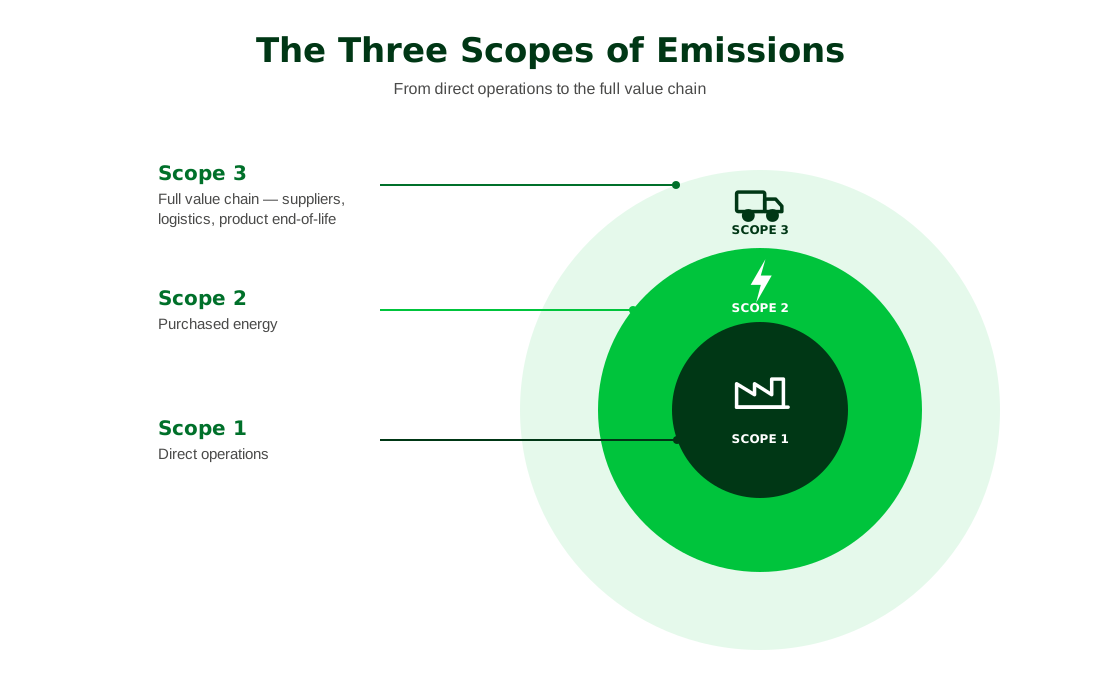
GHG emissions are organized into three scopes, each representing a different layer of business activity.
- Scope 1: Direct emissions from sources owned or controlled by the organization, including company vehicles, on-site furnaces and manufacturing equipment.
- Scope 2: Indirect emissions from purchased energy, primarily electricity, heat and steam generated off-site but consumed by the organization.
- Scope 3: Scope 3 encompasses 15 categories under the GHG Protocol, from purchased goods and services to employee commuting and capital goods. Most organizations don’t need to measure all 15 equally, and materiality analysis upfront determines which categories drive emissions and should receive priority data collection effort. For supply-chain-heavy businesses, Categories 1 (purchased goods/services) and 9 (downstream transportation) typically dominate. For others, Category 11 (use of sold products) or Category 12 (end-of-life treatment) may be material.
Why Your Corporate Carbon Footprint Matters
Carbon data now sits at the intersection of compliance, capital and commerce. Organizations that can’t produce it are increasingly finding themselves playing catch-up.
- Regulatory compliance: The EU’s Corporate Sustainability Reporting Directive (CSRD) already requires large companies to disclose emissions data for Scopes 1, 2 and 3 (with double materiality determining which Scope 3 categories are reportable), and California’s SB 253 extends that obligation to companies with over $1 billion in annual revenue doing business in the state. Companies without a credible carbon footprint methodology are already behind the compliance curve.
- Investor and lender expectations: About 85% of chief investment officers say ESG is a material factor in investment decisions. Carbon performance is a central input in that calculus. Organizations that can’t quantify their emissions give investors and lenders little to work with when assessing long-term risk exposure.
- Customer and competitive pressure: 83% of executives reported increased sustainability investment in 2025, and that spending shapes who they buy from and partner with. Procurement teams at major corporations are embedding carbon criteria directly into supplier qualification processes, and verified emissions data is increasingly what gets an organization on the shortlist.
- Operational cost reduction: A carbon footprint calculation is effectively an energy and resource audit. Companies that follow the data typically find inefficiencies in manufacturing inputs, facility energy use and freight that deliver real cost reductions alongside lower emissions.
Where your company stands on carbon emissions now is undoubtedly shaping the opportunities available down the road.
How to Calculate a Corporate Carbon Footprint for Your Business
Calculating your carbon footprint should follow a structured methodology, and the quality of the output depends entirely on the quality of the inputs. The GHG Protocol is the most widely adopted framework for this process, providing the accounting standards most regulators and investors expect to see.
Step 1: Define Your Organizational Boundary
Before collecting data, you need to establish what’s in scope. Boundary-setting determines which entities, facilities and operations are included in your calculation. Companies typically choose between two approaches:
- Operational control: Captures emissions from all facilities where the organization has direct authority over operating policies. A company that manages a leased facility but doesn’t own it would still include it under this approach.
- Equity share: Allocates emissions based on ownership percentage. A company with a 40% stake in a joint venture would account for 40% of that venture’s emissions.
The right choice depends on your corporate structure. Either way, defining the boundary clearly at the outset keeps the calculation consistent and defensible.
Step 2: Identify Emission Sources by Scope
The next step is mapping every emission source across Scopes 1, 2 and 3. Most organizations find their footprint extends further than initially expected once Scope 3 enters the picture. Supply chain activity alone accounts for the vast majority of emissions for most companies, spanning raw material extraction, component manufacturing and inbound logistics across potentially dozens of supplier tiers. That breadth makes Scope 3 the most complex to measure, but also where focused reduction efforts tend to have the greatest impact.
Step 3: Collect Activity Data
Activity data is the raw input for any carbon calculation: fuel consumption, energy bills, procurement spend and production volumes. Collecting complete, accurate data determines the credibility of the carbon footprint report.
For Scope 1 and 2, collecting primary data from direct operations is relatively straightforward. Scope 3 reporting is harder. Spend-based estimates and industry averages can fill gaps, but they introduce uncertainty that compounds across a large supply base. Engaging suppliers directly to collect primary emissions data is the more reliable path, and increasingly the standard that regulators and investors expect.
Step 4: Apply Emission Factors
Emission factors convert activity data into CO2e figures, and they vary significantly by fuel type, energy source and geography. Recognized bodies including the EPA, the UK’s DESNZ and the GHG Protocol publish regularly updated emission factor databases. Applying outdated or mismatched factors to otherwise solid activity data is one of the most common sources of calculation error.
Step 5: Review, Verify and Report
A completed calculation should be reviewed for consistency before any external disclosure. Third-party verification strengthens the credibility of a carbon footprint report, particularly when disclosing to investors or responding to regulatory requirements. Most organizations start with limited assurance under ISO 14064-3 for initial reports, escalating to reasonable assurance when regulatory or investor requirements demand higher credibility. Reporting frameworks like CDP, GRI and TCFD provide standardized structures for communicating results in a format stakeholders recognize and can act on.
From Carbon Measurement to Reduction
Calculating a business carbon footprint is a starting point, not a deliverable. The organizations that get the most value from the process are the ones that connect measurement to structured reduction targets and track progress over time, particularly across their supply chains where the largest emission concentrations sit.
Alongside measurement, many organizations consider Science-Based Targets initiative (SBTi) validation when setting reduction commitments. SBTi alignment increasingly influences investor and procurement decisions and signals credibility to regulators.
EcoVadis Carbon Action Manager supports that process by helping companies collect emissions data from suppliers with transparency on its quality, segment their supply base by carbon maturity and monitor progress against reduction commitments. For companies navigating disclosure requirements and stakeholder expectations simultaneously, having that infrastructure in place makes the difference between reporting and actually improving.
To learn more about EcoVadis and how we support carbon footprint reduction, reach out to us today.
FAQs
How often should a company measure its carbon footprint?
Most organizations measure annually, which aligns with standard financial reporting cycles and the disclosure requirements of frameworks like CDP and GRI. Annual measurement creates a consistent baseline for tracking progress year over year. Companies with aggressive reduction targets or significant supply chain complexity may conduct more frequent assessments to catch issues early and adjust reduction strategies accordingly.
What are the biggest challenges in measuring a business carbon footprint?
Scope 3 data collection is consistently the most difficult part of the process, but it isn’t the only one. Common challenges include:
- Supplier data gaps: Emissions data from suppliers is often incomplete, inconsistent or estimated rather than directly measured.
- Boundary decisions: Determining which entities and operations to include requires judgment calls that impact the final figures.
- Emission factor accuracy: Selecting the right factors for each activity type, geography and energy source introduces room for error.
- Data consistency across the organization: Maintaining standardized collection processes across multiple business units, regions and reporting periods is operationally demanding.
What is double materiality, and why does CSRD require it?
Double materiality means assessing both financial materiality (which emissions affect shareholder value) and impact materiality (which business activities cause significant environmental harm). Under CSRD, companies must report on both dimensions. This often means that a Scope 3 category representing 5% of emissions might still be material if it affects a major customer’s procurement decisions or poses climate risk to a key supplier. Upfront materiality assessment prevents overinvestment in measuring immaterial categories while ensuring companies capture what investors and regulators actually care about.
What is a carbon footprint report, and what should it include?
A carbon footprint report is a formal document that communicates an organization’s GHG emissions data to external stakeholders. At minimum, a credible report should cover the organizational boundary and methodology used, emissions totals broken out by scope, the data sources and emission factors applied, any third-party verification obtained and the reporting framework the disclosure aligns with, such as CDP, GRI or TCFD.