
 ChatGPT
 Gemini
 Perplexity
 Claude
 Grok


Gain insights from 30+ sustainability leaders, including superstars like Paul Polman, former CEO of Unilever, and Helena Helmersson, former CEO of H&M Group. Learn how to build a sustained advantage through responsible business practices.
20th October 2026
ESG Risk Management: Turning Enterprise Risk Into Strategy
Read summarized version with:
Climate exposure, supplier instability, cyber threats and regulatory change are no longer considered separate risk categories. They compound each other, and boards are running out of room to treat them as isolated problems. The World Economic Forum’s Global Risks Report 2026 found that half of respondents expect a turbulent or stormy global outlook over the next two years, a figure that climbs to 57% over the next decade. That level of uncertainty is why boards, investors and regulators are pushing risk management out of a strictly sustainability function and into broader business strategy.
ESG risk management gives organizations a structured way to identify, assess and mitigate those risks. This article covers what it means, why it matters now and how organizations can put it into practice.
Key Takeaways
- ESG risk management connects environmental, social and governance factors to financial performance, not just sustainability reporting.
- Investors and regulators now expect proactive risk mitigation, not voluntary disclosure.
- Cyber incidents and AI risk top corporate risk rankings in 2026, but climate and regulatory risk remain close behind.
- Data gaps and slow decision cycles are the biggest barriers to effective ESG risk management.
- A strong strategy starts with board-defined risk appetite and ends with capital allocation decisions.
What Is ESG Risk Management?
ESG risk management is the process organizations use to identify, assess and mitigate risks tied to three specific areas:
- Environmental (E): Climate exposure, carbon emissions, resource use, biodiversity impact and environmental compliance.
- Social (S): Human rights, labor practices, health and safety, supply chain working conditions and community impact.
- Governance (G): Board oversight, executive accountability, anti-corruption controls, data security and regulatory compliance.
Unlike broad sustainability statements, ESG risk management puts a strategic focus on financially material risks and measurable oversight. It connects corporate sustainability initiatives, supply chain risk management and governance frameworks into one structured approach.
Why ESG Risk Management Matters
Investor expectations and regulatory requirements have raised the bar for how companies manage risk. Voluntary disclosure is no longer enough. Stakeholders now expect proactive mitigation and resilience-building.
Investors are backing that expectation with how they allocate capital. According to PwC’s Global Investor Survey 2025, 84% of investors globally believe companies should maintain or increase their investment in climate adaptation, even amid political pushback on ESG. Companies that treat climate and supply chain risk as a compliance afterthought are increasingly out of step with what their investors want to see.
Regulation is evolving too, though not in a straight line. The EU’s Omnibus package narrowed the scope of the Corporate Sustainability Reporting Directive (CSRD) and the Corporate Sustainability Due Diligence Directive (CS3D) in 2026, cutting the number of companies required to report. But the broader regulatory picture hasn’t loosened. Germany’s Supply Chain Due Diligence Act (LkSG), the U.S. Uyghur Forced Labor Prevention Act and a growing collection of national disclosure rules mean companies still face potential legal exposure related to supplier conduct and environmental impact, regardless of what happens with any single directive.
ESG risk management gives organizations a way to translate this mix of investor pressure and regulation into an actionable mitigation plan.
Modern Business Risks Organizations Face
Cyber incidents and artificial intelligence risk top the list in the Allianz Risk Barometer for 2026, but those are followed closely by ESG concerns. Business interruption and regulatory change round out the top four, and both trace back to supplier stability and compliance gaps. A supplier disruption or a shift in sourcing regulation can halt production as fast as a cyberattack.
Natural catastrophes and climate change rank lower on the list, but they carry outsized long-term severity. Extreme weather events are already reshaping where companies can safely locate factories, warehouses and suppliers. Political risk and violence add another layer of exposure tied to where and how organizations source.
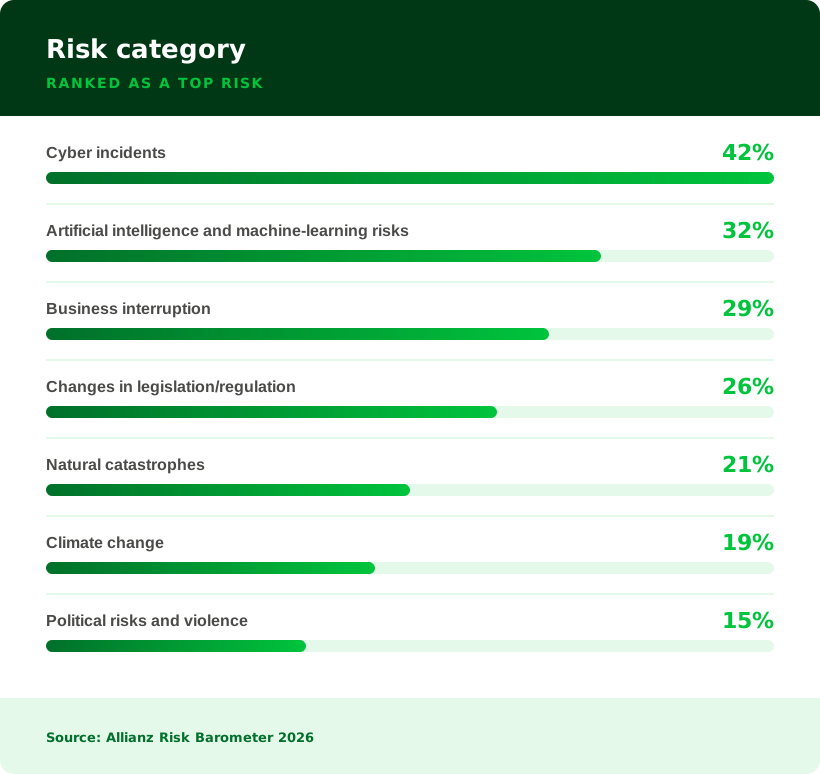
These risks rarely operate in isolation. A cyberattack on a logistics provider can delay shipments and expose labor violations further down the supply chain. Extreme weather can shut down a factory and disrupt transportation networks at the same time. Managing one of these risks effectively requires visibility across all of them.
Common Challenges in ESG Risk Management
Many companies can name their top ESG risks, but fewer can act on them fast enough to make a difference. That gap between awareness and execution is where ESG risk management often breaks down, and it usually comes down to a handful of shared challenges.
- Data gaps and siloed systems: Fragmented systems and inconsistent data formats make it hard to compare supplier risk across teams, let alone across a full ESG program. The problem compounds beyond direct tier 1 suppliers, where most companies have minimal visibility and the least leverage to close the gap.
- Slow decision cycles: Recent surveys found the average crisis response time is five days, and only 17% of respondents can respond to a disruption within 24 hours. For an ESG-specific issue, like a labor violation or environmental incident, that lag is enough time for it to escalate into a compliance issue or a damaging headline before a company has mobilized any response.
- Shifting risk categories: Supplier risk frameworks are often built around static categories, and new risks emerge faster than those frameworks get updated. Consider AI governance, which barely existed as a supplier risk three years ago, and would likely be missed by outdated questionnaires.
- Rising likelihood of black swan events: The Allianz Risk Barometer found that half of business leaders consider a large-scale, geopolitically driven supply chain disruption a real possibility. That shift changes how much contingency planning a risk strategy needs to build in from the start.
How To Build an ESG Risk Management Strategy
A strong ESG risk management strategy starts at the board level and ends in how capital gets allocated, with data quality and supplier due diligence carrying the weight in between. Here’s what that typically looks like.
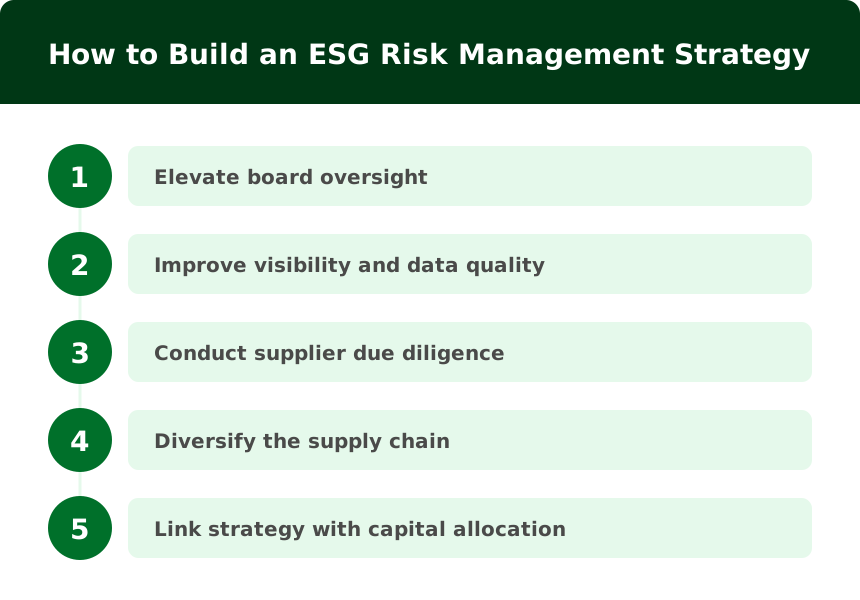
- Elevate board oversight and define risk appetite: Boards should set clear thresholds for how much ESG risk the organization will accept and apply them to investment and procurement decisions. This increasingly reflects double materiality: assessing how ESG factors affect financial performance and how the company’s operations affect the environment and society. ESG risk should be a standing board agenda item, with risk committees reviewing supply chain exposure and mitigation plans regularly.
- Strengthen real-time monitoring and data quality: Data gaps remain one of the biggest barriers to effective ESG risk management, particularly beyond tier-1 suppliers. Centralizing ESG data across teams and systems helps organizations spot and respond to disruption faster.
- Conduct rigorous supplier due diligence: Data collection alone doesn’t prevent disruption. Effective due diligence means evaluating suppliers against ESG criteria alongside financial ones, using analyst-validated ratings that give procurement teams supplier-level intelligence before risk turns into disruption.
- Diversify the supply chain: Third-party failures cause nearly half of all supply chain disruptions. Reducing dependence on a single supplier, transportation provider or region gives companies room to pivot when disruption hits.
- Link risk management to strategy and capital allocation: ESG risk insight should inform pricing, capital expenditure and procurement decisions. If a critical supplier operates in a high flood-risk region, that exposure should drive decisions about diversification and contingency planning. Aligning ESG risk management with strategic planning helps organizations absorb shocks rather than react to them after the fact.
Building ESG Risk Management Into Business Strategy
Supply chain disruption, extreme weather and regulatory change are now persistent features of doing business, not occasional disruptions to it. The organizations that fare best aren’t necessarily the ones that predicted these risks first. They’re the ones that built the structure to respond when the risks arrived.
EcoVadis helps organizations put that structure in place through supplier sustainability ratings and sustainability intelligence that support risk monitoring, supplier improvement and supply chain resilience at scale.
FAQs
What is the difference between ESG risk management and enterprise risk management?
Enterprise risk management covers all risks a company faces, including financial, operational and strategic risk. ESG risk management is a specific lens within that broader practice, focused on environmental, social and governance exposure such as supplier labor conditions, carbon regulation and board accountability. Most organizations run ESG risk as an integrated part of enterprise risk management rather than as a standalone function.
Is ESG risk management legally required?
Not universally, and requirements are narrowing in some jurisdictions. The EU’s 2026 Omnibus changes reduced the number of companies required to report under the CSRD and CS3D. But other rules, including Germany’s Supply Chain Due Diligence Act and the U.S. Uyghur Forced Labor Prevention Act, still carry legal exposure for companies that don’t manage supplier-related ESG risk.
Who owns ESG risk management within a company?
Ownership typically sits with the board’s risk committee, with execution split between procurement, sustainability and enterprise risk teams. Larger organizations increasingly name a single executive, often a chief sustainability officer or chief risk officer, accountable for connecting ESG risk data across those functions.
What frameworks support ESG risk management?
ISO 31000 provides general risk management guidance that many companies adapt for ESG use, while the Task Force on Climate-related Financial Disclosures offers a widely adopted structure for climate risk specifically. Neither is mandatory on its own, but both give organizations a common language for reporting risk to investors and regulators.