
Physical Climate Risk in the Supply Chain: 2026 Guide
Read summarized version with:
 ChatGPT
 Gemini
 Perplexity
 Claude
 Grok
EcoVadis & Kearney’s 2026 Carbon Action Report reframes physical climate risk as a supply chain problem: the companies engaging suppliers now are the ones best prepared for the next shock.
Physical climate risk in the supply chain has moved from a scenario slide in board decks to a critical line item on the P&L. According to WBCSD, 47% of companies globally, and 94% in North America, reported higher costs from physical climate impacts last year. Those costs came through supply chain disruption, commodity price volatility, and damage to infrastructure. The gap between US-linked exposure and the global average tells its own story about where the shocks are landing hardest.
For procurement, sustainability, and risk leaders, the question is no longer whether they need to focus on building resilience against climate impacts. It’s where to start and how to engage suppliers more effectively to accelerate these efforts.
Key takeaways
- 47% of companies globally, and 94% in North America, reported higher costs from physical climate impacts last year, driven by supply chain disruption, commodity price volatility, and damage to infrastructure.
- A super El Niño is already forecast to cost the global economy nearly $1 trillion in 2027, sharpening the urgency of proactive supplier engagement on climate risk.
- Billion-dollar US climate disasters now occur every 10 days on average in 2025, down from 82 days in the 1980s. Supply chains face a new structural reality rather than just another risk cycle.
- Only 7% of companies currently engage suppliers on carbon, leaving the highest-impact resilience lever largely untouched.
- Companies engaging suppliers on carbon are roughly 6x more likely to deliver on science-based targets, and those that also have high-reliability or verified data are roughly 7x more likely than companies doing neither.
Why physical climate risk in the supply chain has become a cost problem
The 2026 Carbon Action Report identifies climate impacts battering supply chains as one of five interconnected pressures raising the cost of inaction. The headline figure is stark: 47% of companies globally reported higher costs from physical climate impacts last year, with the North American figure sitting at 94%.
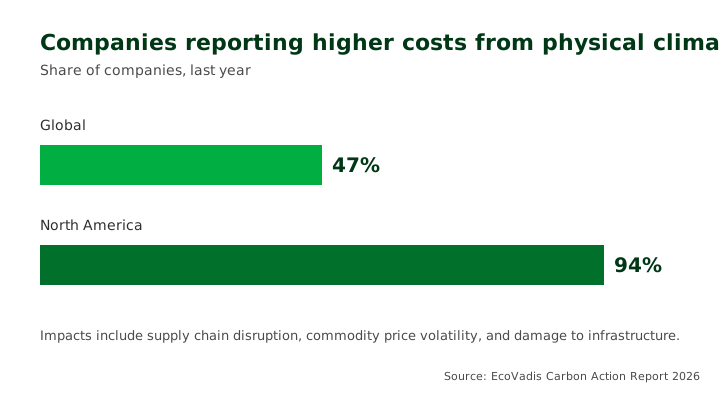
These numbers represent the compounding effect of disrupted logistics corridors, weather-driven commodity price swings, and damaged production infrastructure showing up in unrelated categories at the same time. Where a single flood or wildfire used to be an insurance question, the frequency now reflects a structural change. The gap between billion-dollar US climate disasters has shrunk from 82 days in the 1980s to just 10 days in 2025. That cadence changes what “resilience” means in practice: it’s no longer just about recovering from isolated events, but about building the capacity to operate through a series of overlapping disruptions.
For a broader view of how these pressures interact with regulatory and geopolitical risk, see our article on how supply chain risks are rising.
“Decarbonization is not treated as a compliance exercise. What we’re doing is embedding sustainability into how we create value for our customers and manage risk across our supply chain.”
Aidan Curry – Head of Supplier Sustainability, Hitachi Rail
Source: 2026 Carbon Action Report
The cost of inaction is compounding
The 2026 Carbon Action Report points to a projected cost of nearly $1 trillion from the strengthening super El Niño in 2027 alone. That figure sits alongside a second figure worth noting: the green economy is projected to reach $7 trillion by 2030, growing twice as fast as conventional markets. Physical climate risk and climate opportunity are interlinked: the companies that invest in resilience now are the ones that will be best positioned to access this growth market.
Energy volatility compounds the risk. For energy-intensive industries, fuel and power make up over two-thirds of total production costs. Supply chain analysts now describe oil price unpredictability as structural rather than cyclical, with no resolution in sight. That volatility flows through electricity, steel, chemicals, and agricultural commodities, meaning a climate shock in one part of the world raises input costs in categories that look, on the surface, unrelated.
Regulators are collecting on top of this. Starting in 2027, the EU’s Carbon Border Adjustment Mechanism will require companies to purchase certificates for embedded carbon in imports priced based on the EU ETS spot price (roughly $92 per tCO2e as of July 2026). In parallel, California SB 261 requires large companies to publish climate-related financial risk reports, although enforcement is currently paused.
Why supplier engagement is the primary resilience lever
Building resilience against physical climate risk in the supply chain requires visibility into where suppliers actually operate, how exposed they are, and whether they are investing in their own decarbonization and continuity. That visibility does not come from spend-based estimates – it comes from engaging suppliers and collecting better primary data.
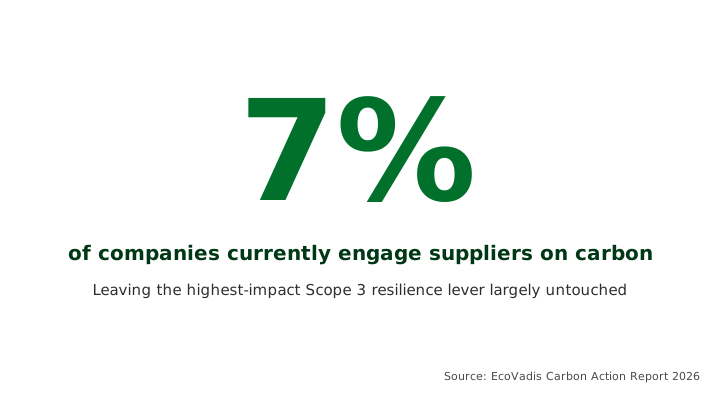
The 2026 Carbon Action Report reveals how rare this still is. Only 7% of companies currently engage suppliers on carbon, leaving the highest-impact Scope 3 lever untouched for most. But the payoff for those who do is significant. Companies actively engaging suppliers on carbon are roughly 6x more likely to deliver on their science-based targets than those that do not. Among those that engage, high-reliability or verified data lifts delivery a further ~1.7x.
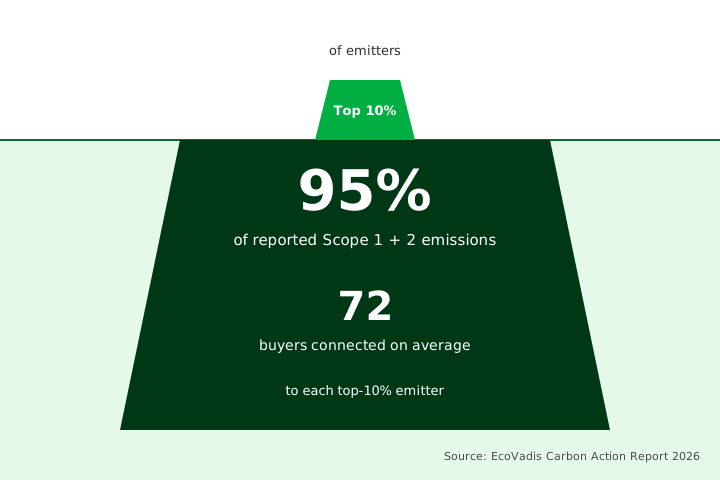
The report also finds that emissions, and by extension risk exposure, are heavily concentrated. The top 10% of emitters in the EcoVadis network account for 95% of all reported Scope 1&2 emissions, and this group is connected to 72 buyers on average. Targeted engagement of a small set of high-impact suppliers can improve resilience visibility for dozens of buyers at once. See our article on supply chain risk management for more insight.
“We are part of this community and platforms like this allow us to support the multiplier effect. It’s not just a few buyers asking suppliers to do this, a growing number of buyers are asking.”
Lucia Melendo – ESG Director, Colt Technology Services
Source: 2026 Carbon Action Report
What leaders in the network are actually doing
The 2026 Carbon Action Report profiles buyers that have already made supplier engagement on climate a core part of their resilience strategy. They share three key pillars:
Cross-functional governance. Atos runs bi-weekly sessions between procurement and sustainability teams to align on priorities and review individual supplier emissions figures. At Hitachi Rail, the Head of Supplier Sustainability sits within procurement, ensuring decarbonization targets flow from board level into buying decisions. BD deliberately built its supplier sustainability team into procurement, with CPO-level involvement when supplier engagement stalls.
Formal targets in contracts. Colt Technology Services embeds a formal sustainability schedule into supplier contracts, requiring high-emitting suppliers to commit to science-based targets and share data. At Volvo Cars, carbon targets are set at the start of every vehicle program alongside cost, quality, and technical requirements.
Engagement tailored to supplier maturity. Accor follows a three-pillar model (Measure, Reduce, Promote), assessing supplier maturity before pushing for data. BD uses a five-level maturity ladder and co-creates “glide paths” with less mature suppliers. Hitachi Rail shapes every supplier conversation around carbon maturity, with mature suppliers discussing science-based targets while lower-maturity suppliers start with the basics. This matters for physical climate risk because pushing an unprepared supplier for emissions data yields unreliable numbers.
For a deeper look at how procurement can operationalize this, see our article on supply chain resilience.
The data reliability question underneath it all
Climate risk assessments are only as good as the supplier data behind them. The 2026 Carbon Action Report shows that companies relying on lower-reliability data may be underestimating their upstream Scope 3 footprint by as much as 2.7x. The same weakness applies to physical risk mapping: if you cannot see where a Tier 2 supplier operates, you cannot model whether that operation sits in a flood zone, a heat-stress region, or a water-scarce basin.
Companies in the network with verified Scope 1&2 data have three times as many buyer connections as those with low-reliability data. Verified data is becoming a commercial signal in its own right. It is also the foundation for the next frontier the report identifies: product carbon footprints, which reveal how much carbon is embedded in the specific materials and components buyers purchase and, by extension, where the risk sits.
For readers looking to build the underlying capability, see our articles on Scope 3 reporting and value chain Scope 3 compliance.
“So many rushed to set science-based targets with supplier engagement goals without thinking of what comes next. If you’re not thinking about it now, you are at a disadvantage in the marketplace.”
Amelia Nunn – Associate Director of Responsible Sourcing, BD
Source: 2026 Carbon Action Report
How to start building resilience against physical climate risk
The 2026 Carbon Action Report makes it clear that companies shouldn’t wait for perfect data. They should act on what they have while investing in the capabilities and supplier relationships that make the next cycle better. For teams starting now, three moves help you get ahead:
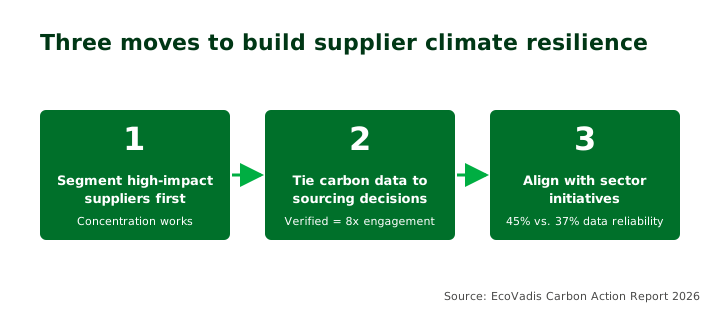
- Segment high-impact suppliers first. Concentration works in your favor here. A small set of high-emitting, highly connected suppliers accounts for most reported emissions, so it’s the most efficient place to start building visibility into resilience. Prioritize them for direct engagement.
- Tie carbon and resilience data to sourcing decisions. Companies with verified data are roughly 8x more likely to engage suppliers on carbon than those with low-reliability data. Making supplier climate performance a formal sourcing input creates the internal accountability that engagement requires.
- Join or align with sector initiatives. Companies in Sector Initiatives are more likely to have high-reliability or verified data (45% versus 37% for those outside). Collective action moves suppliers faster than any single buyer can.
Get the full 2026 Carbon Action Report
For a full read on what separates leading buyers from the rest, download the 2026 Carbon Action Report. The report includes regional and sector-level breakdowns, the five actions that predict a supplier breakthrough on carbon maturity, and a Scope 3 playbook with insights from Accor, Atos, BD, Colt Technology Services, Hitachi Rail, and Volvo Cars.
FAQs
What is physical climate risk in the supply chain?
Physical climate risk in the supply chain refers to the direct operational and financial impacts of climate-driven events on suppliers, logistics, and inputs. According to the 2026 Carbon Action Report, this shows up as supply chain disruption, commodity price volatility, and damage to infrastructure. It is distinct from transition risk (policy and market shifts) and now sits on the P&L: 47% of companies globally and 94% in North America reported higher costs from these impacts last year.
Why is supplier engagement the primary lever for physical climate resilience?
Because most supply chain emissions and climate exposure are concentrated in a small number of highly connected suppliers. The 2026 Carbon Action Report finds the top 10% of emitters account for 95% of reported network emissions and are connected to 72 buyers on average. Direct engagement with these suppliers builds the visibility needed to model physical risk and creates the working relationship required to act on it before disruption hits.
How does data reliability affect physical climate risk assessment?
Physical risk models depend on knowing where suppliers operate and how they’re exposed. The 2026 Carbon Action Report shows that companies with low-reliability data may be underestimating upstream Scope 3 emissions by up to 2.7x, and the same visibility gap applies to physical exposure. Verified supplier data provides the foundation needed to map risk beyond Tier 1 and identify the hotspots that generic estimates hide.
How can procurement teams start a supplier climate engagement program?
Start with the small group of high-impact suppliers responsible for most of your exposure. The 2026 Carbon Action Report highlights three leader patterns: cross-functional governance between procurement and sustainability, formal carbon requirements written into contracts, and engagement tailored to each supplier’s maturity level. Pair formal requirements with high-touch support and commercial incentives, and align with EcoVadis Sector Initiatives to multiply reach across shared supplier networks.
What is the financial case for acting now?
The super El Niño alone is forecast to cost the global economy nearly $1 trillion in 2027. Beyond avoided losses, the 2026 Carbon Action Report estimates that companies with high-reliability or verified Scope 1&2 data reduce operational emissions 50% faster than lower-reliability peers, worth roughly $5 per tCO2e in annual savings by 2030. In an aspirational scenario where suppliers achieve the same data-reliability gains, a large enterprise with 1 million tCO2e in operational emissions could save up to $135 million annually by 2030.