
 ChatGPT
 Gemini
 Perplexity
 Claude
 Grok

Gain insights from 30+ sustainability leaders, including superstars like Paul Polman, former CEO of Unilever, and Helena Helmersson, former CEO of H&M Group. Learn how to build a sustained advantage through responsible business practices.
20th October 2026
Carbon Removal Credits: Inside Supercritical’s Framework
Read summarized version with:
EcoVadis reporting on a Community webinar with Mai Bui, Director of Climate Science at Supercritical, and Emily Nolan, Carbon Removal Adviser at Supercritical, hosted by EcoVadis.
In a recent EcoVadis Community webinar on carbon removal credits, experts from Supercritical (Mai Bui, Director of Climate Science, and Emily Nolan, Carbon Removal Adviser) shared insights on the role of carbon removals in corporate climate action. The session examined the distinction between emission reductions and removals, the evolving regulatory landscape, quality criteria for carbon removal projects, and procurement methodologies for managing residual emissions.
Key Takeaways
- Supercritical told the EcoVadis Community that the IPCC pathway calls for 10 billion tons of CO2 removed annually by 2050, against current capacity of roughly 1 million tons, meaning removal capacity would have to scale about 10,000×.
- Supercritical framed carbon removal credits as structurally different from avoidance or reduction offsets: they physically pull CO2 out of the atmosphere to address residual emissions, rather than paying for someone else’s reduction.
- Under the incoming SBTi Corporate Net-Zero Standard v2, Supercritical explained, “ongoing emissions” must be addressed with removals from 2035 onward, with a mandatory share coming from durable removals that store carbon for 100 years or more.
Why Supercritical Says Carbon Removal Credits Sit at the Center of Net Zero
While emission reductions remain the primary mandate of corporate climate action, scientific consensus indicates that atmospheric carbon dioxide removal is also required to address residual emissions that cannot be eliminated. Katja Wachter, Impact Expert at EcoVadis, opened the session by noting that companies will not be able to remove their way out of a failure to reduce. Supercritical explained how the science nonetheless points to a role for pulling CO2 back out of the atmosphere to address the residual emissions companies cannot eliminate. In the Supercritical framing, that is what carbon removal credits do, and it is why they position these credits alongside reduction as a pillar of a mature climate strategy.
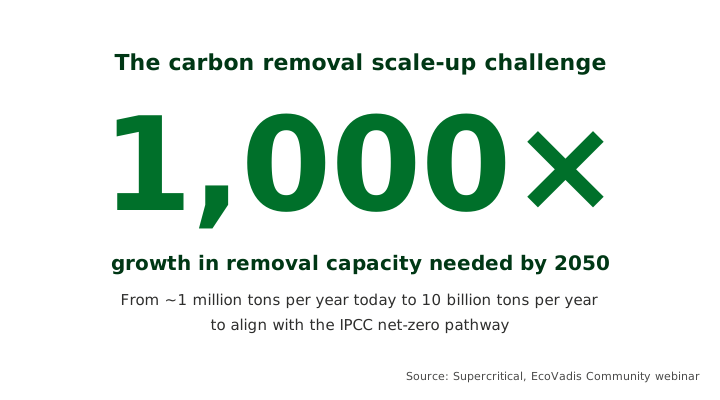
The scale problem, as laid out, is stark. The IPCC pathway calls for 10 billion tons of CO2 removed annually by 2050. Global capacity today is around 1 million tons. Bridging that gap, Supercritical argued, means the market has to grow roughly 10,000×, and early buyers are the ones securing supply and pricing before the market tightens.
For most companies, Supercritical said, the entry point is a target already on the books. If you have a validated science-based target, the incoming SBTi guidance will shape how much removal is expected and by when. If you don’t, the global compliance landscape (from the UK and EU to Japan and California) is closing the gap between voluntary and mandatory markets.
Removal vs. Reduction vs. Avoidance: How Supercritical Draws the Distinction
A conventional offset pays for an emission somewhere else to be avoided or reduced. That has value, Supercritical noted, but it does not neutralize your own emission. Your ton is still in the atmosphere; you have simply funded someone else’s decarbonization.
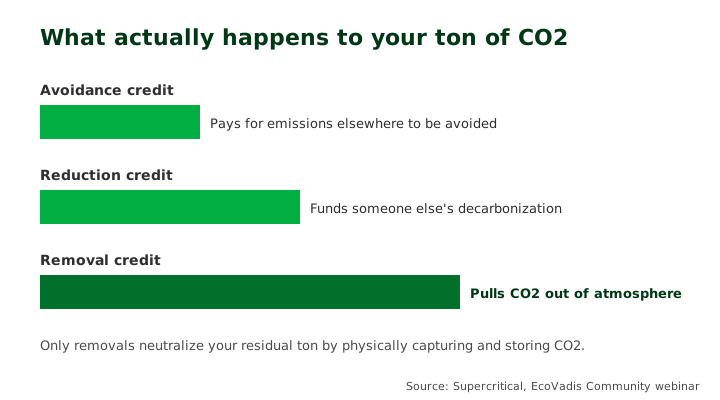
They explain how a carbon removal credit is different. It represents CO2 physically captured out of the atmosphere and stored, so your residual ton is balanced by a ton pulled back down. This is why, they argued, industry standards including the Science Based Targets initiative and ISO’s forthcoming net-zero standard are drawing sharp guardrails around what counts toward a net-zero claim.
“For your residual emissions that you can’t reduce yourself, you should use permanent carbon removals in order to neutralize those emissions.”
Mai Bui, Director of Climate Science, Supercritical
Removal options split into two broad families. Nature-based approaches (native reforestation, agroforestry, soil carbon) tend to be cheaper and closer to deployment, but typically store carbon for decades before it re-releases. Engineered approaches (biochar, bioenergy with carbon capture and storage, enhanced rock weathering, direct air capture) cost more but lock carbon away for hundreds to thousands of years. Supercritical recommends blending the two for the most credible outcome.
The Regulatory Backdrop: From Voluntary to Compliance
Under earlier SBTi guidance, corporate carbon removal targets were primarily aligned with 2050 net-zero goals. However, as Supercritical pointed out during the session, delaying market engagement until 2050 creates a structural supply deficit because technologies require long-term demand signal to scale.
To address this, emerging frameworks from SBTi, ISO, and the Oxford Offsetting Principles emphasize phased procurement ahead of target dates. The regulatory and standard-setting landscape is shifting in the following ways:
SBTi Corporate Net-Zero Standard (v2): Scheduled to become mandatory from February 1st, 2028, the updated standard introduces defined expectations for addressing “ongoing emissions” (combining residual emissions and beyond-value-chain mitigation). It mandates that a progressively higher proportion of residual emissions be neutralized through durable carbon removals storing CO2 for at least 100 years, with durable removals expected to cover all residual emissions by 2050.
Mandatory Compliance & Trading Schemes: Compliance markets in Australia, China, New Zealand, Japan, the EU, and the UK are increasingly integrating carbon removals, with the EU Carbon Removal Certification Framework (CRCF) advancing methodologies for engineered pathways such as BECCS, DAC, and biochar.
For companies already grappling with CSRD and CS3D, the marketing claims dimension matters too. The UK Green Claims Code and the EU’s Empowering Consumers for the Green Transition Directive both hold companies accountable for how they describe net-zero and sustainability progress. A weak removal portfolio, Supercritical argued, is a legal exposure, not just a reputational one.
What Supercritical Says “High Quality” Carbon Removal Credits Look Like
There are hundreds of projects in the market and no single standard for quality. Supercritical uses a weakest-link vetting framework: a project must pass every criterion, or the whole project fails. The result is a pass rate of about 16%, which, they suggested, tells you something about the state of the market.
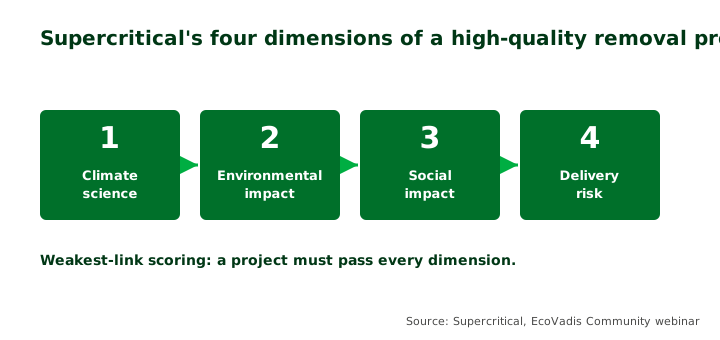
Four dimensions define integrity in their framework:
- Climate science. Can the removal be measured? Is the activity genuinely additional? Can the developer evidence permanence for the promised duration? Is the MRV approach robust at both production and storage sites?
- Environmental impact. Positive claims (biodiversity, soil health) need quantitative field evidence, not marketing narrative. Negative impacts matter too: Mai flagged projects that looked strong on the surface but were sourcing feedstock from invasive species with harmful biodiversity effects.
- Social impact. SDG claims need receipts. If a project claims economic empowerment, what share of revenues actually reaches communities? Human rights and labor conditions have to be checked rigorously, with the same discipline procurement teams already apply to supply chain due diligence.
- Delivery risk. Credits have to arrive on time. That means checking financing, feedstock contracts, site construction status, equipment orders, and operational track record. AML and adverse media checks sit alongside.
“There are projects that look very successful on the surface where they sell loads of credits, and when we do dig deep into the environmental impact side, we find that actually the feedstock might have negative harmful impacts to biodiversity.”
Mai Bui, Director of Climate Science, Supercritical
Building the Procurement Muscle: How Supercritical Structures Carbon Removal Credits Purchases
Emily Nolan advised procurement teams not to overthink the first move. Confirm your net-zero target, decide what “good” looks like for your business (permanence mix, price per ton, geographic preference), and start with an initial portfolio you can actually execute on. The muscle you’re building, she said, is procurement discipline, not a single blockbuster deal.
Two structures dominate, according to Supercritical. Spot credits are already on the market or arriving shortly, with a vintage matching the year of production. They carry a premium because demand is high. Offtakes are multi-year agreements for credits delivered in the future (three, five, ten years out). Prices are lower, but delivery risk is higher. A sensible first portfolio, in their view, often leans toward validated, near-term spot credits (biochar is a common entry point) and adds engineered pathways like direct air capture as the program matures.
“Sometimes organizations think that you have to sign up to a 10-year offtake and otherwise there’s no point doing it at all. And actually that’s really not the case. It’s really great to be able to dip your toe in the water, build that procurement muscle.”
Emily Nolan, Carbon Removal Adviser, Supercritical
Supercritical described a phased ramp: start with a small share of the offset portfolio in engineered removals, then grow that share year over year, with the mix shifting toward more durable options over time. This mirrors the Oxford Offsetting Principles and dovetails with the interim targets SBTi is pushing.
Delivery protection matters, they emphasized. Sensible contract features include pay-on-delivery terms (you pay when the registry verifies the credit, not before), buffer pools that let an intermediary swap in replacement credits if a project misses, and clear contractual paths if a project fails outright. These are the questions Supercritical urged buyers to ask before signing.
Communicating Carbon Removal Credits to the C-suite
Carbon removal credits sit awkwardly in most budget cycles because they look like a discretionary spend against a target that is still years out. Supercritical’s counterargument is supply: given the scale-up required by 2050, the companies buying now are the ones locking in access and prices. Waiting until 2050 to buy means bidding into a constrained market against everyone else who waited.
The other way to frame the argument is from a competition standpoint. EcoVadis data shows carbon is emerging as a competitive dimension in procurement and investor conversations, and how a company describes its residual-emissions strategy is increasingly part of what buyers and capital allocators look at.
Supercritical pointed to Tide, the UK fintech, which built its net-zero narrative around permanent biochar removals purchased through offtakes, alongside deep operational emissions reductions and full neutralization of its residual footprint. That story, they said, is only tellable because the removals are durable and the projects are verified.
For companies just starting, Supercritical’s message to leadership was to start small, learn the vetting discipline, and expand from a position of experience.
Start a Carbon Removal Credits Program: Three Moves
Three moves the webinar kept coming back to:
- Anchor the program to your net-zero target. If you’re SBTi-aligned, model the residual emissions that will need to be addressed through removals under v2 and work backward. If you’re not, Supercritical suggested using frameworks like the Oxford Offsetting Principles as a reference. EcoVadis customers can lean on the Carbon Action Manager to structure the underlying decarbonization roadmap before removals come into play.
- Define “good” in first principles. Permanence mix, price ceiling, geographic tie-in to your operations, tolerance for delivery risk. Write down what “good” looks like to you before you go to market, Supercritical advised. It will filter hundreds of projects down to a manageable shortlist.
- Start with a small, defensible portfolio and ramp. Weight the first year toward validated near-term credits. Add engineered and higher-permanence pathways as budget and comfort grow. Build the internal muscle before you commit to a multi-year offtake. Removal is one piece of a broader climate program that also has to include measurement, supplier engagement, and reporting.
You can check out a recording of the webinar, “Carbon Removal Credits: Supercritical’s Team Share Their Expertise on Building a Credible Strategy” with Emily Nolan and Mai Bui of Supercritical in the EcoVadis Community – it is totally free to sign up and watch!
FAQs
What are carbon removal credits?
Carbon removal credits represent CO2 that has been physically captured from the atmosphere and stored, either through nature-based pathways (reforestation, soil carbon, agroforestry) or engineered pathways (biochar, bioenergy with carbon capture and storage, enhanced rock weathering, direct air capture). As Supercritical explained in the EcoVadis community webinar, unlike avoidance or reduction offsets, which pay for emissions avoided elsewhere, removals address a company’s residual emissions by drawing down an equivalent amount of CO2.
How do carbon removal credits differ from carbon offsets?
Conventional offsets typically fund avoidance or reduction activities: someone else emits less because you paid them to. Your own emission is still in the atmosphere. A carbon removal credit, Supercritical explained, corresponds to CO2 actually pulled out of the air and locked away, so your residual ton is balanced by a removed ton. SBTi, ISO, and the Oxford Offsetting Principles increasingly point toward permanent removals for residual emissions that cannot be reduced.
What does the new SBTi standard say about carbon removal credits?
According to Supercritical, the revised SBTi Corporate Net-Zero Standard (v2) introduces a category called “ongoing emissions” that combines residual emissions and beyond-value-chain mitigation. Companies can earn recognition tiers by addressing a share of these emissions before 2035, and from 2035 must address all residual emissions through carbon removals. A mandatory portion must come from durable removals storing carbon for at least 100 years. The standard becomes mandatory in January 2028.
How much should we budget for carbon removal credits?
There is no universal number. Supercritical noted that companies often start by allocating a modest share of their offset budget to removals and ramp up over time. Within that share, an initial portfolio might lean toward validated, near-term credits (biochar is a common entry point) before adding higher-cost engineered pathways like direct air capture. The Oxford Offsetting Principles suggest steadily increasing both the removal share and the durable-removal share as budget and market maturity allow.
What should we look for when vetting carbon removal projects?
Supercritical outlined four dimensions: climate science (is the removal measurable, additional, and permanent?), environmental impact (are positive claims evidenced with field data, and is the project avoiding harm to biodiversity?), social impact (are SDG claims backed by real community benefit and free of human rights risks?), and delivery risk (financing, feedstock contracts, construction status, operational track record). AML and adverse media checks matter too. Supercritical’s framework passes only about 16% of projects reviewed.

Eloise Moench is a Communications Expert at EcoVadis. Backed by a decade of experience driving communications for international energy transition and ecological restoration organizations, she brings deep insight into clean energy policy, human rights, and biodiversity. She holds a Masters Degree in Climate Ethics from the University of Amsterdam, and specializes in breaking complex environmental frameworks down into clear, actionable insights.