

Canada Modern Slavery Act (S-211)
Read summarized version with:
 ChatGPT
 Gemini
 Perplexity
 Claude
 Grok

Effective January 2024, Canada’s Fighting Against Forced Labour and Child Labour in Supply Chains Act (also known as S-211, the Canada Modern Slavery Act or the Supply Chains Act) introduced new reporting obligations for certain businesses and government institutions. Covered entities must report what they have done to prevent and reduce the risk of forced labor and child labor across their operations and supply chains. Annual reports are due to Public Safety Canada by May 31 each year.
Key Takeaways
- S-211 applies to companies that produce or import goods and meet defined size thresholds, including those headquartered outside Canada.
- Reporting entities must submit an annual PDF report and complete an online questionnaire through Public Safety Canada by May 31 each year.
- Reports must address seven mandatory areas, covering supply chain structure, due diligence policies, risk assessment, remediation measures and employee training.
What Is the Canada Modern Slavery Act?
S-211 is Canada’s response to the growing global effort to eliminate forced labor and child labor from corporate supply chains. The International Labour Organization estimates there are approximately 28 million victims of forced labor worldwide, with 17.6 million in the private economy. That scale reflects how deeply embedded supply chain risk can be, even for companies with no direct knowledge of upstream conditions.
Canada’s Fighting Against Forced Labour and Child Labour in Supply Chains Act (or simply, The Supply Chains Act) follows the framework established by the UK’s Modern Slavery Act, which set a precedent for mandatory supply chain transparency reporting. Like its UK counterpart, S-211 requires covered organizations to publicly disclose what steps they are taking to identify and address forced labor and child labor risks, rather than simply certifying that those risks don’t exist.
Who Does the Act Apply To?
The law expands modern slavery reporting requirements to a host of new companies. Determining whether an organization must report involves a two-step test.
First, the organization must qualify as an entity. It is considered an entity if it is listed on a Canadian stock exchange. Alternatively, it qualifies if it has a place of business, assets or operations in Canada and meets at least two of the following thresholds in one of its two most recent financial years:
- $20 million or more in assets
- $40 million or more in revenue
- An average of at least 250 employees
Second, the entity must be engaged in a qualifying activity. Specifically, those that are:
- Producing goods, whether in Canada or abroad
- Importing goods produced outside Canada
- Directly or indirectly controlling an entity that’s engaged in one of the activities listed above
The control provision is worth noting. It extends reporting obligations down an organization’s corporate chain, meaning parent companies may be responsible for disclosing the practices of subsidiaries even where those subsidiaries operate independently.
Canadian government institutions that produce, purchase or distribute goods are also subject to reporting requirements under the Act.
S-211 Reporting Requirements
Annual reports submitted under The Supply Chains Act S-211 must address seven areas. Entities are expected to describe specific actions taken during the previous financial year, not just aspirational commitments.
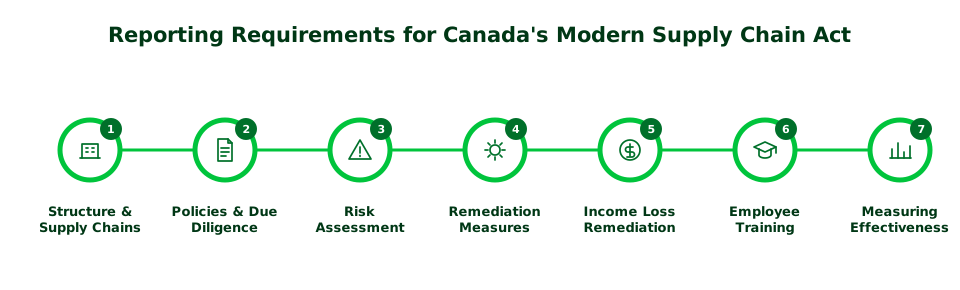
- An overview of the entity’s structure, business activities and supply chains, including the geographies and sectors where forced labor or child labor exposure is most likely.
- Information on corporate policies and due diligence related to forced labor and child labor. This includes internal policies around recruitment, employment practices and supply chain oversight, along with the processes to identify and respond to risks.
- An assessment of risks within the business and its supply chain, covering which operations or supplier relationships carry the greatest exposure and how those risks are being managed.
- Measures taken to remediate identified forced labor or child labor violations, including details on grievance mechanisms where applicable.
- Description of efforts to remediate potential loss of income to the most vulnerable families that may result from steps taken to eliminate forced labor or child labor.
- The training provided to employees on recognizing and responding to forced labor and child labor risks, including who receives it and how frequently.
- An outline of how the entity measures the effectiveness of its anti-slavery policies, including any audits, KPIs or third-party reviews used to track progress year over year.
How to Submit a Compliant Report
Covered entities must complete the following steps each year by the May 31 deadline.
- Prepare a report in PDF format that addresses all seven mandatory requirements outlined above.
- Obtain approval from the entity’s governing body and include a signed attestation confirming that approval. Reports submitted without a valid signature will not be published in Public Safety Canada’s online catalogue.
- Complete the online questionnaire through Public Safety Canada. Questionnaire responses must be consistent with the information provided in the PDF report.
- Upload the approved PDF report at the end of the questionnaire and submit.
- Publish the report in a prominent, publicly accessible location on the entity’s own website.
Need help meeting the Act’s requirements? Our regulatory snapshot provides more detail on what’s in scope and what’s required of your business: Canada Modern Slavery Act: Regulatory Snapshot
FAQs
Q: What is the penalty for non-compliance with S-211?
A: Organizations that fail to file a report, or that submit a report found to be false or misleading, can face fines of up to $250,000. Directors and officers of the entity can also be held personally liable for violations.
Q: Does S-211 apply to foreign companies operating in Canada?
A: Yes. Foreign companies are subject to S-211 if they meet the definition of entity, meaning they do business in Canada, have assets in Canada or maintain a place of business in the country, and meet at least two of the three financial thresholds. Being headquartered outside Canada does not exempt an organization from reporting obligations.
Q: Can a parent company and its subsidiaries file a joint report?
A: Yes, provided the information in the report accurately reflects all entities covered and each is identified by legal name. Joint reports are not appropriate where entities have significantly different risk profiles or policies, as a single report must be able to accurately describe the practices of all organizations it covers.